

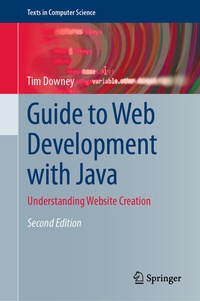
Guide to Web Development with Java
Description

This comprehensive Guide to Web Development with Java introduces the readers to the three-tiered, Model-View-Controller architecture by using Spring JPA, JSPs, and Spring MVC controllers. These three technologies use Java, so that a student with a background in programming will be able to master them with ease, with the end result of being able to create web applications that use MVC, validate user input,and save data to a database.
Topics and features:
Presents web development topics in an accessible, easy-to-follow style, focusing on core information first, and allowing the reader to gain basic understanding before moving forwards
Contains many helpful pedagogical tools for students and lecturers, such as questions and exercises at the end of each chapter, detailed illustrations, chapter summaries, and a glossaryUses existing powerful technologies that are freely available on the web to speedup web development, such as Spring Boot, Spring MVC, Spring JPA, Hibernate, JSP, JSTL, and Java 1.8
Discusses HTML, HTML forms, and Cascading Style SheetsStarts with the simplest technology for web development (JSP) and gradually introduces the reader to more complex topics
Introduces core technologies from the outset, such as the Model-View-Controller architecture
Includes examples for accessing common web services
More details
Other editions
Additional editions
Person
Tim Downey
is a Teaching Professor at the School of Computing and Information Sciences, Florida International University, Miami, FL, USA. He has more than twenty years' experience teaching web development during which he has won numerous Outstanding Teaching Awards.
Content
Web Applications and Maven.- Controllers.- Java Beans and Member Variables.- Spring Framework.- Spring MVC.- Validation and Persistence.- Advanced HTML and Form Elements.- Accounts - Cookies - Cars.- Web Services and Legacy Databases.- Appendix.- Glossary.- Bibliography.- Index.
