

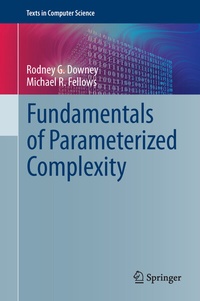
Fundamentals of Parameterized Complexity
Description

Reviews / Votes
"It is a new book that conveys a detailed picture of parameterized complexity as it stands today. . The writing style is direct and engaging, allowing the reader to quickly grasp the core ideas for each topic. The book coverage is comprehensive, including even relatively recent results, and manages to give a rich representation of the current state of the field. In short, this is an excellent book that will serve well anyone interested in algorithm design and complexity." (Marius Zimand, zbMATH 1358.68006, 2017)
"It can be read by graduate students who have some background in computational complexity. . I strongly recommend Fundamentals of Parameterized Complexity for all researchers in theoretical computer science. . It is my belief that this book is now the definitive text on parameterized complexity, both for the breadthand depth of material covered and also for including the latest developments in the field (as recently as 2012)." (Rajesh Chitnis, SIGACT News, Vol. 46 (1), 2015)
"This book is currently the only monograph that covers lower bounds in kernelization or parameterized approximation. . this new volume could serve as a (relatively easily) accessible source for a researcher in the area as well as helping students find their way into this interesting field. . nearly 700 citations and a well-designed index help to navigate through the book and through the literature." (Henning Fernau, Mathematical Reviews, November, 2014)More details
Other editions
Additional editions
Persons
Dr. Rodney G. Downey is a Professor in the School of Mathematics, Statistics and Operations Research, at the Victoria University of Wellington, New Zealand.
Dr. Michael R. Fellows is a Professor in the School of Engineering and Information Technology, at the Charles Darwin University, Darwin, NT, Australia.
Content
Introduction.- Part I: Parameterized Tractability.- Preliminaries.- The Basic Definitions.- Part II: Elementary Positive Techniques.- Bounded Search Trees.- Kernelization.- More on Kernelization.- Iterative Compression, and Measure and Conquer, for Minimization Problems.- Further Elementary Techniques.- Colour Coding, Multilinear Detection, and Randomized Divide and Conquer.- Optimization Problems, Approximation Schemes, and Their Relation to FPT.- Part III: Techniques Based on Graph Structure.- Treewidth and Dynamic Programming.- Heuristics for Treewidth.- Automata and Bounded Treewidth.- Courcelle's Theorem.- More on Width-Metrics: Applications and Local Treewidth.- Depth-First Search and the Plehn-Voigt Theorem.- Other Width Metrics.- Part IV: Exotic Meta-Techniques.- Well-Quasi-Orderings and the Robertson-Seymour Theorems.- The Graph Minor Theorem.- Applications of the Obstruction Principle and WQOs.- Part V: Hardness Theory.- Reductions.- TheBasic Class W[1] and an Analog of Cook's Theorem.- Other Hardness Results.- The W-Hierarchy.- The Monotone and Antimonotone Collapses.- Beyond W-Hardness.- k-Move Games.- Provable Intractability: The Class XP.- Another Basis.- Part VI: Approximations, Connections, Lower Bounds.- The M-Hierarchy, and XP-optimality.- Kernelization Lower Bounds.- Part VII: Further Topics.- Parameterized Approximation.- Parameterized Counting and Randomization.- Part VIII: Research Horizons.- Research Horizons.- Part IX Appendices.- Appendix 1: Network Flows and Matchings.- Appendix 2: Menger's Theorems.
