

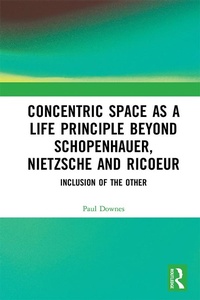
Concentric Space as a Life Principle Beyond Schopenhauer, Nietzsche and Ricoeur
Inclusion of the Other
1st Edition
Published on 2. October 2019
200 pages
978-1-351-39262-4 (ISBN)
Description

Concentric Space as a Life Principle beyond Schopenhauer, Nietzsche and Ricoeur invites a fresh vision of human experience and search for life meanings in terms of potential openings through relational space. Offering a radical spatial rereading of foundational ideas of influential thinkers Schopenhauer, Nietzsche and Ricoeur, it argues that these ideas can be rethought for a more fundamental understanding of life, self and other.
This book offers a radical reconceptualisation of space as an animating principle for life through common, although previously hidden, features across the thought of Schopenhauer, Nietzsche and Ricoeur. It offers a fresh spatial interpretation of key themes in these thinkers' works, such as compassion, will to life, Dionysian rapture, will to power, selfovercoming, re-valuation of values, eternal recurrence, living metaphor and intersubjectivity. It proposes a spatial restructuring of experience from diametric spaces of exclusion towards concentric spaces of inclusion for an experiential restructuring towards unifying modes of experience. This spatial rereading of these major figures in philosophy directly challenges many previous understandings, to offer a distinctive spatial-phenomenological framework for examining a life principle.
This book will appeal to academics, researchers and postgraduates engaged in the study of philosophy, wellbeing, education and human development. The book's interdisciplinary scope ensures that it is also of interest for those in the fields of psychology, anthropology, psychoanalysis and culture studies.
This book offers a radical reconceptualisation of space as an animating principle for life through common, although previously hidden, features across the thought of Schopenhauer, Nietzsche and Ricoeur. It offers a fresh spatial interpretation of key themes in these thinkers' works, such as compassion, will to life, Dionysian rapture, will to power, selfovercoming, re-valuation of values, eternal recurrence, living metaphor and intersubjectivity. It proposes a spatial restructuring of experience from diametric spaces of exclusion towards concentric spaces of inclusion for an experiential restructuring towards unifying modes of experience. This spatial rereading of these major figures in philosophy directly challenges many previous understandings, to offer a distinctive spatial-phenomenological framework for examining a life principle.
This book will appeal to academics, researchers and postgraduates engaged in the study of philosophy, wellbeing, education and human development. The book's interdisciplinary scope ensures that it is also of interest for those in the fields of psychology, anthropology, psychoanalysis and culture studies.
Reviews / Votes
"Paul Downes' book is a rich meditation on how the question of being is at one level the question of well-being, and he explores this in an original and engaging way by investigating the interplay of what he calls the 'diametric' and 'concentric' space-time that structures our existence. He contends that it is 'concentric space' in particular that has been increasingly closed off in the contemporary world, and his aim is to open up this space again so that we may breathe more deeply--or in Heidegger's language, so that we may dwell more fully as mortals upon the earth under the sky in the presence of others, the divinities, and all beings and things."Richard Capobianco, Professor of Philosophy, Stonehill College, and author of Engaging Heidegger and Heidegger's Way of Being.
"Downes offers an excitingly nontraditional study in dialogue with mainstream authors, reading Heidegger -- Downes contends that the concentric 'is' the authentic -- along with an inventive account of space, tackling Nietzschean mountains along the way."
Professor Babette Babich, Professor of Philosophy, Fordham University, New York, USA
"Many scholars have examined the numerous, fascinating connections between Schopenhauer and Nietzsche on points of art, ethics, and metaphysics. Many, too, have done so with the aim of locating both figures in their shared intellectual and historical milieu. Paul Downes's Concentric Space as a Life Principle Beyond Schopenhauer, Nietzsche and Ricoeur: Inclusion of the Other, does both of these things, with an eye to philosophical ambitions of its own that make the work remarkably original. Downes is not interested only in telling us what these three key post-Kantian European figures think, but, more vitally, in getting us to identify and think about the important subtleties they themselves have left unthought, or at least unsaid.. Through a series of close and constructive readings of Schopenhauer and Nietzsche and Ricoeur too (among others like Kant, Levi-Strauss, and Heidegger to name a few), Downes undertakes a comprehensive analysis of the relation between oneself and the other, a spatial alterity ethics, as it were... Downes's book [is] enjoyably challenging. In a time when the space of discourse is increasingly less a space of reasons, a work as this, sensitive and subtle and deeply humane, is a thoughtful refuge from the shrill and shallow..."
Steven DeLay, Christ Church, Oxford, Phenomenological Reviews 2020
More details
Edition
1. Auflage
Language
English
Place of publication
London
United Kingdom
Publishing group
Taylor & Francis Ltd
Target group
Professional and scholarly
College/higher education
Illustrations
5 Illustrations, black and white
ISBN-13
978-1-351-39262-4 (9781351392624)
Copyright in bibliographic data and cover images is held by Nielsen Book Services Limited or by the publishers or by their respective licensors: all rights reserved.
Schweitzer Classification
Other editions
Additional editions
Paul Downes
Concentric Space as a Life Principle Beyond Schopenhauer, Nietzsche and Ricoeur
Inclusion of the Other
Book
06/2021
1st Edition
Routledge
€63.00
Shipment within 10-20 days
Paul Downes
Concentric Space as a Life Principle Beyond Schopenhauer, Nietzsche and Ricoeur
Inclusion of the Other
Book
10/2019
1st Edition
Routledge
€196.00
Shipment within 10-20 days
Person
Paul Downes is Professor of Psychology, School of Human Development, Institute of Education, Dublin City University, Ireland. He has over 100 international peer-reviewed publications across areas of philosophy, psychology, education, law, anthropology and social policy and has given keynotes and invited presentations in 29 countries.
Content
1. Introduction. 2. Features of the Spatial Proto-Language of Concentric and Diametric Space. 3. Compassion and Space. 4. Rapture and Space. 5. The Spatial Background between Dionysian and Apollonian Myths. 6. Power and Space. 7. Space as Freedom in Experience. 8. Space as Movement: Eternal Recurrence beyond Homogenous Time. 9. Space Prior to Metaphor. 10. Space and Internalisation of the Other.
