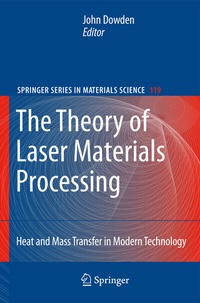
The Theory of Laser Materials Processing
Description

The purpose of the book is to show how general principles can be used to obtain insight into laser processes. The principles used may come from fundamental physical theory or from direct observation of experimental results, but an understanding of the general characteristics of the behaviour of a process is essential for intelligent investigation and implementation, whether the approach is experimental, observational, numerical or analytical. The last two have a special value since the associated costs can be relatively low and may be used as a starting point for more expensive techniques. The construction of simple models whose underlying principles are easy to see is therefore of special value, and an understanding of their strengths and limitations is essential. The applications considered in detail are cutting, keyhole welding, drilling, arc and hybrid laser-arc welding, hardening, cladding, forming and cutting, but the general principles have a very wide application; metallurgical aspects are considered, as are femtosecond interactions with metals. The book begins with a discussion of the mathematical formulation of some relevant classes of physical ideas, and ends with an introduction to comprehensive numerical simulation. Although all the examples considered have the common feature that the source of power is a laser, many of the principles and methods apply to thermal modelling in a variety of different fields and at many different levels of power.
More details
Other editions
Additional editions