

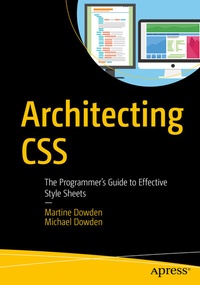
Architecting CSS
Description

Leverage various CSS features in combination with popular architectures in order to bring your style sheets back under your control. While CSS is the primary technology used for building beautiful web user interfaces, the style sheet files themselves are often quite ugly; left chaotic and unstructured through lack of a consistent architectural approach. By addressing the structure of your style sheets in the same way that you do with code, see how it is possible to create style rules that are clean and easy to read. Dig deep into CSS fundamentals and learn how to use the available selectors to build powerful rules.
You will learn how to use cascading, inheritance, pseudo-classes, pre-processors, and components to produce cleaner, DRY-er style sheets, and how to let these features work for you instead of leading you down the road of rule duplication and design inconsistencies. Embrace the clean, semantic HTML to make your code easier to read, while supporting accessibility andassistive technologies.
Separate the concerns of layout and style to simplify dynamic theming and white labeling, making you a marketing hero. Once you've finished this book you will have an advanced knowledge of CSS structures and architectural patterns that will take the pain out of style sheets for you (and your coworkers), and help you implement designs faster and easier than ever before.
What You'll Learn
- Understand the core CSS fundamentals of Inheritance, Cascading, and Specificity
-
Work with architecture and design patterns for better organization and maintenance
- Maximize code reuse with CSS precompilers
- Review the strengths and weaknesses of popular architecture patterns
Who This Book Is For
Primarily for front-end web developers and UI designers and anyone who works with CSS, particularly if they find it cumbersome and inelegant. It's also suitable for software architects and tech leads who are responsible for the maintainability of their code base.
More details
Other editions
Additional editions
Persons
Michael Dowden is the CEO of Andromeda, Founder & Product Architect for FlexePark, an international speaker, a 2019 Google Developer Expert in Firebase, and a 2019 Microsoft MVP in Developer Technologies. For more than 20 years, he has been writing code and geeking out over technology. He is passionate about keeping things simple and focusing on what provides real value to the end user. Michael is the author of Programming Languages ABC++ and Approachable Accessibility: Planning for Success .
Martine Dowden is CTO at Andromeda, Founder and Lead Developer at FlexePark, and an international speaker. She focuses on web interfaces that are beautiful, functional, accessible, and usable, approaching User Experience from both Art and Science, drawing from her degrees in Psychology and Visual Communications. Martine is a 2019 Google Developer Expert in Web Technologies, a 2019 Microsoft MVP in Developer Technologies, and the author of Programming Languages ABC++ and Approachable Accessibility: Planning for Success .
Content
1. Cascading Style Sheets.- 2. Rules & Selectors.- 3. Order of Importance.- 4. Layouts.- 5. Compatibility & Defaults.- 6. Interactions & Transitions.- 7. Preprocessors.- 8. JavaScript.- 9. Architectural Patterns.
