

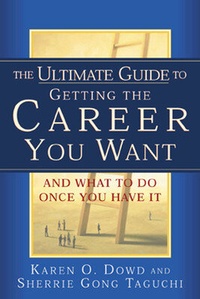
The Ultimate Guide to Getting The Career You Want
1st Edition
Published on 16. October 2003
338 pages
978-0-07-142597-1 (ISBN)
Description

A practical guide to creating a meaningful career pathWhile the desire to find fulfillment through work is overwhelmingly clear, knowing what direction to take often remains uncertain. With the help of The Ultimate Guide to Getting the Career You Want, readers will discover tools, concepts, and strategies for gaining career-building clarity. Dr. Karen O. Dowd and Sherrie Gong Taguchi, two experts in the field of career management, provide an accessible framework to help readers: - Overcome current job inertia
- Understand what makes a job right or wrong for them
- Include significant others in career decisions
- Find work that fits within their life vision
- Understand what makes a job right or wrong for them
- Include significant others in career decisions
- Find work that fits within their life vision
More details
Other editions
Additional editions
Karen O. Dowd | Sherrie Gong Taguchi
The Ultimate Guide to Getting The Career You Want
(And What do Do Once You Have It)
Book
09/2003
McGraw-Hill Inc.,US
€21.00
Article exhausted; check different version
Persons
Author
Karen O. Dowd is Assistant Dean, Career Management and Corporate Engagement, Simon Business School, University of Rochester, New York. Dowd is an experienced teacher, writer, administrator, speaker, and consultant. Prior to the University of Rochester, she was at the University of Denver, the University of Notre Dame, the Empower Group in New York City, and the University of Virginia. Dowd also taught at James Madison University where she teamed with her co-authors and the Management Department to develop a required course in Interpersonal Skills that is offered to all undergraduate business students. Karen is the co-author, with Sherrie Gong Taguchi, of The Ultimate Guide to Getting the Career You Want (New York: McGraw-Hill, 2003). Karen earned her doctorate from the University of Virginia, her masters degree from Indiana University South Bend, and her bachelors degree from Saint Marys College, Notre Dame, Indiana. She is a member of the National Association of Colleges and Employers and has served on the Board of the MBA Career Services and Employers Alliance. Karen has conducted numerous management training programs on many of the topics addressed in this book and on career management for managers. Her research interests include skills sought by employers, faculty careers, career development, candidate selection, and career branding.
Content
- Intro
- Copyright
- Table of Contents
- Acknowledgments
- Part 1 Learn from Your Past
- Principle 1 Know Yourself
- Getting Clear about Your Career
- What's Next in Your Life or Career?
- What Is Self-Assessment?
- The Value of Self-Assessment
- Identifying Your Dreams
- Making Personal Changes
- Case Study: Doug and Brigitte Fletcher-from East Coast Working Professionals to Montana Entrepreneurs Who Know Themselves
- Self-Assessment Exercises
- I. Learning from Your Past
- Exercise: Defining Your Core and Developable Skills
- II. Assessing the Present-What is Important for You to Know Now
- III. Envision Your Future
- Putting It All Together
- Where Do You See Yourself in 5 Years?
- Principle 2 Bounce Back from Setbacks
- Continuous Learning
- Acquisition of New Skills and Experiences
- Stretching beyond the Comfort Zone
- Advantages of Continuous Learning
- How-to Strategies
- A Competency-Based Career
- Evaluate Yourself as a Learner
- Identify Your Sources
- Case Study: Alana Baylor Invests in Herself through Lifelong Learning
- Part 2 Ahead: Assessing the Present
- Part 2 Assess the Present
- Principle 3 Take Measured Risk
- A World Interrupted
- Imperfect Information and Decision Making
- What Is Risk?
- Why Take Risk?
- Finance Theories, Tools, and Terminology
- Career Risks
- Don't Be an Ostrich
- A Five-Step Approach to Risk
- Case Study: The Spirit of Adventure in Life and Work ...
- Learn from Setbacks and Develop Contingencies
- Factoring in Your Significant Others
- Our Top Risk-Taking Tips
- Case Study: Skill and Client Diversification-A CPA Turned Entrepreneur Develops an Innovative Work Life
- Principle 4 Put Money in Perspective
- Rich Rewards
- Meaning and Money
- "Show Me the Money"
- Measures of Success
- No One Size Fits All
- What Does Money Mean to You?
- Baseline Needs
- A Self-Inventory
- Case Study: The Happiness Factor-Following Her Passion to the New York City Chamber of Commerce
- A Budget as a Planning Tool
- A Framework for Your Finances
- In It Together
- Your Reserves-Saving for Breaks and Rainy Days
- Flexible Models for Work
- Case Study: Right on the Money ... A California Boy's Hard-Won Career Mosaic
- Principle 5 Make People a Priority
- Cultivate Interdependence
- Make Room for Others
- Managing Our Careers as though Others Mattered
- Involving Others in Our Decisions
- Case Study: Susan Higgins and Her Husband ... Not Sleepless in Seattle
- Making Life-Altering Decisions with a Significant Other
- Collaborative Decision Making
- Cultivating a Diversified Lifetime Network
- An Ideal Coach and Mentor
- Transcendence-Helping Others
- Giving Back through Mentoring
- Principle 6 Plan Ahead-Now!
- Planned and Unplanned Change
- Step 1: Commit to the Idea of Change
- Case Study: George and Mary Trigiani-Mid-Fifties and Living Life to Its Fullest
- A Twenty-Something Plans Ahead and Makes Changes for His Career: From Consulting to a Media Start-up in Hong Kong
- Step 2: Visualize the Desired Outcome
- Step 3: Develop and Test Plans
- Step 4: Refine and Implement a Specific Plan
- Step 5: Monitor Your Progress
- A Nonlinear Planning Process
- Part 3 Envision the Future
- Principle 7 Enjoy Your Life and Sustain Your Career
- Life Is Beautiful
- The Need for a Sustainable Career and Life
- Having a Sense of Purpose
- Case Study: Changing Roles-From Lawyer to Broadway Producer
- Shaping Our Identity-Actualizing Ourselves and Others
- Being Who You Are
- Adaptability: Understanding and Embracing Change
- High Notes and Low Notes-A Musician Composes Her Life
- A Book Editor's Career Shifting
- Two Men and a Baby
- Successful Change Strategies
- Principle 8 Give Yourself a Break
- Beginnings and Endings
- Global Perspective
- Why Take Breaks?
- Paradigm Shift
- The Principle-Give Yourself a Break
- Benefits of Taking Breaks
- The Basics of Breaks
- Between or Within Jobs or Careers
- Formal or Informal Leaves
- Planning for a Break
- Considering Your Significant Others
- Getting the Word Out
- Chilling Out
- Mini-Breaks
- But Will It Hurt My Career?
- Worst-Case Scenarios
- Worst Case 1: Lack of Financial Resources
- Worst Case 2: Excuses, Excuses
- Worst Case 3: Pangs of Guilt
- Worst Case 4: People Will Think the Worst of You
- Worst Case 5: Pressure to Take a Break Later
- Worst Case 6: Outdated Skills and Knowledge
- Worst Case 7: I'm Lost-Where to Begin?
- Worst Case 8: Flat-Out Fear
- Attitude
- Readying Yourself for Reentry
- Case Study: A Bodacious Break-A Thirty-Something's Journey from High-Tech High Performer to Pastry Chef
- Part 4 Take Action to Manage Your Career
- Principle 9 Just Do It
- Career Model for a Lifetime
- Continuous Movement: An Ongoing Journey
- Knowing versus Doing
- The Bigger Picture
- Rules of Thumb for Timing
- Phase 1: Self-Knowledge
- Phase 2: Career Discovery
- Phase 3: Career Focus
- Phase 4: Market Planning
- P 1: Product
- P 2: Place (Distribution)
- Phase 5: Implementation/Feedback
- P 3: Promotion
- P 4: Positioning
- P 5: Price
- Preparing for Interviews
- Preparing for Compensation Negotiation
- Evaluating among Offers-Three Alternative Methods
- T Accounts
- Weighted Averages
- Feedback and Improving
- Case Study: Job Search Strategies and Plans-A Tale of Two Kellogg and University of Chicago MBAs, Class of 2002
- Principle 10 Own Your Career
- Work in the Context of Your Complete Life Vision
- So Now What?
- Guidelines for Owning Your Career
- Consider where Babies and Marriage Fit In
- Build Survival Skills for Your Toolkit
- 11 Executives Share Their Lessons Learned
- Case Study: Jim Collins, Best-Selling Author of From Good to Great and Built to Last, Educator, and Management Visionary
- Appendix A Best of the Web-Our 25 Favorites
- Appendix B Résumé and Cover Letter Pointers
- Handling Common Résumé Problems
- Cover Letter Outline
- Appendix C Values-Based Questions for Evaluating Organizations
- Intrinsic Values
- Work Relationship Values
- Appendix D Compensation Negotiation Tip Sheet and Resources
- Helpful Resources
- Appendix E Getting It Right: Due Diligence and Entry Strategy
- Ask the Person Making You the Offer
- Find Out from Your Hiring Manager
- Listen and Learn After You've Accepted the Job
- Notes
- Index
