

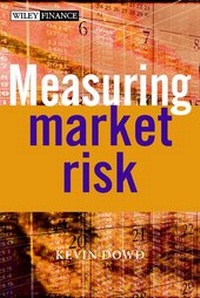
Measuring Market Risk
Published on 9. December 2002
392 pages
978-0-470-85521-8 (ISBN)
Description

The most up-to-date resource on market risk methodologies
Financial professionals in both the front and back office requirean understanding of market risk and how to manage it. MeasuringMarket Risk provides this understanding with an overview of themost recent innovations in Value at Risk (VaR) and Expected TailLoss (ETL) estimation. This book is filled with clear andaccessible explanations of complex issues that arise in riskmeasuring-from parametric versus nonparametric estimation toincre-mental and component risks. Measuring Market Risk alsoincludes accompanying software written in Matlab(r)-allowing thereader to simulate and run the examples in the book.
More details
Other editions
New editions
Additional editions
Kevin Dowd
Measuring Market Risk
Book
08/2002
1st Edition
Wiley
€99.90
Article exhausted; check for reprint

Person
Kevin Dowd (Nottingham, UK) is Professor of Financial Risk Management at Nottingham University Business School. He is the author of Beyond Value at Risk: The New Science of Risk Management (Wiley: 0-471-97621-0). Dowd regularly has articles published in Financial Engineering News and Derivatives Professional.
Content
- Intro
- Measuring Market Risk
- Contents
- Preface
- Acknowledgements
- 1 The Risk Measurement Revolution
- 1.1 Contributory Factors
- 1.1.1 A Volatile Environment
- 1.1.2 Growth in Trading Activity
- 1.1.3 Advances in Information Technology
- 1.2 Risk Measurement Before VaR
- 1.2.1 Gap Analysis
- 1.2.2 Duration Analysis
- 1.2.3 Scenario Analysis
- 1.2.4 Portfolio Theory
- 1.2.5 Derivatives Risk Measures
- 1.3 Value at Risk
- 1.3.1 The Origin and Development of VaR
- 1.3.2 Attractions of VaR
- 1.3.3 Criticisms of VaR
- 1.4 Recommended Reading
- 2 Measures of Financial Risk
- 2.1 The Mean-Variance Framework For Measuring Financial Risk
- 2.1.1 The Normality Assumption
- 2.1.2 Limitations of the Normality Assumption
- 2.1.3 Traditional Approaches to Financial Risk Measurement
- 2.1.3.1 Portfolio Theory
- 2.1.3.2 Duration Approaches to Fixed-income Risk Measurement
- 2.2 Value at Risk
- 2.2.1 VaR Basics
- 2.2.2 Choice of VaR Parameters
- 2.2.3 Limitations of VaR as a Risk Measure
- 2.2.3.1 VaR Uninformative of Tail Losses
- 2.2.3.2 VaR Can Create Perverse Incentive Structures
- 2.2.3.3 VaR Can Discourage Diversification
- 2.2.3.4 VaR Not Sub-additive
- 2.3 Expected Tail Loss
- 2.3.1 Coherent Risk Measures
- 2.3.2 The Expected Tail Loss
- 2.4 Conclusions
- 2.5 Recommended Reading
- 3 Basic Issues in Measuring Market Risk
- 3.1 Data
- 3.1.1 Profit/Loss Data
- 3.1.2 Loss/Profit Data
- 3.1.3 Arithmetic Returns Data
- 3.1.4 Geometric Returns Data
- 3.2 Estimating Historical Simulation VaR
- 3.3 Estimating Parametric VaR
- 3.3.1 Estimating VaR with Normally Distributed Profits/Losses
- 3.3.2 Estimating VaR with Normally Distributed Arithmetic Returns
- 3.3.3 Estimating Lognormal VaR
- 3.4 Estimating Expected Tail Loss
- 3.5 Summary
- Appendix: Mapping Positions to Risk Factors
- A3.1 Selecting Core Instruments or Factors
- A3.1.1 Selecting Core Instruments
- A3.1.2 Selecting Core Factors
- A3.2 Mapping Positions and VaR Estimation
- A3.2.1 The Basic Building Blocks
- A3.2.1.1 Basic FX Positions
- A3.2.1.2 Basic Equity Positions
- A3.2.1.3 Zero-coupon Bonds
- A3.2.1.4 Basic Forwards/Futures
- A3.2.2 More Complex Positions
- A3.3 Recommended Reading
- 4 Non-parametric VaR and ETL
- 4.1 Compiling Historical Simulation Data
- 4.2 Estimation of Historical Simulation VaR and ETL
- 4.2.1 Basic Historical Simulation
- 4.2.2 Historical Simulation Using Non-parametric Density Estimation
- 4.2.3 Estimating Curves and Surfaces for VaR and ETL
- 4.3 Estimating Confidence Intervals for Historical Simulation VaR and ETL
- 4.3.1 A Quantile Standard Error Approach to the Estimation of Confidence Intervals for HS VaR and ETL
- 4.3.2 An Order Statistics Approach to the Estimation of Confidence Intervals for HS VaR and ETL
- 4.3.3 A Bootstrap Approach to the Estimation of Confidence Intervals for HS VaR and ETL
- 4.4 Weighted Historical Simulation
- 4.4.1 Age-weighted Historical Simulation
- 4.4.2 Volatility-weighted Historical Simulation
- 4.4.3 Filtered Historical Simulation
- 4.5 Advantages and Disadvantages of Historical Simulation
- 4.5.1 Advantages
- 4.5.2 Disadvantages
- 4.5.2.1 Total Dependence on the Data Set
- 4.5.2.2 Problems of Data Period Length
- 4.6 Principal Components and Related Approaches to VaR and ETL Estimation
- 4.7 Conclusions
- 4.8 Recommended Reading
- 5 Parametric VaR and ETL
- 5.1 Normal VAR and ETL
- 5.1.1 General Features
- 5.1.2 Disadvantages of Normality
- 5.2 The Student t-distribution
- 5.3 The Lognormal Distribution
- 5.4 Extreme Value Distributions
- 5.4.1 The Generalised Extreme Value Distribution
- 5.4.2 The Peaks Over Threshold (Generalised Pareto) Approach
- 5.5 Miscellaneous Parametric Approaches
- 5.5.1 Stable Lévy Approaches
- 5.5.2 Elliptical and Hyperbolic Approaches
- 5.5.3 Normal Mixture Approaches
- 5.5.4 The Cornish-Fisher Approximation
- 5.6 The Multivariate Normal Variance-Covariance Approach
- 5.7 Non-normal Variance-Covariance Approaches
- 5.7.1 Elliptical Variance-Covariance Approaches
- 5.7.2 The Hull-White Transformation-to-normality Approach
- 5.8 Handling Multivariate Return Distributions With Copulas
- 5.9 Conclusions
- 5.10 Recommended Reading
- Appendix 1: Delta-Gamma and Related Approximations
- A5.1 Delta-Normal Approaches
- A5.2 Delta-Gamma Approaches
- A5.2.1 The Delta-Gamma Approximation
- A5.2.2 The Delta-Gamma Normal Approach
- A5.2.3 Wilson's Delta-Gamma Approach
- A5.2.4 Other Delta-Gamma Approaches
- A5.3 Conclusions
- A5.4 Recommended Reading
- Appendix 2: Solutions for Options VaR?
- A5.5 When and How Can We Solve for Options VaR
- A5.6 Measuring Options VaR and ETL
- A5.6.1 A General Framework for Measuring Options Risks
- A5.6.2 A Worked Example: Measuring the VaR of a European Call Option
- A5.6.3 VaR/ETL Approaches and Greek Approaches to Options Risk
- A5.7 Recommended Reading
- 6 Simulation Approaches to VaR and ETL Estimation
- 6.1 Options VaR and ETL
- 6.1.1 Preliminary Considerations
- 6.1.2 An Example: Estimating the VaR and ETL of an American Put
- 6.1.3 Refining MCS Estimation of Options VaR and ETL
- 6.2 Estimating VaR by Simulating Principal Components
- 6.2.1 Basic Principal Components Simulation
- 6.2.2 Scenario Simulation
- 6.3 Fixed-income VaR and ETL
- 6.3.1 General Considerations
- 6.3.1.1 Stochastic Processes for Interest Rates
- 6.3.1.2 The Term Structure of Interest Rates
- 6.3.2 A General Approach to Fixed-income VaR and ETL
- 6.4 Estimating VaR and ETL under a Dynamic Portfolio Strategy
- 6.5 Estimating Credit-related Risks with Simulation Methods
- 6.6 Estimating Insurance Risks with Simulation Methods
- 6.7 Estimating Pensions Risks with Simulation Methods
- 6.7.1 Estimating Risks of Defined-benefit Pension Plans
- 6.7.2 Estimating Risks of Defined-contribution Pension Plans
- 6.8 Conclusions
- 6.9 Recommended Reading
- 7 Lattice Approaches to VaR and ETL Estimation
- 7.1 Binomial Tree Methods
- 7.1.1 Introduction to Binomial Tree Methods
- 7.1.2 A Worked Example: Estimating the VaR and ETL of an American Put with a Binomial Tree
- 7.1.3 Other Considerations
- 7.2 Trinomial Tree Methods
- 7.3 Summary
- 7.4 Recommended Reading
- 8 Incremental and Component Risks
- 8.1 Incremental VaR
- 8.1.1 Interpreting Incremental VaR
- 8.1.2 Estimating IVaR by Brute Force: The 'Before and After' Approach
- 8.1.3 Estimating IVaR Using Marginal VaRs
- 8.1.3.1 Garman's 'delVaR' Approach
- 8.1.3.2 Potential Drawbacks of the delVaR Approach
- 8.2 Component VaR
- 8.2.1 Properties of Component VaR
- 8.2.2 Uses of Component VaR
- 8.2.2.1 'Drill-Down' Capability
- 8.2.2.2 Reporting Component VaRs
- 8.3 Conclusions
- 8.4 Recommended Reading
- 9 Estimating Liquidity Risks
- 9.1 Liquidity and Liquidity Risks
- 9.2 Estimating Liquidity-adjusted VaR and ETL
- 9.2.1 A Transactions Cost Approach
- 9.2.2 The Exogenous Spread Approach
- 9.2.3 The Market Price Response Approach
- 9.2.4 Derivatives Pricing Approaches
- 9.2.5 The Liquidity Discount Approach
- 9.2.6 A Summary and Comparison of Alternative Approaches
- 9.3 Estimating Liquidity at Risk
- 9.4 Estimating Liquidity in Crises
- 9.5 Recommended Reading
- 10 Backtesting Market Risk Models
- 10.1 Preliminary Data Issues
- 10.1.1 Obtaining Data
- 10.2 Statistical Backtests Based on The Frequency of Tail Losses
- 10.2.1 The Basic Frequency-of-tail-losses (or Kupiec) Test
- 10.2.2 The Time-to-first-tail-loss Test
- 10.2.3 A Tail-loss Confidence-interval Test
- 10.2.4 The Conditional Backtesting (Christoffersen) Approach
- 10.3 Statistical Backtests Based on the Sizes of Tail Losses
- 10.3.1 The Basic Sizes-of-tail-losses Test
- 10.3.2 The Crnkovic-Drachman Backtest Procedure
- 10.3.3 The Berkowitz Approach
- 10.4 Forecast Evaluation Approaches to Backtesting
- 10.4.1 Basic Ideas
- 10.4.2 The Frequency-of-tail-losses (Lopez I) Approach
- 10.4.3 The Size-adjusted Frequency (Lopez II) Approach
- 10.4.4 The Blanco-Ihle Approach
- 10.4.5 An Alternative Sizes-of-tail-losses Approach
- 10.5 Comparing Alternative Models
- 10.6 Assessing the Accuracy of Backtest Results
- 10.7 Backtesting With Alternative Confidence Levels, Positions and Data
- 10.7.1 Backtesting with Alternative Confidence Levels
- 10.7.2 Backtesting with Alternative Positions
- 10.7.3 Backtesting with Alternative Data
- 10.8 Summary
- 10.9 Recommended Reading
- 11 Stress Testing
- 11.1 Benefits and Difficulties of Stress Testing
- 11.1.1 Benefits of Stress Testing
- 11.1.2 Difficulties with Stress Tests
- 11.2 Scenario Analysis
- 11.2.1 Choosing Scenarios
- 11.2.1.1 Stylised Scenarios
- 11.2.1.2 Actual Historical Events
- 11.2.1.3 Hypothetical One-off Events
- 11.2.2 Evaluating the Effects of Scenarios
- 11.3 Mechanical Stress Testing
- 11.3.1 Factor Push Analysis
- 11.3.2 Maximum Loss Optimisation
- 11.4 Conclusions
- 11.5 Recommended Reading
- 12 Model Risk
- 12.1 Models and Model Risk
- 12.1.1 Models
- 12.1.2 Model Risk
- 12.2 Sources of Model Risk
- 12.2.1 Incorrect Model Specification
- 12.2.2 Incorrect Model Application
- 12.2.3 Implementation Risk
- 12.2.4 Other Sources of Model Risk
- 12.2.4.1 Incorrect Calibration
- 12.2.4.2 Programming Problems
- 12.2.4.3 Data Problems
- 12.3 Combating Model Risk
- 12.3.1 Combating Model Risk: Some Guidelines for Risk Practitioners
- 12.3.2 Combating Model Risk: Some Guidelines for Managers
- 12.3.3 Institutional Methods to Combat Model Risk
- 12.3.3.1 Procedures to Vet, Check and Review Models
- 12.3.3.2 Independent Risk Oversight
- 12.4 Conclusions
- 12.5 Recommended Reading
- Toolkit
- Bibliography
- Author Index
- Subject Index
- Software Index
