

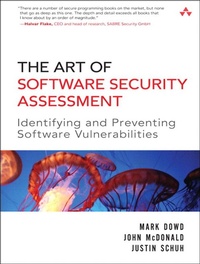
Art of Software Security Assessment, The
Identifying and Preventing Software Vulnerabilities
1st Edition
Published on 20. November 2006
1200 pages
978-0-13-270193-8 (ISBN)
Description

The Definitive Insider's Guide to Auditing Software Security
This is one of the most detailed, sophisticated, and useful guides to software security auditing ever written. The authors are leading security consultants and researchers who have personally uncovered vulnerabilities in applications ranging from sendmail to Microsoft Exchange, Check Point VPN to Internet Explorer. Drawing on their extraordinary experience, they introduce a start-to-finish methodology for "ripping apart" applications to reveal even the most subtle and well-hidden security flaws.
The Art of Software Security Assessment covers the full spectrum of software vulnerabilities in both UNIX/Linux and Windows environments. It demonstrates how to audit security in applications of all sizes and functions, including network and Web software. Moreover, it teaches using extensive examples of real code drawn from past flaws in many of the industry's highest-profile applications.
Coverage includes
* Code auditing: theory, practice, proven methodologies, and secrets of the trade
* Bridging the gap between secure software design and post-implementation review
* Performing architectural assessment: design review, threat modeling, and operational review
* Identifying vulnerabilities related to memory management, data types, and malformed data
* UNIX/Linux assessment: privileges, files, and processes
* Windows-specific issues, including objects and the filesystem
* Auditing interprocess communication, synchronization, and state
* Evaluating network software: IP stacks, firewalls, and common application protocols
* Auditing Web applications and technologies
This is one of the most detailed, sophisticated, and useful guides to software security auditing ever written. The authors are leading security consultants and researchers who have personally uncovered vulnerabilities in applications ranging from sendmail to Microsoft Exchange, Check Point VPN to Internet Explorer. Drawing on their extraordinary experience, they introduce a start-to-finish methodology for "ripping apart" applications to reveal even the most subtle and well-hidden security flaws.
The Art of Software Security Assessment covers the full spectrum of software vulnerabilities in both UNIX/Linux and Windows environments. It demonstrates how to audit security in applications of all sizes and functions, including network and Web software. Moreover, it teaches using extensive examples of real code drawn from past flaws in many of the industry's highest-profile applications.
Coverage includes
* Code auditing: theory, practice, proven methodologies, and secrets of the trade
* Bridging the gap between secure software design and post-implementation review
* Performing architectural assessment: design review, threat modeling, and operational review
* Identifying vulnerabilities related to memory management, data types, and malformed data
* UNIX/Linux assessment: privileges, files, and processes
* Windows-specific issues, including objects and the filesystem
* Auditing interprocess communication, synchronization, and state
* Evaluating network software: IP stacks, firewalls, and common application protocols
* Auditing Web applications and technologies
More details
Edition
1. Auflage
Language
English
Place of publication
Boston
United States
Publishing group
Pearson Education (US)
Target group
College/higher education
ISBN-13
978-0-13-270193-8 (9780132701938)
Copyright in bibliographic data and cover images is held by Nielsen Book Services Limited or by the publishers or by their respective licensors: all rights reserved.
Schweitzer Classification
Other editions
Additional editions
Mark Dowd | John McDonald | Justin Schuh
Art of Software Security Assessment, The
Identifying and Preventing Software Vulnerabilities
Book
12/2006
Addison Wesley
€73.64
Shipment within 10-20 days
Persons
Mark Dowd is a principal security architect at McAfee, Inc. and an established expert in the field of application security. His professional experience includes several years as a senior researcher at Internet Security Systems (ISS) X-Force, and the discovery of a number of high-profile vulnerabilities in ubiquitous Internet software. He is responsible for identifying and helping to address critical flaws in Sendmail, Microsoft Exchange Server, OpenSSH, Internet Explorer, Mozilla (Firefox), Checkpoint VPN, and Microsoft's SSL implementation. In addition to his research work, Mark presents at industry conferences, including Black Hat and RUXCON.
John McDonald is a senior consultant with Neohapsis, where he specializes in advanced application security assessment across a broad range of technologies and platforms. He has an established reputation in software security, including work in security architecture and vulnerability research for NAI (now McAfee), Data Protect GmbH, and Citibank. As a vulnerability researcher, John has identified and helped resolve numerous critical vulnerabilities, including issues in Solaris, BSD, Checkpoint FireWall-1, OpenSSL, and BIND.
Justin Schuh is a senior consultant with Neohapsis, where he leads the Application Security Practice. As a senior consultant and practice lead, he performs software security assessments across a range of systems, from embedded device firmware to distributed enterprise web applications. Prior to his employment with Neohapsis, Justin spent nearly a decade in computer security activities at the Department of Defense (DoD) and related agencies. His government service includes a role as a lead researcher with the National Security Agency (NSA) penetration testing team-the Red Team.
John McDonald is a senior consultant with Neohapsis, where he specializes in advanced application security assessment across a broad range of technologies and platforms. He has an established reputation in software security, including work in security architecture and vulnerability research for NAI (now McAfee), Data Protect GmbH, and Citibank. As a vulnerability researcher, John has identified and helped resolve numerous critical vulnerabilities, including issues in Solaris, BSD, Checkpoint FireWall-1, OpenSSL, and BIND.
Justin Schuh is a senior consultant with Neohapsis, where he leads the Application Security Practice. As a senior consultant and practice lead, he performs software security assessments across a range of systems, from embedded device firmware to distributed enterprise web applications. Prior to his employment with Neohapsis, Justin spent nearly a decade in computer security activities at the Department of Defense (DoD) and related agencies. His government service includes a role as a lead researcher with the National Security Agency (NSA) penetration testing team-the Red Team.
Content
ABOUT THE AUTHORS xv
PREFACE xvii
ACKNOWLEDGMENTS xxi
I Introduction to Software Security Assessment
1 SOFTWARE VULNERABILITY FUNDAMENTALS 3
2 DESIGN REVIEW 25
3 OPERATIONAL REVIEW 67
4 APPLICATION REVIEW PROCESS 91
II Software Vulnerabilities
5 MEMORY CORRUPTION 167
6 C LANGUAGE ISSUES 203
7 PROGRAM BUILDING BLOCKS 297
8 STRINGS ANDMETACHARACTERS 387
9 UNIX I: PRIVILEGES AND FILES 459
10 UNIX II: PROCESSES 559
11 WINDOWS I: OBJECTS AND THE FILE SYSTEM 625
12 WINDOWS II: INTERPROCESS COMMUNICATION 685
13 SYNCHRONIZATION AND STATE 755
III Software Vulnerabilities in Practice
14 NETWORK PROTOCOLS 829
15 FIREWALLS 891
16 NETWORK APPLICATION PROTOCOLS 921
17 WEB APPLICATIONS 1007
18 WEB TECHNOLOGIES 1083
BIBLIOGRAPHY 1125
INDEX 1129
PREFACE xvii
ACKNOWLEDGMENTS xxi
I Introduction to Software Security Assessment
1 SOFTWARE VULNERABILITY FUNDAMENTALS 3
2 DESIGN REVIEW 25
3 OPERATIONAL REVIEW 67
4 APPLICATION REVIEW PROCESS 91
II Software Vulnerabilities
5 MEMORY CORRUPTION 167
6 C LANGUAGE ISSUES 203
7 PROGRAM BUILDING BLOCKS 297
8 STRINGS ANDMETACHARACTERS 387
9 UNIX I: PRIVILEGES AND FILES 459
10 UNIX II: PROCESSES 559
11 WINDOWS I: OBJECTS AND THE FILE SYSTEM 625
12 WINDOWS II: INTERPROCESS COMMUNICATION 685
13 SYNCHRONIZATION AND STATE 755
III Software Vulnerabilities in Practice
14 NETWORK PROTOCOLS 829
15 FIREWALLS 891
16 NETWORK APPLICATION PROTOCOLS 921
17 WEB APPLICATIONS 1007
18 WEB TECHNOLOGIES 1083
BIBLIOGRAPHY 1125
INDEX 1129
