

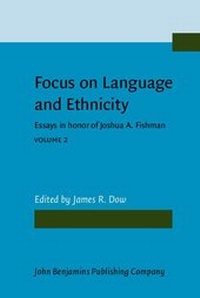
Focus on Language and Ethnicity
Essays in honor of Joshua A. Fishman. Volume 2
1st Edition
Published on 5. July 1991
VIII, 244 pages
978-90-272-8477-8 (ISBN)
Description

An impressive collection of theoretical perspectives and empirical data which includes papers on Catalan, Galician, Tagalog, and the minority languages of Kenya. Most of the contributions deal with ethnic minorities in North America: language maintenance and shift and cultural aspects of various language minorities' as well as Judeo-English and Yiddish spoken by children of Jewish immigrants.
More details
Other editions
Additional editions
Book
07/1991
John Benjamins Publishing Co
€116.60
Shipment within 10-15 days
Content
- LANGUAGE AND ETHNICITY
- Editorial page
- Title page
- Copyright page
- Preface
- Table of contents
- Introduction
- Pennsylvania German: "Do they love it in their hearts?
- Procedures for this Study
- Language Usage
- Linguistic Evidence
- Discussion
- Linguistic Markers of Anabaptist Ethnicity through Four Centuries
- 0. Introduction
- 1. Linguistic Markers of Peoplehood during the Founding Phase
- 2. Linguistic Markers of Peoplehood during the Post-Foundation Phases
- 3. Linguistic Markers of Peoplehood during the Migration to Other Language Areas
- 4. Conclusion
- Linkages of Language and Ethnic Identity: Changes in Barcelona, 1980-1987
- A Brief Reviewof Some Major Linguistic Policy Changes
- Changes in Linguistic Choices?
- Language Choices in Informal Domains
- The Ethnographer's Experience
- Changes in Linguistic Choices among Students
- Case Study: First Year High School
- Language Attitudes
- Notes
- Language and Ethnicity: The Case of Rosalía de Castro
- Making Ethnicity Salient in Codeswitching
- Introduction
- Explaining Social Motivations for Code Choices
- Unmarked Choices
- Marked Choices
- Permissible" Marked Choices
- Exclusive" Marked Choices
- Exploratory Choices: Marked Use of an Ethnic Language
- Conclusion
- Notes
- Cebuiano and Tagalog: Ethnic Rivalry Redivivus
- 1. Introduction
- 2. Cebuanos and Tagalogs: Some Social Data
- 3. Cebuano and Tagalog: Some Sociolinguistic Data
- 4. Conclusion
- Notes
- The Emergence of Language Minorities in the United States
- 1. Introduction
- 2. Functional and Conflict Perspectives on Language
- 3. Domains of Language Policy and Debate in the United States
- 4. Theoretical Implications
- Note
- Theory and Method in the Study of Language Shift
- 1. Introduction
- 2. Definitions
- 3. The Measurement of Language Shift
- 4. The Interpretation of Language Shift Data
- 5. Demographic Modelling
- Conclusion
- Notes
- A So-Called Dialect of English
- Notes
- EthnicIdentity and Aging: Children of Jewish Immigrants Return to Their First Language
- Introduction
- Yiddish during the Life Cycle of Children of Immigrants
- Current Yiddish Language Use
- Aging, Language and Ethnic Identification
- Notes
- W(h)ither Ethnic Languages and Bilingual Education in the US? Crisis & the Struggle between Hegemony & Humanism
- The Hegemonic Paradigm - The Received World View in the U.S.
- The Current National/World Crisis
- Whither the US? - Can/Will It Change?
- The Humanistic Paradigm - An Alternative World View for the US
- Whither the Paradigm Shift?
- Conclusion
- References
- Contributors
- Joanna Courteau
- James R. Dow
- Werner Enninger
- Andrew Gonzalez
- Marion Lois Huffines
- Alan S. Kaye
- Rolf Kjolseth
- David Lopez
- Carol Myers-Scotton
- Rakhmiel Peltz
- Calvin Veltman
- Kathryn Woolard
- Index
