

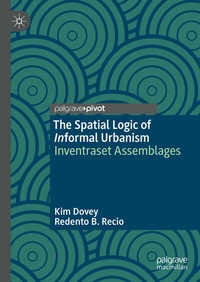
The Spatial Logic of Informal Urbanism
Description

Highly informalized cities of the global South are often portrayed as chaotic and out of control - this book reveals a spatial logic of informal urbanism that is central to the economic life and livelihoods of such cities. 'Inventraset' is a concept that shows how informal street vending, transport and settlement are fundamentally integrated with each other and the more formal city. Street vending and transport provide crucial forms of employment and mobility, while informal settlement is the key source of affordable and adaptable housing. Informal urbanism is not ideal but it is the way such cities work; it is often hidden or camouflaged within the ideal of a clean, green and modern city to which middle-classes and elites aspire. Through comparative studies, with a focus on Manila and Jakarta, the book maps and analyzes how such cities work through alliances and synergies between vending, transport and settlement - inventraset assemblages are inventive and transgressive, yet settled.
More details
Other editions
Additional editions
Persons
Kim Dovey is Professor of Architecture and Urban Design at the University of Melbourne, where he also Co-Directs the Informal Urbanism Research Hub ( InfUr - ). Kim is a widely recognized scholar in urban studies, urban design and architecture; authored books include Framing Places (2008), Becoming Places (2010), Urban Design Thinking (2016) and Atlas of Informal Settlement (2023).
Redento B. Recio is Associate Professor at the College of Social Work and Community Development, University of the Philippines Diliman. Reden is widely published in leading academic journals in the fields of urban planning, informality, governance and development studies. He also works with grassroots networks and global South scholars in South and Southeast Asia.
Content
Chapter 1: INVENTRASET ASSEMBLAGES.- Chapter 2: READING THE INFORMAL CITY.- Chapter 3: INCLUSION AND ILLUSION.- Chapter 4: THE INFORMALIZED UNIVERSITY.- Chapter 5: RETHINKING URBAN INFORMALITIES.
