

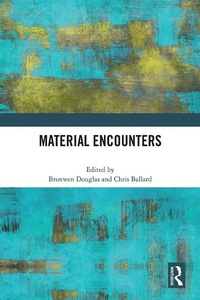
Material Encounters
1st Edition
Published on 24. October 2023
196 pages
978-1-000-99315-8 (ISBN)
Description

This topical and conceptually innovative book proposes new perspectives on the theme of materiality which, since the 1980s, has animated work across and within disciplines in the Humanities and Social Sciences.
The particular focus of the chapters in this volume is the materiality of knowledge produced through embodied encounters between people, places, and things in the Pacific Islands, New Guinea, Australia, and Myanmar. The authors consider how materiality mediates the ways in which knowledge is generated or acquired in encounters and becomes expressed through things and material forms of inscription - charts and maps; journals, letters, and reports; drawings; objects; human remains; legends, cartouches, captions, labels, marginalia, and notes; and published works of all kinds. The essays further address processes whereby materialized knowledge is archived, conserved, distributed, restricted, or dispersed - through serendipity, excess, loss, silence, absence, and suppression.
This book will be of great interest to upper-level students, researchers, and academics in History, Anthropology and Oceania Studies. The chapters in this book were originally published as a special issue of History and Anthropology.
The particular focus of the chapters in this volume is the materiality of knowledge produced through embodied encounters between people, places, and things in the Pacific Islands, New Guinea, Australia, and Myanmar. The authors consider how materiality mediates the ways in which knowledge is generated or acquired in encounters and becomes expressed through things and material forms of inscription - charts and maps; journals, letters, and reports; drawings; objects; human remains; legends, cartouches, captions, labels, marginalia, and notes; and published works of all kinds. The essays further address processes whereby materialized knowledge is archived, conserved, distributed, restricted, or dispersed - through serendipity, excess, loss, silence, absence, and suppression.
This book will be of great interest to upper-level students, researchers, and academics in History, Anthropology and Oceania Studies. The chapters in this book were originally published as a special issue of History and Anthropology.
More details
Edition
1. Auflage
Language
English
Place of publication
London
United Kingdom
Publishing group
Taylor & Francis Ltd
Target group
College/higher education
ISBN-13
978-1-000-99315-8 (9781000993158)
Copyright in bibliographic data and cover images is held by Nielsen Book Services Limited or by the publishers or by their respective licensors: all rights reserved.
Schweitzer Classification
Other editions
Additional editions
Bronwen Douglas | Chris Ballard
Material Encounters
Book
01/2025
1st Edition
Routledge
€63.00
Shipment within 10-20 days
Bronwen Douglas | Chris Ballard
Material Encounters
Book
10/2023
1st Edition
Routledge
€206.10
Shipment within 10-20 days
Persons
Bronwen Douglas is Honorary Professor in the College of Arts & Social Sciences at the Australian National University. Her work combines the ethnohistory of encounters in Oceania with the history of the human sciences and the sciences of place.
Chris Ballard is a Pacific historian at the Australian National University. His work focuses on Indigenous historicities and histories and the supplementary role in these histories of repatriated archives, grounded in collaborative fieldwork with communities in West Papua, Papua New Guinea, and Vanuatu.
Chris Ballard is a Pacific historian at the Australian National University. His work focuses on Indigenous historicities and histories and the supplementary role in these histories of repatriated archives, grounded in collaborative fieldwork with communities in West Papua, Papua New Guinea, and Vanuatu.
Content
Introduction-Contact tracing: The materiality of encounters 1. Mapping the once and future strait: Place, time, and Torres Strait from the sixteenth century to the Pleistocene 2. Re-presenting encounters: The drawings of Jean Piron 3. 'With the consent of the tribe': Marking lands on Tanna and Erromango, New Hebrides 4. Marginal history 5. Making the visual record of New Guinea: William G. Lawes's photographic encounters 6. Heads and 'cultures': A. C. Haddon, colonial exploration and the 'Strickland River' inscription 7. Smoke and mirrors in Arnhem Land: What expeditions tell us about the materiality of crosscultural encounters 8. On the banality of paperwork and the brutality of judicial bureaucracy in Myanmar
