

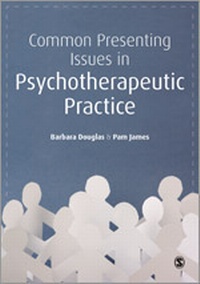
Common Presenting Issues in Psychotherapeutic Practice
1st Edition
Published on 16. December 2013
200 pages
978-1-4462-9670-7 (ISBN)
Description

Learning how to work effectively with a broad range of clients and their presenting issues is a vital part of a career as a therapist, but engaging with the often conflicting worlds of descriptive psychopathology and the subjective meanings of the therapist and client is a real challenge for trainees. They have to develop the skills and knowledge that allow both approaches - one medical, one humanistic - to work successfully together.
With the support of expert contributors, Pam James and Barbara Douglas help your students to confidently do just that, proving a comprehensive introduction to the theory, research and practice behind a range of common presenting issues. Key issues covered include:
- Anxiety
- Depression
- Trauma
- Bipolar disorder
- Psychosis
- Eating disorders
- Borderline personality disorder
This book should be on the desk of every counselling, psychotherapy and counselling psychology trainee, and is recommended reading for other practitioners of health and social care working with these common presenting issues.
With the support of expert contributors, Pam James and Barbara Douglas help your students to confidently do just that, proving a comprehensive introduction to the theory, research and practice behind a range of common presenting issues. Key issues covered include:
- Anxiety
- Depression
- Trauma
- Bipolar disorder
- Psychosis
- Eating disorders
- Borderline personality disorder
This book should be on the desk of every counselling, psychotherapy and counselling psychology trainee, and is recommended reading for other practitioners of health and social care working with these common presenting issues.
Reviews / Votes
For too long Counselling Psychology perspectives to understanding human distress have been drowned out by medical and clinical voices. This book challenges this, adding as it does to the emerging literature offering reflection and debate as to what a human - and humane - approach to such distress might be. By reflecting on the dilemmas embedded in this area this book offers a rare chance to think meaningfully about distress rather than simply 'do something' to it. -- Dr Martin Milton, CPsychol, CSci, AFBPsS, UKCP Reg I believe that this book makes a really useful and timely contribution to the literature and therefore potentially to clinical practice. It will be valuable to psychologists, psychotherapists, psychiatrists and others engaged in therapeutic practice in a wide range of contexts. It combines elements of critical thinking with a real depth of clinical experience and a useful selection of examples. The book contains contributions from both the authors and a range of clinicians with many years of experience. Each of the authors deconstructs some of the difficulties and dilemmas associated with the use of diagnostic categories and considers the contextual factors which are at play. The structure of the book is very helpful in that each chapter gives a historical perspective on a particular diagnostic category; this is followed by a discussion of the real life dilemmas in clinical practice, followed by a section which explores research and practice with service users labelled with this diagnostic categorisation. The reflection box at the end of each chapter is particularly useful as it will enable individuals or groups to consider and reflect upon the issues raised in the preceding chapter. I believe this book will be a real asset to the work of a range of professionals and will stimulate debate and critical thinking which can only ultimately benefit the service user and the delivery of psychological and therapeutic services. -- Professor Rachel Tribe This is an excellent and timely evaluation of some of the most common presenting problems faced by the contemporary psychological therapist. What makes this book so unique is constant linking between theory and practice, allowing the reader true insight into the thinking behind the conceptualisation of distress as well as how to work with it effectively in the consulting room. The book will appeal to students, practitioners and academics alike. -- Professor Ewan Gillon For me, a therapist but not a psychologist, the book's greatest strength was the insight it gave me into the breadth of counselling psychology practice and the inclusion by the authors of multiple perspectives in their interventions with clients. It is, I would suggest, essential reading for counselling psychologists and may also be of interest to other therapists. -- Louise Guy This insightful book [...] should be in the library of every counselling, psychotherapy and counselling psychology practitioner, whether experienced or in training [...] This is a thoroughly refreshing read that validates the importance of keeping the client in mind and providing a type of care that is individual, attuning and compassionate via the therapeutic relationship. -- Sandra Zecevic-Gonzalez, counselling psychologist and CBT therapistAll prices
More details
Language
English
Place of publication
London
United Kingdom
Target group
College/higher education
ISBN-13
978-1-4462-9670-7 (9781446296707)
Copyright in bibliographic data and cover images is held by Nielsen Book Services Limited or by the publishers or by their respective licensors: all rights reserved.
Schweitzer Classification
Other editions
Additional editions
Barbara Douglas | Pam James
Common Presenting Issues in Psychotherapeutic Practice
Book
12/2013
1st Edition
SAGE Publications Ltd
€181.54
Shipment within 15-20 days
Barbara Douglas | Pam James
Common Presenting Issues in Psychotherapeutic Practice
Book
12/2013
1st Edition
SAGE Publications Ltd
€81.50
Shipment within 15-20 days
Persons
Barbara Douglas is a Chartered and Registered Counselling Psychologist. She is Registrar for the British Psychological Society's Qualification in Counselling Psychology and has a private practice in Edinburgh. Barbara previously taught Counselling Psychology at the University of the West of England and prior to that was Director of the North West Centre for Eating Disorders. She is co-editor of the third edition of the Sage Handbook of Counselling Psychology and has particular interest in the histories of both psychology and psychiatry. Barbara was honoured to receive the BPS Professional Practice Board's Practitioner of the Year Award in 2011 and is a former Chair of the Division of Counselling Psychology.
Pam James is a Chartered and HCPC Registered Counselling Psychologist and a Registered Psychologist Specialising in Psychotherapy (Senior Practitioner). She has been Chair of the BPS Qualification in Counselling Psychology and twice Chair of the BPS Division of Counselling Psychology. She held lecturing and management posts at Liverpool John Moores University over 25 years where she was awarded Professor of Counselling Psychology in 2000. She worked in NHS Adult Mental Health for 10 years; currently she has a private practice in Southport. Her doctoral thesis was in learning and she remains interested in the learning process per se, including the process of change whilst in the therapeutic relationship.
Pam James is a Chartered and HCPC Registered Counselling Psychologist and a Registered Psychologist Specialising in Psychotherapy (Senior Practitioner). She has been Chair of the BPS Qualification in Counselling Psychology and twice Chair of the BPS Division of Counselling Psychology. She held lecturing and management posts at Liverpool John Moores University over 25 years where she was awarded Professor of Counselling Psychology in 2000. She worked in NHS Adult Mental Health for 10 years; currently she has a private practice in Southport. Her doctoral thesis was in learning and she remains interested in the learning process per se, including the process of change whilst in the therapeutic relationship.
Content
Foreword - Professor Ray Woolfe
Introduction (with Carol Lund) - With a contribution from Dr Carole Lund
Exploring anxiety (with Mary Reid) - With a contribution from Dr Mary Reid
Exploring depression (with Dee Danchev) - With a contribution from Dr Dee Danchev
Exploring trauma and post traumatic stress (with Tony Parnell) - With a contribution from Anthony Parnell
Exploring psychosis (with Hamilton Fairfax) - With a contribution from Hamilton Fairfax
Exploring bipolar (with Roly Fletcher) - With a contribution from Dr Mabel Martinelli
Exploring the borderline (with Clare John and Nicola Gale) - With a contribution from Nicola Gale and Dr Claire John
Exploring eating disorders (with Amanda Hall) - With a contribution from Amanda Hall
Conclusion (with Sheelagh Strawbridge) - With a contribution from Sheelagh Strawbridge
Introduction (with Carol Lund) - With a contribution from Dr Carole Lund
Exploring anxiety (with Mary Reid) - With a contribution from Dr Mary Reid
Exploring depression (with Dee Danchev) - With a contribution from Dr Dee Danchev
Exploring trauma and post traumatic stress (with Tony Parnell) - With a contribution from Anthony Parnell
Exploring psychosis (with Hamilton Fairfax) - With a contribution from Hamilton Fairfax
Exploring bipolar (with Roly Fletcher) - With a contribution from Dr Mabel Martinelli
Exploring the borderline (with Clare John and Nicola Gale) - With a contribution from Nicola Gale and Dr Claire John
Exploring eating disorders (with Amanda Hall) - With a contribution from Amanda Hall
Conclusion (with Sheelagh Strawbridge) - With a contribution from Sheelagh Strawbridge
