

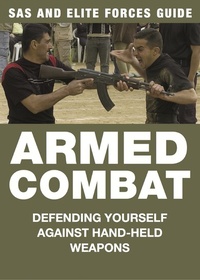
Armed Combat
Description

Presented in an easy to follow format, SAS and Elite Forces Guide Armed Combat is divided into separate chapters covering fighting skills mindset, what to attack and where to defend, blunt weapons, sharp and pointed weapons, firearms, unarmed techniques, training drills, and improvised techniques. The author also offers plenty of short, handy tips on key topics such as bayonet training, quick draw techniques, copying with injury and dirty tricks.
Written in easy-to-understand steps and accompanied with more than 150 black-and-white illustrations, SAS and Elite Forces Guide Armed Combat guides the reader through everything they need to know to overcome an armed aggressor in any hand-to-hand combat situation.
All prices
More details
Other editions
Additional editions
Person
Content
PART ONE: THE ESSENCE OF ARMED COMBAT
1. Fighting Skills and Mindset
2. What to Attack and Where to Defend
3. Weapon Threat versus Weapon Use
PART TWO: USING WEAPONS
4. Blunt Weapons
5. Sharp and Pointed Weapons
6. Firearms
7. Improvised and Miscellaneous Weapons
8. 'Unarmed' Techniques in Armed Combat
9. Weapon Training Drills
PART THREE: IN ACTION
10. Unarmed or Improvised Response
11. With Blunt Weapons
12. With Sharp or Pointed Weapons
13. Fighting with Guns
Final Notes
Glossary
Index
INTRODUCTION
We often hear that something is a 'dangerous weapon' but in truth that phrase is meaningless. A weapon is a weapon and nothing more. It can be used for good or ill, or not at all, but it needs a guiding intellect. In the hands of a pacifist, the most lethal implement is harmless. In the hands of a psychopath, a fairly innocuous object can kill. In the hands of a friend, a weapon is a source of reassurance. Similarly, anyone can kill with their bare hands or an improvised weapon if they try hard enough. It is us that make weapons dangerous, not the other way around.
Armed and Dangerous
This soldier is armed with a fully automatic carbine. As a backup he has a handgun and a knife, and probably a grenade or two as well. These are simply tools; what makes him dangerous - or not - is his willingness to use them and the choices he makes about when and how.
Humans today occupy a position right at the top of the food chain, but it was not always so. The natural weapons available to humans are fairly puny, and we are neither spectacularly fast nor powerful. True, human beings are agile, but this is more useful as a defensive trait, allowing us to escape predators by climbing into places that they cannot go. As a species we are best suited to hunting small game and gathering fruit and vegetables. As such, we rightfully occupy a place in the middle of the food chain, prey for some creatures and preying on others.
What changed that status was tool use. As well as being agile, humans are clever, and our species learned to improvise and later craft tools to assist in survival. Of those tools, arguably the most important were those falling into the subset we call weapons - tools intended to cause harm to other living things.
Armed with spear, club and crude hatchet, a lone primitive human was a match for creatures that otherwise would kill and eat him. With a bow, and as part of a similarly armed party, our primitive ancestor elevated himself to the status of apex predator, capable of bringing down the largest of land creatures. Firearms simply tipped the odds further in our favour.
Improvised Weapons
Almost any object can be pressed into service as a weapon, but stabbing and puncturing implements are perhaps the easiest to use of all.
Thus it is today that armed humans are the most dangerous creatures inhabiting planet Earth, and this creates a situation where the most serious threat is not a sabre-tooth tiger or wolf pack, but another human.
The weapons that made us masters of our world also make us a threat to one another. Fortunately, the same tools can be used to defend and protect as to attack and destroy. Weapons are tools, and, like all tools, how they are used very much depends on the user.
Types of Weapon
There are essentially three types of hand weapon, sometimes categorized as 'Pointed, Sharp, Blunt' or 'PSB'. Each has its own unique characteristics, influencing how it is used or defended against.
Sharp Weapons
Sharp or bladed weapons come in two general types: those that have enough mass to hack deep into flesh; and those with lighter or smaller blades, which need to move along the surface in order to cut.
Pointed weapons include all stabbing implements such as the tip of a knife or sword, a screwdriver or anything that can be driven into a target. Pointed weapons are potentially the most lethal of all hand weapons as they cause deep wounds that can reach vital organs or cause massive internal bleeding. Pointed weapons can be pushed into the target with little effort and do not need a big swing to be effective. Conversely, they are only dangerous along a straight line from the tip. Anything off this line is not in danger until the weapon is redirected.
Sharp weapons have a cutting edge, and must move in contact with the target in order to be effective. Such weapons include knives and swords, as well as improvised sharp-edged weapons such as broken bottles. A sharp weapon that is held immobile cannot cut, but conversely a slashing action can make contact with flesh at any point and cause injury; it is easier to deflect a stab than a cut.
Blunt instruments rely on impact to cause injury, using a combination of the weight and the force with which they are swung. A blunt weapon can be used to cause pain or force compliance by grinding it against a sensitive area of the body, such as a baton used to apply a restraint hold, but for the most part blunt weapons are swung (or sometimes thrust) to impact the target area, causing tissue trauma and breaking bones. An immobile blunt weapon, or one that there is little room to swing, is not a serious threat.
Blunt Instruments
Blunt instruments are easy to obtain. The most dangerous of them concentrate force at the striking point by their shape. This is what makes a hammer capable of inflicting serious wounds.
Telescopic Baton
Spring batons consist of sprung-steel sections contained within a metal handle. A flick of the wrist extends the baton, and it can be used to deliver stunning blows to joints or the side of the head.
Some weapons are a combination of these factors. For example an axe uses impact to cause injury, but concentrates the force of its blow using a sharp edge. Others use the principles in other ways. Projectile weapons (i.e. firearms) cause a penetrating injury much like a pointed weapon, but do so by a combination of the mass and high velocity of the bullet. A firearm at close range can be used as a fairly reasonable club, but can best be thought of as an extremely long pointed weapon - anything on a line from the barrel to the nearest solid object is in severe danger if the trigger is pulled, but a gun that is pointed elsewhere can cause little harm unless it is redirected.
Stopping Power vs Lethality
We often hear of the lethality of weapons - their ability to cause the target to die - but this is actually a lesser consideration to the soldier, police officer or civilian facing a desperate threat. What matters is stopping power, not necessarily killing power. Stopping power is the ability to 'stop' a target, i.e. to make him cease whatever he is doing and collapse. The concept is normally connected with firearms but can be applied to all weapons.
Sniper Team
A sniper team provides a good example of lethality versus stopping power. If the sniper shoots, it will be at fairly long range and the emphasis is normally on lethality. A target that can continue to act for a few moments is not normally a problem. If the security element must fire, the threat is close and must be stopped before the team can be endangered; killing the target is far less important than stopping him from shooting.
A target that is 'stopped' may or may not die, but in the immediate future he (or she) will not be able to act against the weapon's user or any other intended victim. For the soldier in combat, the lone police officer facing multiple assailants or the civilian under attack, this is what matters. An enemy who is out of the fight is out of the fight whether he dies then and there (or later) or makes a full recovery. An enemy who can continue to shoot or fight for a time, even if he will collapse and die eventually, is still a threat until he goes down.
Using a Taser
Tasers deliver a paralyzing electrical shock that instantly incapacitates the attacker. The operating switch on the device can be applied to deliver subsequent shocks.
Thus when choosing a weapon for close-range combat, military personnel and law enforcement officers prefer a weapon that will 'put down' an opponent over one that is more likely to kill, but not straight away. An assassin or a sniper might choose lethality over stopping power, but those who fight primarily at close range want the opponent downed or disabled and incapable of fighting on - anything else comes a long way second.
As a general rule, pointed weapons and firearms are the most likely to kill of all weapon types, with blunt instruments the least likely and blades somewhere in between. However, it is possible to kill with any weapon, whether this is intended or not. For this reason, knives are not ideal for civilian self-defence. It is very easy to kill someone outright with a knife, even if the intent was only to injure or frighten, and not all knife wounds kill straight away. Thus a knife suffers from the twin problems of being perhaps too lethal and not quick enough to disable an opponent. For self-defence, a blunt instrument is more likely to cause incapacitating injury without being lethal.
For soldiers in combat, this consideration is not as critical - the aim is to win the fight by whatever means, and killing the enemy is an integral part of warfare. A knife is an ideal tool for what amounts to assassination, such as taking out an enemy sentry quickly and quietly. It also makes a good, versatile fighting tool with many other applications, and is easy to carry. For this reason a knife is an essential part of a soldier's kit, but a police officer will normally carry a baton for situations where less lethality is desirable.
Generally speaking, a skilled and determined fighter armed with any weapon (or even none) is likely to be more effective than a frightened or half-hearted person equipped with an excellent weapon. Having said that, a weapon...
