

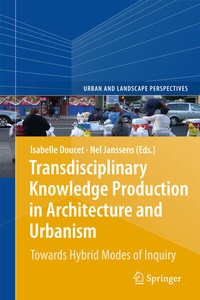
Transdisciplinary Knowledge Production in Architecture and Urbanism
Description

The volume addresses the hybridisation of knowledge production in space-related research. In contrast with interdisciplinary knowledge, which is primarily located in scholarly environments, transdisciplinary knowledge production entails a fusion of academic and non-academic knowledge, theory and practice, discipline and profession. Architecture (and urbanism), operating as both a discipline and a profession, seems to form a particularly receptive ground for transdisciplinary research. However, this specificity has not yet been developed into a full-fledged, unique mode of knowledge production.
In order to dedicate specific attention to transdisciplinary knowledge production, this book aims to explore (new) hybrid modes of inquiry that allow many of architecture's longstanding schisms to be overcome: such as between theory/history and practice, critical theory and projective design, the adoption of an external viewpoint and a view-from-within (often under the guise of bottom-up vs. top-down). It therefore offers the reader a mix of contributions that elaborate on knowledge production that is situated in the (architectural and urban) profession or practice, and on practice-based approaches in theory.
More details
Other editions
Additional editions
Content
1.1 - References [Seite 8]
2 - Contributors [Seite 9]
3 - Contents [Seite 14]
4 - 1 Editorial: Transdisciplinarity, the Hybridisation of Knowledge Production and Space-Related Research [Seite 15]
4.1 - 1.1 Defining Transdisciplinarity [Seite 16]
4.2 - 1.2 Introduction to the Chapters [Seite 19]
4.3 - 1.3 Conclusions Incitements (Agenda Setting) [Seite 23]
4.4 - Notes [Seite 26]
4.5 - Bibliography [Seite 27]
5 - 2 Getting over Architecture: Thinking, SurmountingINTbreak [Seite 29]
5.1 - 2.1 The Collective Moment, the Unsustainable and the Practice of Architecture [Seite 31]
5.2 - 2.2 Architecture Now and Then [Seite 32]
5.2.1 - 2.2.1 Sustainability Sustaining the Unsustainable [Seite 33]
5.2.2 - 2.2.2 Technics and Design After the Subject (Designer) [Seite 35]
5.3 - 2.3 Redesigning the Self, the Practice and Its Pro-duct [Seite 37]
5.4 - 2.4 Post-disciplinary Thought and Redirective Action: Three Examples [Seite 39]
5.4.1 - 2.4.1 Metrofitting [Seite 39]
5.4.2 - 2.4.2 Moving Cities [Seite 40]
5.4.3 - 2.4.3 Rapid Cities [Seite 42]
5.5 - 2.5 Conclusions: Architectural and Design History and Theory [Seite 43]
5.6 - Notes [Seite 44]
5.7 - Bibliography [Seite 45]
6 - 3 Implementing Transdisciplinarity: Architecture andINTtie [Seite 47]
6.1 - 3.1 Introduction [Seite 47]
6.2 - 3.2 Defining Transdisciplinarity [Seite 49]
6.3 - 3.3 Architecture and Urban Planning as Undisciplined Disciplines [Seite 49]
6.3.1 - 3.3.1 The Case of Urban Planning [Seite 50]
6.3.2 - 3.3.2 The Case of Architecture [Seite 52]
6.3.3 - 3.3.3 Narrowing the Gap Between Research and Practice [Seite 53]
6.4 - 3.4 Bringing Architects, Planners and Social Scientists to Work Together: The Case of GIRBa [Seite 54]
6.4.1 - 3.4.1 A Context to Narrow the Gap Between Research and Practice [Seite 55]
6.4.2 - 3.4.2 A Research and Action Programme on Suburbs and Urban Sprawl [Seite 57]
6.4.3 - 3.4.3 The Limitations and Strengths of Operating Within Academia [Seite 60]
6.5 - 3.5 Conclusions [Seite 61]
6.6 - Notes [Seite 62]
6.7 - Bibliography [Seite 62]
7 - 4 MODERN 2.0 -- Post-criticality and Transdisciplinarity [Seite 64]
7.1 - Preface [Seite 65]
7.2 - Notes [Seite 75]
8 - 5 Transdisciplinarity and New Paradigm Research [Seite 76]
8.1 - 5.1 Setting the Scene [Seite 76]
8.2 - 5.2 Disciplines and Cultures of Knowledge [Seite 78]
8.3 - 5.3 Architectural Practice and Architectural Research [Seite 83]
8.4 - 5.4 Considering Architectural Research as Transdisciplinary [Seite 87]
8.5 - 5.5 Taking a New Perspective [Seite 89]
8.6 - Notes [Seite 90]
8.7 - Bibliography [Seite 91]
9 - 6 Building (Trans)Disciplinary Architectural Research Introducing Mode 1 and Mode 2 to Design Practitioners [Seite 92]
9.1 - 6.1 Preamble [Seite 92]
9.2 - 6.2 Patchwork Quilts of Knowledges and Doctoral Scholarship in Architecture and Design [Seite 94]
9.2.1 - 6.2.1 The Mid-1970s Until the Beginning of the 1990s [Seite 94]
9.2.2 - 6.2.2 The 1990s and the Turn of the Millennium [Seite 97]
9.2.3 - 6.2.3 Mode 1 and Mode 2 of Knowledge Production with Regard to Architectural and Design Scholarship [Seite 100]
9.3 - 6.3 Mode 1 and/or Mode 2 for Future Doctoral Scholarship in Architecture and Design? [Seite 104]
9.4 - Notes [Seite 106]
9.5 - Bibliography [Seite 106]
10 - 7 Discard an Axiom [Seite 110]
10.1 - Prelude. [Seite 111]
10.2 - Games of Chance. [Seite 111]
10.3 - Proposition. [Seite 112]
10.4 - Architecture Object. [Seite 112]
10.5 - Soft and Hard. [Seite 113]
10.6 - On Teaching. [Seite 114]
10.7 - On Finding Soft Space. [Seite 114]
10.8 - On Teaching. [Seite 116]
10.9 - On Rules. [Seite 116]
10.10 - Delight. [Seite 116]
10.11 - Tension. [Seite 116]
10.12 - The Internal View of the Architect. [Seite 118]
10.13 - The Framing of Practice. [Seite 118]
10.14 - SoftPraxis. [Seite 119]
10.15 - On the Production of Space. [Seite 120]
10.16 - Games of Chance. [Seite 122]
10.17 - Fragility/Failure. [Seite 122]
10.18 - On Collaboration. [Seite 123]
10.19 - On Wasting Time. [Seite 124]
10.20 - Addendum. [Seite 126]
10.21 - Notes [Seite 127]
10.22 - Bibliography [Seite 127]
11 - 8 From Reflecting-in-Action Towards Mapping of the Real [Seite 129]
11.1 - 8.1 Two Types of Enquiry [Seite 130]
11.2 - 8.2 What Is a Controversy? What Is Mapping Controversies? [Seite 133]
11.3 - 8.3 From Reflecting-in-Action Towards Mapping of the Real [Seite 138]
11.4 - Notes [Seite 139]
11.5 - Bibliography [Seite 140]
12 - Name Index [Seite 141]
13 - Subject Index [Seite 143]
