

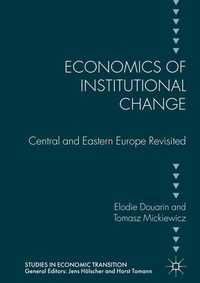
Economics of Institutional Change
Central and Eastern Europe Revisited
3rd Edition
Published on 24. October 2017
XIX, 319 pages
978-3-319-65474-4 (ISBN)
Description

This book, a third edition, has been significantly expanded and updated. It revisits the process of institutional change: its characteristics, determinants and implications for economic performance. New chapters address the significance of Post-Communist transition, the differences and importance of initial conditions in institutional building, and, social norms, values, and happiness. Other chapters have been expanded to include, for example, a focus on the Washington consensus, commentary on the 2008 financial crisis, state capacity and corruption, and new findings on redistribution and inequality.
With specific focus on Central Europe, Eastern Europe and Central Asia, this revised edition examines the process of development, and its interdependence with institutions.
With specific focus on Central Europe, Eastern Europe and Central Asia, this revised edition examines the process of development, and its interdependence with institutions.
More details
Series
Edition
3rd ed. 2017
Language
English
Place of publication
Cham
Switzerland
Publishing group
Springer International Publishing
Target group
Professional and scholarly
Product notice
Reflowable
Illustrations
XIX, 319 p. 36 illus., 24 illus. in color.
File size
4,26 MB
ISBN-13
978-3-319-65474-4 (9783319654744)
DOI
10.1007/978-0-230-29128-7
Schweitzer Classification
Other editions
Additional editions
Elodie Douarin | Tomasz Mickiewicz
Economics of Institutional Change
Central and Eastern Europe Revisited
Book
11/2017
3rd Edition
Palgrave Macmillan
€128.39
Shipment within 10-15 days
Persons
Professor Tomasz Mickiewicz
is a professor of Economics, and Head of the Economics, Finance and Entrepreneurship Group at Aston University, UK. He teaches on emerging and transitional economics, and his research interests include comparative entrepreneurship, social entrepreneurship, high growth aspiration entrepreneurship, informal economy, tax avoidance; foreign direct investment, and the applications of institutional theory to both entrepreneurship and international business. He has has published numerous journal papers and book chapters, and is currently Associate Editor of the journal
Regional Studies.
Dr Elodie Douarin is Lecturer in Economics and is the Admissions Tutor for Economics and Business programmes at the School of Slavonic and East European Studies (SSEES), University College London, UK. She is a Development Economist with broad research interests and is currently working on the causes and consequences of conflict, aspects of political participation, migration and subjective wellbeing. She teaches on emerging markets, microeconomics, migration and health, development economics, and public choice.
Dr Elodie Douarin is Lecturer in Economics and is the Admissions Tutor for Economics and Business programmes at the School of Slavonic and East European Studies (SSEES), University College London, UK. She is a Development Economist with broad research interests and is currently working on the causes and consequences of conflict, aspects of political participation, migration and subjective wellbeing. She teaches on emerging markets, microeconomics, migration and health, development economics, and public choice.
Content
Introduction.- Chapter 1: Transition away from the Command Economy in Central and Eastern Europe and the Former Soviet Union - An Overview.- Chapter 2: The Soviet System.- Chapter 3: Institutions; Institutional Reform.- Chapter 4: Political Economy of Reforms.- Chapter 5: Stabilisation.- Chapter 6: Outcomes of Reforms. Growth.- Chapter 7: Privatisation: Speed, Efficiency, and Effects on Wealth Distribution.- Chapter 8: Unemployment and Labour Market Policies.- Chapter 9: Financial Liberalisation.- Chapter 10: Public Finance.- Chapter 11: Transition and Institutional Change.- Chapter 12: Back to "Normality"?.
