

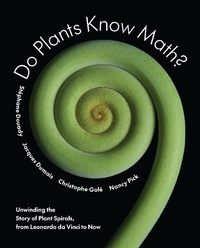
Do Plants Know Math?
Unwinding the Story of Plant Spirals, from Leonardo da Vinci to Now
1st Edition
Published on 5. September 2024
352 pages
978-0-691-26108-9 (ISBN)
Description

A breathtakingly illustrated look at botanical spirals and the scientists who puzzled over them
Charles Darwin was driven to distraction by plant spirals, growing so exasperated that he once begged a friend to explain the mystery "if you wish to save me from a miserable death." The legendary naturalist was hardly alone in feeling tormented by these patterns. Plant spirals captured the gaze of Leonardo da Vinci and became Alan Turing's final obsession. This book tells the stories of the physicists, mathematicians, and biologists who found themselves magnetically drawn to Fibonacci spirals in plants, seeking an answer to why these beautiful and seductive patterns occur in botanical forms as diverse as pine cones, cabbages, and sunflowers.
Do Plants Know Math? takes you down through the centuries to explore how great minds have been captivated and mystified by Fibonacci patterns in nature. It presents a powerful new geometrical solution, little known outside of scientific circles, that sheds light on why regular and irregular spiral patterns occur. Along the way, the book discusses related plant geometries such as fractals and the fascinating way that leaves are folded inside of buds. Your neurons will crackle as you begin to see the connections. This book will inspire you to look at botanical patterns-and the natural world itself-with new eyes.
Featuring hundreds of gorgeous color images, Do Plants Know Math? includes a dozen creative hands-on activities and even spiral-plant recipes, encouraging readers to explore and celebrate these beguiling patterns for themselves.
Charles Darwin was driven to distraction by plant spirals, growing so exasperated that he once begged a friend to explain the mystery "if you wish to save me from a miserable death." The legendary naturalist was hardly alone in feeling tormented by these patterns. Plant spirals captured the gaze of Leonardo da Vinci and became Alan Turing's final obsession. This book tells the stories of the physicists, mathematicians, and biologists who found themselves magnetically drawn to Fibonacci spirals in plants, seeking an answer to why these beautiful and seductive patterns occur in botanical forms as diverse as pine cones, cabbages, and sunflowers.
Do Plants Know Math? takes you down through the centuries to explore how great minds have been captivated and mystified by Fibonacci patterns in nature. It presents a powerful new geometrical solution, little known outside of scientific circles, that sheds light on why regular and irregular spiral patterns occur. Along the way, the book discusses related plant geometries such as fractals and the fascinating way that leaves are folded inside of buds. Your neurons will crackle as you begin to see the connections. This book will inspire you to look at botanical patterns-and the natural world itself-with new eyes.
Featuring hundreds of gorgeous color images, Do Plants Know Math? includes a dozen creative hands-on activities and even spiral-plant recipes, encouraging readers to explore and celebrate these beguiling patterns for themselves.
More details
Other editions
Additional editions
Stephane Douady | Jacques Dumais | Christophe Gole
Do Plants Know Math?
Unwinding the Story of Plant Spirals, from Leonardo da Vinci to Now
Book
09/2024
Princeton University Press
€27.50
Available immediately
Persons
Stéphane Douady, who has researched plant patterns for thirty years, is a silver medalist CNRS director of research in the Matière et Systèmes Complexes laboratory at Paris Cité University. Jacques Dumais works on plant-inspired technologies as a professor in the Faculty of Engineering and Science at Universidad Adolfo Ibáñez in Chile. Christophe Golé runs the Plant Math Lab at Smith College, where he is a professor of mathematics. Nancy Pick is a science writer whose books include The Rarest of the Rare, telling the stories behind the natural history collections at Harvard University.
Content
- Cover
- Contents
- Preface
- Introduction
- Part I. Who Noticed First?
- Chapter 1. The (So-Called) Fibonacci Sequence in History
- Chapter 2. Plant Patterns in Leonardo's Notebook
- Chapter 3. The Golden Ratio as a New Year's Gift
- Part II. Could Early Scientists Explain Plant Spirals?
- Chapter 4. First Spirals in the Dew
- Chapter 5. Biomathematics on a Watch Face
- Chapter 6. So Many Spirals on a Pinecone
- Chapter 7. Irrational Angles in a French Garden
- Part III. What Did the Microscope Reveal?
- Chapter 8. A Glimpse of the Growing Tip
- Chapter 9. Biomechanics under the Lens
- Chapter 10. A Critical Tree on Graph Paper
- Part IV. Have Computers Shed Any Light?
- Chapter 11. Sunflowers on Turing's Primitive Computer
- Chapter 12. Leaves and Petals as Data Points
- Chapter 13. The Big Experiment with Tiny Droplets
- Chapter 14. Zigzag Fronts in an Artichoke
- Chapter 15. Self-Repeating Patterns in Plants (Perhaps?)
- Chapter 16. Leaf Bud Kirigami
- Part V. What Do Biologists Think?
- Chapter 17. The Hormone That Makes Spirals
- Chapter 18. A Cell Division Discovery via Soap Bubbles
- Chapter 19. A Brief Detour to Animals
- Part VI. Conclusion
- Chapter 20. Do Plants Know Math?
- Chapter 21. A Spiral Dinner (with Recipes)
- Appendix
- Notes
- Illustration Credits
- Acknowledgents
- Index
