

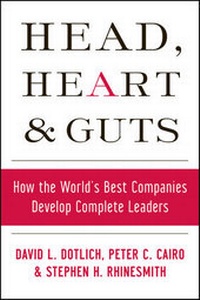
Head, Heart and Guts
How the World's Best Companies Develop Complete Leaders
Published on 27. September 2010
240 pages
978-0-470-73060-7 (ISBN)
Description

This book reveals the three most important capabilities leaders must demonstrate today: the ability to set strategy, empathize with others, and take risks--all at the same time. In Head, Heart, and Guts, leadership experts David Dotlich, Peter Cairo, and Stephen Rhinesmith--who teach and coach CEOs and executive teams throughout the world--argue that to be successful in a complex, matrixed, fast-moving world, "whole" leaders must set strategy, develop trusting relationships with others, and consistently do the right thing based on personal values. "Partial" leaders, often the product of traditional executive programs, may be successful in the shortrun, but their companies lose over time. Filled with case studies of companies such as Bank of America, Johnson & Johnson, Novartis, and UBS, Head, Heart, and Guts, lays out specific steps and actions for leaders who want to grow beyond their "leadership comfort zone" and an action plan for companies that want to move beyond tried-and-true leadership development in order to develop "whole" leaders throughout their leadership pipeline.
Reviews / Votes
"balanced, progressive view of leadership." (CPO Agenda, September 2006)More details
Other editions
Additional editions
David L. Dotlich | Peter C. Cairo | Stephen Rhinesmith
Head, Heart and Guts
How the World's Best Companies Develop Complete Leaders
Book
06/2006
Jossey-Bass
€30.50
Shipment within 10-20 days
Persons
David L. Dotlich is president of Mercer Delta ExecutiveLearning Center (formerly CDR International). He is formerexecutive vice president of Honeywell International.
Peter C. Cairo is head of executive programs andleadership strategy for Mercer Delta Executive Learning Center andformer chairman of the Department of Counseling and OrganizationalPsychology at Columbia University.
Stephen H. Rhinesmith is a partner of Mercer DeltaExecutive Learning Center. He is former special ambassador to theSoviet Union and was president of Holland America Line.
Content
Introduction.
Part One: The Case for Whole Leadership.
1. Whole Leadership Versus Partial Leadership.
2. Developing Leaders the Systemic, Integrated Way.
Part Two: Head Leadership.
3. Rethinking the Way We Do Things Around Here.
4. Reframing the Boundaries.
5. Getting Things Done.
6. Developing and Articulating a Point of View.
Part Three: Heart Leadership.
7. Balancing People Needs with Business Requirements: TouchingAll the Bases.
8. Delivering Integrated Solutions Through Trust.
9. Working with and Leading People from Diverse Cultures:Developing True Empathy.
10. Overcoming Personal Derailers in Working with Others.
Part Four: Guts Leadership.
11. Taking Risks with Little or No Data.
12. Balancing Risk and Reward.
13. Acting with Unyielding Integrity.
Part Five: Mature Leadership.
14. Developing Mature Leaders for the Twenty-First Century.
References.
About the Authors.
Index.
1 WHOLE LEADERSHIP VERSUS PARTIAL LEADERSHIP
To be a leader in today's business environment, you need to use your head, demonstrate heart, and act with guts. This is not an unrealistic objective, in that most people are fully capable of exhibiting all three qualities in given situations. Unfortunately, the majority of executives have either come to rely on one capacity or they live in organizational systems that do not reward or reinforce them to develop others. They remain partial leaders, even when their organizations require whole ones. Why this is so is a combination of history and training. Historically, business leaders have led with their heads-the notion being that if you analyze a situation, absorb the data, and decide among rational alternatives, you can be a strong leader. Generations of MBAs have been trained using these traditional tools. It is not surprising, therefore, that CEOs often have been selected because they are the smartest people in the room. Organizations choose great thinkers as leaders in the same way that patients choose great diagnosticians as doctors; in both cases, little emphasis is given to bedside manner. Business school executive programs have reinforced the emphasis on cognitive leaders by focusing on case histories and the mastery of strategic and analytical competencies. As important as the head is to leadership, it is insufficient for the demands leaders face today. The inability to exhibit compassion and display character, for instance, alienates many employees and causes them to disengage, sometimes executing a great strategy but in an uninspired way that lacks creativity and fails to generate commitment. The lack of guts may mean that a leader cannot make tough but necessary decisions regarding everything from people to product lines, which inadvertently creates a culture that is rife with indecision and lacks energy and passion. Despite the fact that most organizations continue to emphasize the head over heart and guts, we have known for a long time that effective leaders need more than a quick mind and strong analytics. Research over the past several decades has shown this time and time again. In the nineties psychologist Bob Hogan reviewed all of the leadership research to date and concluded that personal characteristics have a strong connection to leadership effectiveness (Hogan, Curphy, & Hogan, 1994). Among the qualities that distinguish the best leaders from others are emotional maturity, the capacity to create trust, and the flexibility to work with a range of different types of people. In other words, the best leaders have heart, in addition to their other strengths. Effective leaders show tenacity, persistence, and the ability to overcome obstacles that get in their way-what we would refer to as guts. Here are some of the other things we know from the study of leadership: Ask people what they want in their leaders, and they come up with words like intelligence, honesty, determination, and aggressiveness, as well as the ability to get along with people-qualities that fall neatly into our view of head, heart, and guts. The way people are perceived as leaders relates not only to how smart they are but to other qualities as well. People are more likely to be perceived as leaders if they have the right combination of what we're calling head, heart, and guts. Leaders are more likely to derail if they are untrustworthy, overcontrolling, and unwilling to make tough people and business decisions, and if they tend to micromanage their people. In other words, people without head, heart, and guts have a greater likelihood of derailing than those who do have these qualities. So the idea that leaders must be able to reach beyond their cognitive ability to demonstrate other capabilities is well documented, even if it isn't practiced as frequently as it should be. Of course, a leader who relies primarily on heart or guts is equally ineffective. Most people who achieve senior-level leadership positions in business today, however, are head-oriented individuals; the heart- or guts-oriented managers tend to be stigmatized or eliminated before they make it to a top position, or they are relegated to a function best-suited to their orientation (that is, heart leaders historically have been shuttled off to staff or HR positions in "support" roles). Integrating head, heart, and guts into leadership is both art and science. Later, we will look at what this integration entails, but first we would like to make the case for why whole leadership is so critical today.
We have seen a surprisingly large number of very smart and extremely savvy CEOs fail spectacularly in recent years. Dirk Jagger at Procter & Gamble, Mike Miles at Philip Morris, and Phil Purcell at Morgan Stanley were all extremely intelligent, smart individuals. (And they were honest ones.) Though some of their failures resulted from events beyond their control, many can be traced back to the CEOs' singled-minded approach to leadership. As driven and determined as they were, their lack of empathy, courage, instinct, and willingness to acknowledge their own vulnerability derailed them and, in some cases, their organizations. In the past, they most likely would not have derailed. Until relatively recently, partial leaders could not only survive; they could thrive. Before world markets became more transparent, virtual, and volatile, one-dimensional leadership often sufficed. It was not unusual to find senior executives who ran companies through command and control. Conservative CEOs who eschewed risk were more the rule than the exception, and leaders who empathized and emoted were deemed "soft." Things have changed. Specifically, some of the drivers of the change to whole leadership that we have observed are:
In an article titled, "The Upwardly Global MBA," Nigel Andrews and Laura D'Andrea Tyson report the results of a survey of one hundred global leaders about what young executives need to succeed today. Andrews is a governor and Tyson is the dean of the London Business School, and their survey was prompted by their concern that they were not teaching MBAs what they needed to learn in order to be effective in a global marketplace. According to survey results, their concern was justified. Global executives believed that their focus on content-on teaching students what they needed to know-was insufficient. Andrews and Tyson reported that future global leaders will also need what they term "skills and attributes" as well as knowledge. These skills and attributes include the skills of giving feedback, listening, and observing. Global companies need leaders and managers who thrive on change and whose actions reflect the highest level of integrity (attributes). Many of the qualities they describe translate into heart and guts, as well as a "broader-minded" head. Their insights apply, especially when you consider the implications of running or working in a global enterprise. First, an interpersonal orientation toward business is prevalent in most countries outside the United States. The character and personality of leaders count for as much as the products and services they sell. If you do business with other countries, you must display certain qualities (respect, humility, trust) that leaders of foreign companies unconsciously expect and value. Heart, therefore, is a critical attribute. Second, if you are operating globally, the risks are naturally greater than if you are a domestic organization. The complexity and ambiguity involved in international transactions or working in a different culture are significant, and they require making decisions without the usual degree of certainty that they are the right ones experienced in a familiar home environment. The best global leaders are comfortable operating in an ambiguous environment, able to make risks pay off, based as much on their instinct and relationships as their analytical skills. The volatility of social, economic, and political conditions in a global marketplace demands leaders who can live with and even capitalize on this volatility. Leaders who become risk-averse in the face of uncertainty and changing conditions do not make effective global leaders. Third, the global senior leader cannot be focused just on technical issues operations and strategy. People in leadership positions with global companies fail when they are limited to their areas of specialization. When American business executives dine with European leaders, for instance, their point of view and understanding must not only be informed on business issues, but encompass social, political, and economic trends as well. These leaders must also be open-minded and able to appreciate diverse cultural values and patterns of behavior.
A widely held myth is that people who "get things done" in organizations operate primarily out of their heads, that they are no-nonsense, hard-driving automatons who drive and measure everything in order to achieve stellar results. Although execution does require drive and focus, Larry Bossidy and Ram Charan have provided ample evidence that execution also involves strong people skills and a willingness to roll the dice. In their books, Execution and Confronting Reality, they make it clear that emotional intelligence plays a significant role in getting things done, that the ability to encourage others to...
To be a leader in today's business environment, you need to use your head, demonstrate heart, and act with guts. This is not an unrealistic objective, in that most people are fully capable of exhibiting all three qualities in given situations. Unfortunately, the majority of executives have either come to rely on one capacity or they live in organizational systems that do not reward or reinforce them to develop others. They remain partial leaders, even when their organizations require whole ones. Why this is so is a combination of history and training. Historically, business leaders have led with their heads-the notion being that if you analyze a situation, absorb the data, and decide among rational alternatives, you can be a strong leader. Generations of MBAs have been trained using these traditional tools. It is not surprising, therefore, that CEOs often have been selected because they are the smartest people in the room. Organizations choose great thinkers as leaders in the same way that patients choose great diagnosticians as doctors; in both cases, little emphasis is given to bedside manner. Business school executive programs have reinforced the emphasis on cognitive leaders by focusing on case histories and the mastery of strategic and analytical competencies. As important as the head is to leadership, it is insufficient for the demands leaders face today. The inability to exhibit compassion and display character, for instance, alienates many employees and causes them to disengage, sometimes executing a great strategy but in an uninspired way that lacks creativity and fails to generate commitment. The lack of guts may mean that a leader cannot make tough but necessary decisions regarding everything from people to product lines, which inadvertently creates a culture that is rife with indecision and lacks energy and passion. Despite the fact that most organizations continue to emphasize the head over heart and guts, we have known for a long time that effective leaders need more than a quick mind and strong analytics. Research over the past several decades has shown this time and time again. In the nineties psychologist Bob Hogan reviewed all of the leadership research to date and concluded that personal characteristics have a strong connection to leadership effectiveness (Hogan, Curphy, & Hogan, 1994). Among the qualities that distinguish the best leaders from others are emotional maturity, the capacity to create trust, and the flexibility to work with a range of different types of people. In other words, the best leaders have heart, in addition to their other strengths. Effective leaders show tenacity, persistence, and the ability to overcome obstacles that get in their way-what we would refer to as guts. Here are some of the other things we know from the study of leadership: Ask people what they want in their leaders, and they come up with words like intelligence, honesty, determination, and aggressiveness, as well as the ability to get along with people-qualities that fall neatly into our view of head, heart, and guts. The way people are perceived as leaders relates not only to how smart they are but to other qualities as well. People are more likely to be perceived as leaders if they have the right combination of what we're calling head, heart, and guts. Leaders are more likely to derail if they are untrustworthy, overcontrolling, and unwilling to make tough people and business decisions, and if they tend to micromanage their people. In other words, people without head, heart, and guts have a greater likelihood of derailing than those who do have these qualities. So the idea that leaders must be able to reach beyond their cognitive ability to demonstrate other capabilities is well documented, even if it isn't practiced as frequently as it should be. Of course, a leader who relies primarily on heart or guts is equally ineffective. Most people who achieve senior-level leadership positions in business today, however, are head-oriented individuals; the heart- or guts-oriented managers tend to be stigmatized or eliminated before they make it to a top position, or they are relegated to a function best-suited to their orientation (that is, heart leaders historically have been shuttled off to staff or HR positions in "support" roles). Integrating head, heart, and guts into leadership is both art and science. Later, we will look at what this integration entails, but first we would like to make the case for why whole leadership is so critical today.
Factors Driving This Leadership Trend
We have seen a surprisingly large number of very smart and extremely savvy CEOs fail spectacularly in recent years. Dirk Jagger at Procter & Gamble, Mike Miles at Philip Morris, and Phil Purcell at Morgan Stanley were all extremely intelligent, smart individuals. (And they were honest ones.) Though some of their failures resulted from events beyond their control, many can be traced back to the CEOs' singled-minded approach to leadership. As driven and determined as they were, their lack of empathy, courage, instinct, and willingness to acknowledge their own vulnerability derailed them and, in some cases, their organizations. In the past, they most likely would not have derailed. Until relatively recently, partial leaders could not only survive; they could thrive. Before world markets became more transparent, virtual, and volatile, one-dimensional leadership often sufficed. It was not unusual to find senior executives who ran companies through command and control. Conservative CEOs who eschewed risk were more the rule than the exception, and leaders who empathized and emoted were deemed "soft." Things have changed. Specifically, some of the drivers of the change to whole leadership that we have observed are:
Global Interdependence
In an article titled, "The Upwardly Global MBA," Nigel Andrews and Laura D'Andrea Tyson report the results of a survey of one hundred global leaders about what young executives need to succeed today. Andrews is a governor and Tyson is the dean of the London Business School, and their survey was prompted by their concern that they were not teaching MBAs what they needed to learn in order to be effective in a global marketplace. According to survey results, their concern was justified. Global executives believed that their focus on content-on teaching students what they needed to know-was insufficient. Andrews and Tyson reported that future global leaders will also need what they term "skills and attributes" as well as knowledge. These skills and attributes include the skills of giving feedback, listening, and observing. Global companies need leaders and managers who thrive on change and whose actions reflect the highest level of integrity (attributes). Many of the qualities they describe translate into heart and guts, as well as a "broader-minded" head. Their insights apply, especially when you consider the implications of running or working in a global enterprise. First, an interpersonal orientation toward business is prevalent in most countries outside the United States. The character and personality of leaders count for as much as the products and services they sell. If you do business with other countries, you must display certain qualities (respect, humility, trust) that leaders of foreign companies unconsciously expect and value. Heart, therefore, is a critical attribute. Second, if you are operating globally, the risks are naturally greater than if you are a domestic organization. The complexity and ambiguity involved in international transactions or working in a different culture are significant, and they require making decisions without the usual degree of certainty that they are the right ones experienced in a familiar home environment. The best global leaders are comfortable operating in an ambiguous environment, able to make risks pay off, based as much on their instinct and relationships as their analytical skills. The volatility of social, economic, and political conditions in a global marketplace demands leaders who can live with and even capitalize on this volatility. Leaders who become risk-averse in the face of uncertainty and changing conditions do not make effective global leaders. Third, the global senior leader cannot be focused just on technical issues operations and strategy. People in leadership positions with global companies fail when they are limited to their areas of specialization. When American business executives dine with European leaders, for instance, their point of view and understanding must not only be informed on business issues, but encompass social, political, and economic trends as well. These leaders must also be open-minded and able to appreciate diverse cultural values and patterns of behavior.
Increased Complexity of Execution
A widely held myth is that people who "get things done" in organizations operate primarily out of their heads, that they are no-nonsense, hard-driving automatons who drive and measure everything in order to achieve stellar results. Although execution does require drive and focus, Larry Bossidy and Ram Charan have provided ample evidence that execution also involves strong people skills and a willingness to roll the dice. In their books, Execution and Confronting Reality, they make it clear that emotional intelligence plays a significant role in getting things done, that the ability to encourage others to...
