

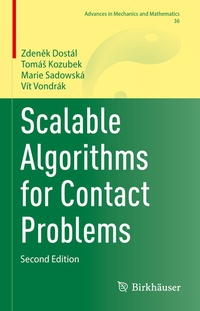
Scalable Algorithms for Contact Problems
2nd Edition
Published on 28. October 2023
XXII, 443 pages
978-3-031-33580-8 (ISBN)
Description

This book presents a comprehensive treatment of recently developed scalable algorithms for solving multibody contact problems of linear elasticity. The brand-new feature of these algorithms is their theoretically supported numerical scalability (i.e., asymptotically linear complexity) and parallel scalability demonstrated in solving problems discretized by billions of degrees of freedom. The theory covers solving multibody frictionless contact problems, contact problems with possibly orthotropic Tresca's friction, and transient contact problems. In addition, it also covers BEM discretization, treating jumping coefficients, floating bodies, mortar non-penetration conditions, etc.
This second edition includes updated content, including a new chapter on hybrid domain decomposition methods for huge contact problems. Furthermore, new sections describe the latest algorithm improvements, e.g., the fast reconstruction of displacements, the adaptive reorthogonalization of dual constraints, and an updated chapter on parallel implementation. Several chapters are extended to give an independent exposition of classical bounds on the spectrum of mass and dual stiffness matrices, a benchmark for Coulomb orthotropic friction, details of discretization, etc.
The exposition is divided into four parts, the first of which reviews auxiliary linear algebra, optimization, and analysis. The most important algorithms and optimality results are presented in the third chapter. The presentation includes continuous formulation, discretization, domain decomposition, optimality results, and numerical experiments. The final part contains extensions to contact shape optimization, plasticity, and HPC implementation. Graduate students and researchers in mechanical engineering, computational engineering, and applied mathematics will find this book of great value and interest.
This second edition includes updated content, including a new chapter on hybrid domain decomposition methods for huge contact problems. Furthermore, new sections describe the latest algorithm improvements, e.g., the fast reconstruction of displacements, the adaptive reorthogonalization of dual constraints, and an updated chapter on parallel implementation. Several chapters are extended to give an independent exposition of classical bounds on the spectrum of mass and dual stiffness matrices, a benchmark for Coulomb orthotropic friction, details of discretization, etc.
The exposition is divided into four parts, the first of which reviews auxiliary linear algebra, optimization, and analysis. The most important algorithms and optimality results are presented in the third chapter. The presentation includes continuous formulation, discretization, domain decomposition, optimality results, and numerical experiments. The final part contains extensions to contact shape optimization, plasticity, and HPC implementation. Graduate students and researchers in mechanical engineering, computational engineering, and applied mathematics will find this book of great value and interest.
More details
Series
Edition
Second Edition 2023
Language
English
Place of publication
Cham
Switzerland
Publishing group
Springer International Publishing
Target group
Primary & secondary/elementary & high school
Product notice
Reflowable
Illustrations
XXII, 443 p. 104 illus., 29 illus. in color.
File size
18,71 MB
ISBN-13
978-3-031-33580-8 (9783031335808)
DOI
10.1007/978-3-031-33580-8
Schweitzer Classification
Other editions
Additional editions
Zdenek Dostál | Tomás Kozubek | Marie Sadowská
Scalable Algorithms for Contact Problems
Book
10/2023
2nd Edition
Springer
€171.19
Shipment within 15-20 days
Persons
Zdenek Dostál
is a professor at the Department of Applied Mathematics and Senior Researcher at IT4Innovations National Supercomputing Center, VSB-Technical University of Ostrava. Zdenek works in Numerical Linear Algebra, Optimization, and Computational Mechanics. He published his results in more than 120 papers (Scopus). He is an author of the book 'Optimal Quadratic Programming Algorithms' (Springer 2009) and coauthor of 'Scalable Algorithms for Contact Problems' (Springer 2017) on massively parallel algorithms with theoretically supported linear (optimal) complexity. His current research concerns QP, QCQP, and generalization of the above results to H-TFETI and H-TBETI.
Tomás Kozubek is a professor of applied mathematics at IT4Innovations National Supercomputing Center, VSB-Technical University of Ostrava, specialising in developing scalable algorithms for massively parallel solutions ofengineering problems. He is a scientific director at IT4Innovations. He is also the author or coauthor of over 60 articles (concerning WoS) published in conference proceedings and journals. He is/was PI for the Czech Republic of the project FP7-ICT EXA2CT (Exascale Algorithms and Advanced Computational Techniques), H2020-MSCA-ITN EXPERTISE (models, Experiments and high PERformance computing for Turbine mechanical Integrity and Structural dynamics in Europe), H2020-JTI-EuroHPC Hercules (Hpc EuRopean ConsortiUm Leading Education activitieS), and ERASMUS+ SCTrain. He participates in activities of the H2020 Centre of Excellence in HPC project SPACE focused on computational astrophysics, and the European Digital Innovation Hub Ostrava focused on supporting industry and public organisations in HPC, artificial intelligence, and advanced data analysis. He is a guarantor of the doctoral study programme Computational Sciences at VSB-Technical University of Ostrava, a member of university scientific boards and programming committees of conferences, and a leading organiser of the HPCSE (HPC in Science and Engineering Conference). He is also the primary coordinator of the national Doctoral School for Education in Mathematical Methods and Tools in HPC.
Marie Sadowská works as an assistant professor at the Department of Applied Mathematics, closely cooperating with IT4Innovations National Supercomputing Center, both at VSB-Technical University of Ostrava. She has been interested in boundary element methods in combination with domain decomposition approaches with applications to computational mechanics.
Vít Vondrák has been working at VSB-Technical University of Ostrava since 1993, with the longest period spent at the Department of Applied Mathematics at the Faculty of Electrical Engineering and Computer Science, where he received the title of associate professor in 2007. His professional focus is on numerical linear algebra, optimisation methods including design optimisation, domain decomposition methods, highperformance computing and their applications in structural mechanics, biomechanics, hydrological and traffic simulations. From 1997 to 2007, he spent 2 years at Aalborg University, Denmark, as part of several research stays, and in 2004 and 2006, he stayed in the USA at the University of Colorado at Boulder and Stanford University, California. He was one of the founders of IT4Innovations National Supercomputing Center in the Czech Republic, of which he has been the Managing Director since 2017. As part of his scientific career, he has led or participated in leading a number of research projects, including international EU projects. He was the principal investigator of the Intel Parallel Computing Centre funded by Intel corp., the CzeBaCCA project for cooperation between the Czech Republic and Bavaria in the field of supercomputing applications, and the project to support large infrastructures in the Czech Republic.
Tomás Kozubek is a professor of applied mathematics at IT4Innovations National Supercomputing Center, VSB-Technical University of Ostrava, specialising in developing scalable algorithms for massively parallel solutions ofengineering problems. He is a scientific director at IT4Innovations. He is also the author or coauthor of over 60 articles (concerning WoS) published in conference proceedings and journals. He is/was PI for the Czech Republic of the project FP7-ICT EXA2CT (Exascale Algorithms and Advanced Computational Techniques), H2020-MSCA-ITN EXPERTISE (models, Experiments and high PERformance computing for Turbine mechanical Integrity and Structural dynamics in Europe), H2020-JTI-EuroHPC Hercules (Hpc EuRopean ConsortiUm Leading Education activitieS), and ERASMUS+ SCTrain. He participates in activities of the H2020 Centre of Excellence in HPC project SPACE focused on computational astrophysics, and the European Digital Innovation Hub Ostrava focused on supporting industry and public organisations in HPC, artificial intelligence, and advanced data analysis. He is a guarantor of the doctoral study programme Computational Sciences at VSB-Technical University of Ostrava, a member of university scientific boards and programming committees of conferences, and a leading organiser of the HPCSE (HPC in Science and Engineering Conference). He is also the primary coordinator of the national Doctoral School for Education in Mathematical Methods and Tools in HPC.
Marie Sadowská works as an assistant professor at the Department of Applied Mathematics, closely cooperating with IT4Innovations National Supercomputing Center, both at VSB-Technical University of Ostrava. She has been interested in boundary element methods in combination with domain decomposition approaches with applications to computational mechanics.
Vít Vondrák has been working at VSB-Technical University of Ostrava since 1993, with the longest period spent at the Department of Applied Mathematics at the Faculty of Electrical Engineering and Computer Science, where he received the title of associate professor in 2007. His professional focus is on numerical linear algebra, optimisation methods including design optimisation, domain decomposition methods, highperformance computing and their applications in structural mechanics, biomechanics, hydrological and traffic simulations. From 1997 to 2007, he spent 2 years at Aalborg University, Denmark, as part of several research stays, and in 2004 and 2006, he stayed in the USA at the University of Colorado at Boulder and Stanford University, California. He was one of the founders of IT4Innovations National Supercomputing Center in the Czech Republic, of which he has been the Managing Director since 2017. As part of his scientific career, he has led or participated in leading a number of research projects, including international EU projects. He was the principal investigator of the Intel Parallel Computing Centre funded by Intel corp., the CzeBaCCA project for cooperation between the Czech Republic and Bavaria in the field of supercomputing applications, and the project to support large infrastructures in the Czech Republic.
Content
Chapter. 1 Contact Problems and Their Solution.- Part. I. Basic Concepts.- Chapter. 2. Linear Algebra.- Chapter. 3. Optimization.- Chapter. 4. Analysis.- Part. II. Optimal QP and QCQP Algorithms.- Chapter. 5. Conjugate Gradients.- Chapter. 6. Gradient Projection for Separable Convex Sets.- Chapter. 7. MPGP for Separable QCQP.- Chapter. 8. MPRGP for Bound-Constrained QP.- Chapter. 9. Solvers for Separable and Equality QP/QCQP Problems.- Part. III. Scalable Algorithms for Contact Problems.- Chapter. 10. TFETI for Scalar Problems.- Chapter. 11. Frictionless Contact Problems.- Chapter. 12. Contact Problems with Friction.- Chapter. 13. Transient Contact Problems.- Chapter. 14. TBETI.- Chapter. 15. Hybrid TFETI and TBETI.- Chapter. 16. Mortars.- Chapter. 17. Preconditioning and Scaling.- Part. IV. Other Applications and Parallel Implementation.- Chapter. 18. Contact with Plasticity.- Chapter.19. Contact Shape Optimization.- Chapter. 20. Massively Parallel Implementation.- Notation and List of Symbols.
