

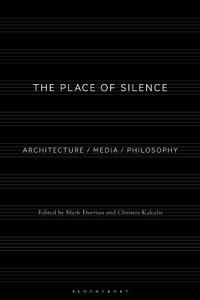
The Place of Silence
Architecture / Media / Philosophy
1st Edition
Published on 6. February 2020
304 pages
978-1-350-07660-0 (ISBN)
Description

The Place of Silence explores the poetics and politics of silence in architecture. Bringing together contributions by internationally recognized scholars in architecture and the humanities, it explores the diverse practices, affects, politics and cultural meanings of silence, silent places and silent buildings in historical and contemporary contexts.
What counts as silence in specific situations is highly relative, and the term itself carries complex and varied significations which make it a revealing field of study. Chapters explore a range of themes, from the apparent 'loss of silence' in the contemporary urban world; through designed silent spaces; to the forced silences of oppression, catastrophe, or technological breakdown. The book unfolds a rich and complementary array of perspectives which address - through the lens of architecture and place - questions of sound, atmosphere, and attunement, together building a volume which will form the key scholarly resource on architecture and silence.
What counts as silence in specific situations is highly relative, and the term itself carries complex and varied significations which make it a revealing field of study. Chapters explore a range of themes, from the apparent 'loss of silence' in the contemporary urban world; through designed silent spaces; to the forced silences of oppression, catastrophe, or technological breakdown. The book unfolds a rich and complementary array of perspectives which address - through the lens of architecture and place - questions of sound, atmosphere, and attunement, together building a volume which will form the key scholarly resource on architecture and silence.
More details
Edition
1. Auflage
Language
English
Place of publication
London
United Kingdom
Publishing group
Bloomsbury Publishing PLC
Target group
College/higher education
Illustrations
45 b&w illus
ISBN-13
978-1-350-07660-0 (9781350076600)
Copyright in bibliographic data and cover images is held by Nielsen Book Services Limited or by the publishers or by their respective licensors: all rights reserved.
Schweitzer Classification
Other editions
Additional editions
Book
02/2022
Bloomsbury Visual Arts
€43.50
Shipment within 15-20 days
Book
02/2020
Bloomsbury Visual Arts
€123.00
Shipment within 15-20 days
Persons
Mark Dorrian holds the Forbes Chair in Architecture at the University of Edinburgh and co-directs Metis, an atelier for art, architecture and urbanism. He has been a visiting professor at the Arkitektskolen Aarhus (Denmark), University of Michigan (USA), and Tianjin University (China), and a visiting scholar at the Canadian Centre for Architecture.
Christos Kakalis is an architect and Lecturer in Architecture at the School of Architecture, Planning and Landscape of Newcastle University.
Christos Kakalis is an architect and Lecturer in Architecture at the School of Architecture, Planning and Landscape of Newcastle University.
Content
Introduction, Mark Dorrian (Edinburgh College of Art, UK) and Christos Kakalis (Newcastle University, UK)
Mediating Silence
1. 'Then There Was War': John Hejduk's Silent Witnesses as Nuclear Criticism, Mark Dorrian (Edinburgh College of Art, UK)
2. Textures of Silence in Claire Denis's Beau Travail, Hannah Paveck (Kings College London, UK)
3. Listening to Visaginas: on the Rescaling of Silences and Sounds in a Former Soviet Nuclear Town, Benjamin Cope (European Humanities University, Lithuania)
4. Urban Silence and Informational Noise: a Study of Athens's Invisible Structures, Aikaterini Antonopoulou (University of Liverpool, UK)
5. The Silent Present: the Contemporary Atmosphere of Architectural Historiography, Amy Kulper (RISD, USA)
Material Silences
6. Between the Lines, Manuela Antoniu (Japan)
7. The Silence of Michelangelo's Hammer, Jonathan Foote (Aarhus School of Architecture, Denmark)
8. Making Silence: Modes of Emptiness in Iberian Art and Architecture, Ross Jenner (University of Auckland, New Zealand)
9. On Becoming Petrified: the Erotic Gaze in Architectural Conception, Carolina Dayer (Aarhus School of Architecture in Denmark)
Practising Silence
10. Silence, Paradox and Religious Topography, Christos Kakalis (Newcastle University, UK)
11. Silences Generating Space, Tina Engels-Schwarzpaul (AUT University, New Zealand) and Carl Mika (University of Waikato, New Zealand)
12. Silence in the Middle Ground: Aesthetic Immersion in the Geologic, Tiago Torres-Campos (University of Edinburgh, UK)
13. John Hejduk and Samuel Beckett: Going On, in Silence and Lateness, Jason O'Shaughnessy (University College Cork, Ireland)
Silence and the Senses
14. Quiet Places - Silent Space: Towards a Phenomenology of Silence, Gernot Böhme (Institut für Praxis der Philosophie, Germany)
15. Silence Please! A Brief History of Silence at the Theatre, Louise Pelletier (UQÀM, Canada)
16. Vessels of Place: Auditory Landscapes, Cross-Cultural Echoes in South-West Victoria, Paul Carter (RMIT University, Australia)
17. Attunement and Silence, Alberto Pérez-Gómez (McGill University, Canada)
Bibliography
Index
Mediating Silence
1. 'Then There Was War': John Hejduk's Silent Witnesses as Nuclear Criticism, Mark Dorrian (Edinburgh College of Art, UK)
2. Textures of Silence in Claire Denis's Beau Travail, Hannah Paveck (Kings College London, UK)
3. Listening to Visaginas: on the Rescaling of Silences and Sounds in a Former Soviet Nuclear Town, Benjamin Cope (European Humanities University, Lithuania)
4. Urban Silence and Informational Noise: a Study of Athens's Invisible Structures, Aikaterini Antonopoulou (University of Liverpool, UK)
5. The Silent Present: the Contemporary Atmosphere of Architectural Historiography, Amy Kulper (RISD, USA)
Material Silences
6. Between the Lines, Manuela Antoniu (Japan)
7. The Silence of Michelangelo's Hammer, Jonathan Foote (Aarhus School of Architecture, Denmark)
8. Making Silence: Modes of Emptiness in Iberian Art and Architecture, Ross Jenner (University of Auckland, New Zealand)
9. On Becoming Petrified: the Erotic Gaze in Architectural Conception, Carolina Dayer (Aarhus School of Architecture in Denmark)
Practising Silence
10. Silence, Paradox and Religious Topography, Christos Kakalis (Newcastle University, UK)
11. Silences Generating Space, Tina Engels-Schwarzpaul (AUT University, New Zealand) and Carl Mika (University of Waikato, New Zealand)
12. Silence in the Middle Ground: Aesthetic Immersion in the Geologic, Tiago Torres-Campos (University of Edinburgh, UK)
13. John Hejduk and Samuel Beckett: Going On, in Silence and Lateness, Jason O'Shaughnessy (University College Cork, Ireland)
Silence and the Senses
14. Quiet Places - Silent Space: Towards a Phenomenology of Silence, Gernot Böhme (Institut für Praxis der Philosophie, Germany)
15. Silence Please! A Brief History of Silence at the Theatre, Louise Pelletier (UQÀM, Canada)
16. Vessels of Place: Auditory Landscapes, Cross-Cultural Echoes in South-West Victoria, Paul Carter (RMIT University, Australia)
17. Attunement and Silence, Alberto Pérez-Gómez (McGill University, Canada)
Bibliography
Index
