

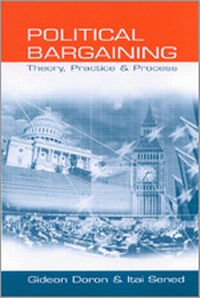
Political Bargaining
Theory, Practice and Process
1st Edition
Published on 27. March 2001
192 pages
978-0-85702-192-2 (ISBN)
Description

This book brings an exciting and innovative new approach to the study of politics today. It introduces political bargaining, a process at the heart of all political and economic exchanges in contemporary society and the very essence of politics itself, to provide a new framework and fresh insights to modern political science.
The authors trace the prevalence of bargaining processes in politics from the abstract level of individual human interaction and the `state of nature' to the more concrete political or institutionalized level.
They introduce students to theory -- the basic models of game theory, rational choice theory and positivist approaches; practice -- the practical manifestations of political bargaining in everyday national and international political life; and process -- its setting, the interests of the players involved, the conditions and properties that affect their calculations and, consequently, their ability to obtain desired outcomes.
Political Bargaining provides students with the basic tools for learning about and participating in politics today by richly illustrating how the authoritative allocation of scarce resources is arrived at through a complex bargaining process between competing interests in society. It will be essential reading for student and lecturer alike across political science and the social sciences more widely.
The authors trace the prevalence of bargaining processes in politics from the abstract level of individual human interaction and the `state of nature' to the more concrete political or institutionalized level.
They introduce students to theory -- the basic models of game theory, rational choice theory and positivist approaches; practice -- the practical manifestations of political bargaining in everyday national and international political life; and process -- its setting, the interests of the players involved, the conditions and properties that affect their calculations and, consequently, their ability to obtain desired outcomes.
Political Bargaining provides students with the basic tools for learning about and participating in politics today by richly illustrating how the authoritative allocation of scarce resources is arrived at through a complex bargaining process between competing interests in society. It will be essential reading for student and lecturer alike across political science and the social sciences more widely.
More details
Edition
First Edition
Language
English
Place of publication
London
United Kingdom
Target group
College/higher education
Professional and scholarly
ISBN-13
978-0-85702-192-2 (9780857021922)
Copyright in bibliographic data and cover images is held by Nielsen Book Services Limited or by the publishers or by their respective licensors: all rights reserved.
Schweitzer Classification
Other editions
Additional editions
Book
03/2001
1st Edition
SAGE Publications Inc
€231.20
Shipment within 15-20 days
Book
03/2001
1st Edition
SAGE Publications Inc
€113.30
Shipment within 15-20 days
Persons
Itai Sened received his Ph.D. from the University of Rochester in 1990. He rose to the rank of a senior lecturer with tenure at Tel Aviv University. In 1997 he moved to Washington University in St. Louis. There, between 2001-2012 he was the founding Director of the Center for New Institutional Social Sciences (CNISS). Promoted to Full Professor in 2004, he served as the Chair of the Department between 2004-7.
His book, The Political Institution of Private Property, was published by Cambridge University Press in 1997. The paperback edition was published in 2007. His second book, Political Bargaining: Theory, Practice and Process, co-authored with Gideon Doron, was published by SAGE Publication in 2001. He published numerous articles in all the top refereed journals in Political Science including, The American Political Science Review, The American Journal of Political Science, The Journal of Politics, The British journal of Political Science, the European Journal for Political Research, the Journal of Theoretical Politics and many other refereed publications. He is the co-editor, with Jack Knight, of Explaining Social Institutions from the University of Michigan Press (1995, a paperback edition in 2005). In 2006, he co-authored with Norman Schofield: Multiparty Democracy, published by Cambridge University Press, also available in paperback. He is currently completing a new edited volume with Sebastian Galiani, entitled: Economic Institutions, Rights, Growth, and Sustainability: The Legacy of Douglass North to be published by Cambridge University Press in the fall of 2013.
His book, The Political Institution of Private Property, was published by Cambridge University Press in 1997. The paperback edition was published in 2007. His second book, Political Bargaining: Theory, Practice and Process, co-authored with Gideon Doron, was published by SAGE Publication in 2001. He published numerous articles in all the top refereed journals in Political Science including, The American Political Science Review, The American Journal of Political Science, The Journal of Politics, The British journal of Political Science, the European Journal for Political Research, the Journal of Theoretical Politics and many other refereed publications. He is the co-editor, with Jack Knight, of Explaining Social Institutions from the University of Michigan Press (1995, a paperback edition in 2005). In 2006, he co-authored with Norman Schofield: Multiparty Democracy, published by Cambridge University Press, also available in paperback. He is currently completing a new edited volume with Sebastian Galiani, entitled: Economic Institutions, Rights, Growth, and Sustainability: The Legacy of Douglass North to be published by Cambridge University Press in the fall of 2013.
Content
Introduction
A Conceptual Framework for the Study of Political Bargaining
The Social Problem
A Bargained Social Contract
Special Interests and Political Entrepreneurs
Electoral and Post-Electoral Bargaining in Parliamentary Systems
Post-Electoral Bargaining in Presidential Systems
Bargaining at the International Arena
Conclusions
A Conceptual Framework for the Study of Political Bargaining
The Social Problem
A Bargained Social Contract
Special Interests and Political Entrepreneurs
Electoral and Post-Electoral Bargaining in Parliamentary Systems
Post-Electoral Bargaining in Presidential Systems
Bargaining at the International Arena
Conclusions
