

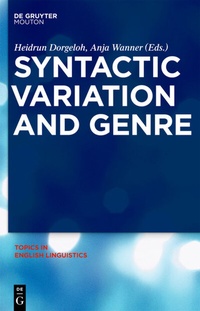
Syntactic Variation and Genre
Description

This volume explores the interplay of syntactic variation and genre. How do genres emerge and what is the role of syntax in constituting them? Why do certain constructions appear in certain types of text? The book takes the concept of genre as a reference-point for the description and analysis of morpho-syntactic variation and change. It includes both overviews of theoretical approaches to the concept of genre and text type in linguistics and studies of specific syntactic phenomena in English, German, and selected Romance languages.
Contributions to the volume make use of insights from attempts for text classification and rhetorical views on genre and reach from quantitative, corpus-based methodology to qualitative, text-based analyses. The types of texts investigated cover spoken, highly interactive, and written forms of communication, including selected genres of computer-mediated communication. Corpus data come from both synchronic and diachronic linguistic corpora, such as LOB, Brown, FLOB, Frown, ARCHER, and ICE-Jamaica. This spectrum both in approaches and data is meant to provide a theoretical foundation as well as a realistic view of the inherent complexity of form-function relationships in syntax. At the same time, genre is treated as a category relevant beyond discourse studies, consisting of forms and conventions at all levels of linguistic analysis, including syntax.
The book is therefore of interest to linguists and graduate students in the area of syntax, discourse analysis, and pragmatics, as well as to sociolinguists and corpus linguists working on register variation.
Reviews / Votes
"Without a doubt, the volume in its entirety is inspiring. [...]The articles are all written in an accessible style, so that the publication is suitable not only for experts, but also for students of linguistics. It is recommendable to all who want to broaden their horizons and embark on linguistic studies at the borders of traditional sub-disciplines."Sixta Quassdorf in: Linguist List 22.3028More details
Other editions
Additional editions
Persons
Content
- Frontmatter
- Contents
- Introduction
- Genre as difference: The sociality of linguistic variation
- Variation across texts and discourses: Theoretical and methodological perspectives on text type and genre
- A new genre for a specialized community: The rise of the experimental essay
- Do some genres or text types become more complex than others?
- Mein Problem ist/mein Thema ist ('My problem is/my topic is'): How syntactic patterns and genres interact
- Thank you for thinking we could: Use and function of interpersonal pronouns in corporate web logs
- Grammatical constructions and communicative genres
- Genre effects in the replacement of reflexives by particles
- Clause linkage techniques as a symptom of discourse traditions: Methodological issues and evidence from Romance languages
- Syntactic constructions as a means of spatial representation in fictional prose
- Agreement in educated Jamaican English: A corpus-based study of spoken usage in ICE-Jamaica
- I know you guys hate forwards: Address pronouns in digital folklore
- Backmatter
