

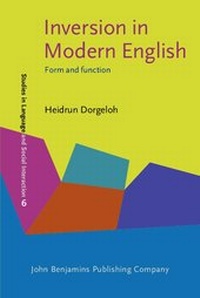
Inversion in Modern English
Form and function
1st Edition
Published on 6. March 1997
X, 236 pages
978-90-272-7582-0 (ISBN)
Description

The book offers a comprehensive study of the different forms of subject-verb and subject-auxiliary-inversion in Modern English declarative sentences. It treats inversion as a speaker-based decision for reordering within a fairly rigid word order system and identifies the meaning of the construction in terms of point of view and speaker subjectivity. This semantic claim is tested against the occurrence, as well as the absence, of the different forms of inversion in natural discourse.
The analysis of the pragmatics and discourse function of inversion is based on the LOB and the Brown corpus and takes into account various textual relations: British and American English, written mode, style, text type, genre. The results suggest a strong affinity with the greater or lesser subjectivity of a text: the construction is a marker of interpersonal meaning. Provided the context is one of relative unexpectedness, it additionally becomes a discourse marker, which points to the limited value of quantitative corpus data in functional syntax.
The analysis of the pragmatics and discourse function of inversion is based on the LOB and the Brown corpus and takes into account various textual relations: British and American English, written mode, style, text type, genre. The results suggest a strong affinity with the greater or lesser subjectivity of a text: the construction is a marker of interpersonal meaning. Provided the context is one of relative unexpectedness, it additionally becomes a discourse marker, which points to the limited value of quantitative corpus data in functional syntax.
More details
Other editions
Additional editions
Book
03/1997
John Benjamins Publishing Co
€111.30
Shipment within 10-15 days
Person
Content
- INVERSION IN MODERN ENGLISH FORM AND FUNCTION
- Editorial page
- Title page
- Copyright page
- Table of Contents
- Abbreviations
- Chapter 1. Introduction
- Chapter 2. Word order in English: Some theoretical preliminaries
- 2.1 Basic concepts
- 2.1.1 Topic
- 2.1.2 Focus
- 2.1.3 The clause as representation, exchange and message
- 2.2 English within word order-based language typologies
- 2.3 Basic and natural word order
- Chapter 3. Inversion in English: The state of the art
- 3.1 A preliminary typology
- 3.1.1 Types of inversion excluded
- 3.1.2 The FI and SAI types
- 3.1.2.1 Full inversion (FI)
- 3.1.2.2 Subject-auxiliary-inversion (SAI)
- 3.2 Diachronic aspects
- 3.2.1 Inversion in earlier stages of English
- 3.2.2 Inversion and grammaticalisation
- 3.3 Two formal hypotheses
- 3.3.1 Inversion as a root transformation
- 3.3.2 "Mixed" subject status in full inversion
- 3.4 The functional claims
- 3.4.1 Focus-marking and the presentative functio
- 3.4.2 The information-packaging claim
- 3.5 Related phenomena
- 3.5.1 There-insertion
- 3.5.2 Preposing and initial adverbial placement
- 3.5.3 Left-dislocation
- Chapter 4. The semantics of inversion
- 4.1 The semantics of choice: inverted vs. canonical word order
- 4.1.1 On the nature of the semiotic process
- 4.1.2 Full inversion vs. canonical word order
- 4.1.2.1 A deictic presentative prototype
- 4.1.2.2 The lexical presentative type of FI
- 4.1.2.3 The lexical predicative type of FI
- 4.1.2.4 The anaphoric/cataphoric type
- 4.1.3 Subject-auxiliary-inversion vs. canonical word order
- 4.2 Viewpoint and subjectivity in inversion
- 4.2.1 Inversion in embedded constructions
- 4.2.2 Viewpoint analysis of main clause full inversion
- 4.2.3 Focus management through point of view
- 4.2.4 Markedness, unexpectedness and emotive meaning
- 4.3 Summary: a functional classification of English inversion
- Chapter 5. Inversion in discourse
- 5.1 Inversion and other textual relations
- 5.1.1 Spoken vs. written mode
- 5.1.2 Colloquial vs. literary style
- 5.1.3 British vs. American English
- 5.2 Inversion and categories of discourse
- 5.2.1 Discourse types and discourse typologies
- 5.2.1.1 Function and structure - basic discourse types
- 5.2.1.2 Convention - the status of genre
- 5.2.2 Inversion in a corpus of written non-fictional discourse
- 5.2.2.1 Syntactic variation and a corpus-based approach
- 5.2.2.2 Inversion in five text categories of the LOB and the Brown corpus
- 5.2.2.3 Typical uses and characteristics of text categories
- 5.3 Inversion and discourse under conditions of displacement
- 5.3.1 Basic affinities in non-fictional discourse
- 5.3.2 Displaced immediacy, organisation of discourse and comment in political news reporting
- 5.4 Summary: inversion as a discourse marker
- Chapter 6. Summary and conclusion
- Appendix. Corpustexts and other sources of occurrences
- Notes
- References
- Name Index
- Subject Index
