

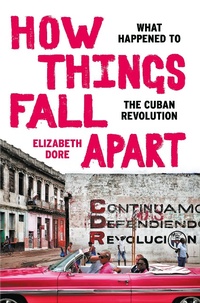
How Things Fall Apart
What Happened to the Cuban Revolution
1st Edition
Published on 4. August 2022
352 pages
978-1-80328-377-7 (ISBN)
Description

A powerful account of the decline of the Cuban Revolution, told through the lives of five ordinary Cuban citizens.
'Masterful... Dore uses oral history to tell a history of Cuba from the bottom up' Professor Linda Gordon
'A vital addition to Cuba's rich oral tradition' Will Grant, BBC Cuba Correspondent
'Opens wide a window on the last forty years of Cuban history' Professor Gerald Martin
'To have gathered these life stories together with such grace, eloquence and trust is a towering achievement' Professor Ruth Behar
Cuba is not the country it used to be. The regime is disintegrating, and unprecedented protest marches are challenging the gerontocratic Communist Party leadership.
How Things Fall Apart reveals the decay of this political system through the lives of five ordinary Cuban citizens. Born in the 1970s and 80s, these men and women recount how their lives changed over a tumultuous stretch of thirty-five years: first when Fidel opened the country to tourism following the fall of the Soviet bloc; then when Raúl Castro allowed market forces to operate, thinking it would stop the country's economic slide; and finally when President Trump's tightening of the US embargo combined with the Covid-19 pandemic to cause economic collapse. With warmth and humanity, they describe learning to survive in an environment where a tiny minority has grown rich by local standards, the great majority has been left behind, and inequality has destroyed the very things that used to give meaning to Cubans' lives.
Born out of the first oral history project authorized by the Cuban government in forty years, Professor Elizabeth Dore gathers these stories to illuminate the slow and agonizing decline of the Cuban Revolution over the past four decades. For over sixty years the government controlled the historical narrative. In this book, Cubans tell their own stories.
'Masterful... Dore uses oral history to tell a history of Cuba from the bottom up' Professor Linda Gordon
'A vital addition to Cuba's rich oral tradition' Will Grant, BBC Cuba Correspondent
'Opens wide a window on the last forty years of Cuban history' Professor Gerald Martin
'To have gathered these life stories together with such grace, eloquence and trust is a towering achievement' Professor Ruth Behar
Cuba is not the country it used to be. The regime is disintegrating, and unprecedented protest marches are challenging the gerontocratic Communist Party leadership.
How Things Fall Apart reveals the decay of this political system through the lives of five ordinary Cuban citizens. Born in the 1970s and 80s, these men and women recount how their lives changed over a tumultuous stretch of thirty-five years: first when Fidel opened the country to tourism following the fall of the Soviet bloc; then when Raúl Castro allowed market forces to operate, thinking it would stop the country's economic slide; and finally when President Trump's tightening of the US embargo combined with the Covid-19 pandemic to cause economic collapse. With warmth and humanity, they describe learning to survive in an environment where a tiny minority has grown rich by local standards, the great majority has been left behind, and inequality has destroyed the very things that used to give meaning to Cubans' lives.
Born out of the first oral history project authorized by the Cuban government in forty years, Professor Elizabeth Dore gathers these stories to illuminate the slow and agonizing decline of the Cuban Revolution over the past four decades. For over sixty years the government controlled the historical narrative. In this book, Cubans tell their own stories.
More details
Edition
1. Auflage
Language
English
Place of publication
London
United Kingdom
Publishing group
Bloomsbury Publishing PLC
Illustrations
1x8pp col
ISBN-13
978-1-80328-377-7 (9781803283777)
Copyright in bibliographic data and cover images is held by Nielsen Book Services Limited or by the publishers or by their respective licensors: all rights reserved.
Schweitzer Classification
Other editions
Additional editions
Book
08/2023
Apollo
€14.00
Shipment within 3-4 weeks
Book
08/2022
Apollo
€54.71
Article exhausted; check different version
Person
Elizabeth Dore is a professor of Latin American Studies, specializing in class, race, gender and ethnicity, with a focus on modern history. She is Professor Emeritus at the University of Southampton, Associate Fellow of the Institute of the Americas, University College London, and has a PhD from Columbia University. Elizabeth is Project Director of the Oral History Project 'Memories of the Cuban Revolution' and has written extensively on Cuban history and politics.
Content
- Intro
- Title Page
- Copyright
- Dedication
- Epigraph
- Contents
- PROLOGUE
- 1. THE NARRATORS
- Pseudonyms
- 2. BACKSTORY
- 3. FIDEL'S FALL, AN OMEN
- PART 1: THE 1980s
- 4. MARIO SÁNCHEZ CORTÉZ
- Old Havana
- 'I spent my childhood visiting prisons.'
- 'You looked to one side, then the other. Everyone was equal. You felt you were a part of the whole.'
- 'In my time everybody was equal.'
- 'Unbelievable, me, the son of a nobody, going to school in Vedado.'
- 'Their clothes, and I am not talking just about clothes. You could see the status they wore.'
- Do you think there might have been a little, like, I don't know what to call it, racism, a little discrimination? You say that the fathers of the other compañeros were painters. Could you say more about this?
- 5. ALINA RODRÍGUEZ ABREU
- San Miguel del Padrón, Havana
- 6. JUAN GUILLARD MATUS
- Santa Ana de la Laguna, Artemisa Province
- What is your telephone number?
- What's your neighbour's number?
- Where do you work?
- Were you an empleado, white collar worker?
- Are you married?
- Do you have children?
- Do you live alone?
- No, I mean, do you live with your mother and father?
- Religion: coming out of the closet
- The move from Central Havana to Santa Ana
- Racism
- Have you ever felt discrimination?
- So, you're saying there was discrimination in Santa Ana?
- Is that so?
- What marks did discrimination leave? I mean how did it affect you?
- Remembering the 1980s
- Remembering as a form of resistance
- 'I had to throw myself into life's hustle and tussle.'
- How did you survive?
- 7. RACISM
- Breaking the silence
- 8. ESTEBAN CABRERA MONTES
- Fontanar, Havana, 2005-06
- 'Politics tore my family apart.'
- 'Family separation. the national tragedy.'
- 'Our American connection.'
- When did you first think about leaving?
- Was this way of thinking common?
- In the 1980s did your generation share a vision?
- What did they teach in school?
- Because of the blockade?
- Craving trainers
- 'Fashion brands. have destroyed young people psychologically.'
- 'We had to begin again at zero.'
- 9. BARBARA VEGAS
- Regla
- 10. FIDEL CASTRO
- 11. PAVEL GARCÍA ROJAS
- El Cerro, Havana
- 'We took equality for granted.'
- 'We took equality for granted.'
- What else do you remember about growing up in the 80s?
- Memories of the past to fit the present
- The Gold and Silver Stores: a missing piece of history
- 'Now we are going to build socialism.'
- Why do some Cubans refer to the 1980s as a golden age?
- Stories Pavel forgot to tell
- PART 2: FIDEL AND THE COLLAPSE 1990-2006
- 12. MARIO SÁNCHEZ CORTÉZ
- Old Havana
- My brother the balsero
- When was the last time you received news from your brother?
- Turning the army to my advantage
- Tell me a little more about the period when you were in Orden 18, a little more about your economic limitations.
- Mario could not afford to buy shoes
- 'I wanted a life.'
- 'In the service I decided I wanted to be a somebody.'
- Do you think military service helped you in any way, maybe in making a man of you? Lilia asked.
- 'To remain at university I had to have courage.'
- Racism: 'My facial characteristics do not fit the part.'
- Why not with cars?
- Tell me, what does a university student look like?
- Do you think there could be a problem with the police?
- An egalitarian fantasy: 'It was something like socialism is supposed to be.'
- 'The neighbourhood is changing. Money has become everything.'
- 'The Party's principles are beautiful, but it was an illusion. It was utopian.'
- 'Cubans today are not the same as Cubans back then.'
- What are your happiest and saddest memories?
- 13. ALINA RODRÍGUEZ ABREU
- San Miguel del Padrón, Havana
- Backstory
- 14. JUAN GUILLARD MATUS
- Santa Ana de la Laguna
- Changes underway
- 'For a poor person I have enough.'
- Juan, would you ever leave Santa Ana for another place?
- Miami vis-à-vis Cuba
- Tell me what it was like when your compañero Leo came back to visit?
- Yes, it's like that.
- What is there on the other side that attracts? (The other side meaning the US, particularly Miami, on the other side of the Florida Straits.)
- But you, have you any plans to, err, leave? Or will you stay in Santa Ana?
- But you? Will you stay with this [Cuba]?
- Race and sex
- How is your life as far as girls are concerned?
- Tell us about it.
- Your partners, are they white or Black girls?
- Why?
- So white women fall for you?
- Most have been white?
- Don't you think you're being discriminatory, in a sense, regarding your own, towards people of your same skin colour? Don't you think so?
- 'If I can't be a boxer, at least I can be a ping pong player.'
- You said you don't like politics?
- But you do go to the marches and light stuff like that, don't you?
- Juan, what does the Revolution mean to you?
- 15. ESTEBAN CABRERA MONTES
- Fontanar, Havana, 2005-06
- 'Memories are all I have left. It is my destiny.'
- How did they leave?
- 'You?' Julia shouted over Nirvana's music.
- What did your father say?
- 'Thanks to the blackouts I learned how to think.'
- 'I tried to speak myself.'
- 'A US visa. The chance of a lifetime.'
- Did you get some sleep?
- What do you mean like every other day?
- Was the crowd mostly young, or were there people of all ages?
- 'Now I don't have to devote my time to changing history.'
- So, overall you say what you think? Is that right?
- An insider's story of the black market
- What kinds of activities?
- 'Survival comes at a price.'
- Do you have friends who've been inside?
- 'I am not a delinquent.'
- Second failed escape
- Why did you fail the security check?
- Slumming
- Do you often go to the centre of the city?
- 'No Cuban is a complete atheist.'
- Who do you ask?
- 16. BARBARA VEGAS
- Regla
- 17. PAVEL GARCÍA ROJAS
- El Cerro, Havana
- 'We don't really have any memories of the end of socialism in the USSR.'
- Black humour and the Special Period
- Pavel's privilege
- Sex work
- The politics of the Film School
- 'The Cuban ethos is to leave.'
- 18. ALEJANDRO ESPADA BETANCOURT
- Boyeros, Havana
- The geopolitics of cancer
- -from Olga Betancourt's perspective
- -from Alejandro's perspective
- Did you want to return to Cuba?
- Were there girls in the games networks?
- 'It was a time you don't forget.' A struggle that pitted David against Goliath.
- A rising star
- 'The great divide in Cuba is economic'
- 'How much more you enjoy what you have when you have earned it through your own sacrifices.'
- '"I no longer have dreams."'
- What are your dreams for the future?
- Do you dream of leaving?
- PART 3: INEQUALITY, 2006-20
- 19. MARIO SÁNCHEZ CORTÉZ
- Old Havana
- 'The thread of equality is broken.'
- 'Liz, make sure you put this in your book.'
- 'Don't worry. We're not about to take away free healthcare.'
- 'It was beautiful because we were equal, but it wasn't egalitarianism.'
- 'Almost everyone above me was under investigation for corruption.'
- Did you manage to pass the driving test?
- 'Youth don't identify with the Revolution.'
- To your way of thinking what are the most important issues facing Cuba today?
- Do you think the government is allowing people to express themselves a little more? Is that beginning to happen?
- 'Some Cubans have advantages. Just like everywhere else it depends on the cradle you were born in.'
- 'What inequality looks like.'
- 'The economic changes haven't gotten to the root of the problem.'
- How have the recent economic measures affected you and your friends?
- What impact are the measures having on equality?
- 'The last thing you lose is hope.'
- 'We are not the same Cubans we were before.'
- 'Let me tell you what is wrong with egalitarianism.'
- 'To tell the truth the changes are bad.'
- How are the changes affecting you and your friends?
- Do you think the general population will benefit from laws allowing better off Cubans to buy houses and cars?
- How would you describe the new petty bourgeoisie?
- You seem to have retained the values you had growing up.
- What do you think Cuba will look like in five years?
- Do people feel they can say out loud whatever it is they are thinking?
- 'Inequality is here. Now we have to learn to live with it.'
- What do you think will happen to inequality?
- Dissidents and machismo
- He or she, I said too aggressively.
- It's marvellous that women have made gains, but at what cost? Do men share the housework? Or do women do housework, political work, and also direct enterprises? Do women do it all?
- Really?
- 'I would quit my job tomorrow and try to make a go of it in business.'
- 'Most Cubans' lives have not improved.'
- 20. ALINA RODRÍGUEZ ABREU
- San Miguel del Padrón, Havana
- 'Alina, something puzzles me. Why in the title, Buscándote Havana, is Havana spelled the English way, and not the Spanish way, Habana?'
- 21. JUAN GUILLARD MATUS
- Santa Ana de la Laguna, Artemisa Province
- Juan, President of the Committee for the Defence of the Revolution
- 'So everyone can live.'
- What do you think of the updated economic model?
- 'There is no room to give.'
- Would you prefer not to continue talking about the economic situation?
- Would you say that here in Santa Ana there is a sense that the system isn't working?
- With municipal elections coming up is there a possibility of electing some new delegates? Marisol asked.
- What do you think will come of people's dissatisfaction, and what can you do about it? I asked.
- 'I am the salad to the meal.'
- How would you describe your life right now?
- 'I would be a caged bird.'
- Will you ever leave Santa Ana?
- Postscript
- 22. RAÚL CASTRO: THE GENERAL
- 23. ESTEBAN CABRERA MONTES
- Fontanar, Havana, 2006
- 'Year after year I try to emigrate. That is the story of my life.'
- 'Capitalist society is monstrous. I know it is very crude.'
- 'We are not chicos malos.'
- What changes would you like to see? asked Julia.
- 'Cubans are constantly plotting ways to leave. It drives them crazy.'
- 'Escape is our only hope.'
- Did you say something about social workers? asked Julia.
- I know that salaries are a huge problem, but aren't there any jobs that would give you some satisfaction because you would be doing something that really interests you?
- OK, so what motivates people who do go to work?
- 'They label us anti-social.'
- 'Youth here are different than in other countries. They don't get together to demonstrate.'
- What do young people do when they get together?
- 'If your idea is to conduct interviews about people's lives, you might have come to the wrong country.'
- Racial problems
- Are there racial problems?
- Do they stop some people more than others?
- They stop everyone?
- 24. BARBARA VEGAS
- Do you feel like an outsider at work because you are Black?
- Your husband, what is his skin colour?
- 25. PAVEL GARCÍA ROJAS
- El Cerro, Havana
- 'I am a publicly declared opponent. I am what you see.'
- What are the major causes of inequality?
- 'When Fidel Castro was about to give a speech on television it was like, "Whoa, Cuba hold on!"'
- 'Opening the border is a major change.'
- How do the measures enacted by Raúl Castro's government affect you personally?
- 'The state simply handed him to the dissidents on a silver platter.'
- Who finances your activities?
- How do your friends and neighbours react to your political involvement?
- What would you like to see happen in Cuba over the next five to ten years?
- Do you consider yourself a socialist?
- Who are your role models?
- Has inequality increased during Raúl's term of office?
- I'm sorry Pavel, but to me this sounds trite and far-fetched.
- Postscript
- 26. ALEJANDRO ESPADA BETANCOURT
- Havana, March 2015
- 'I could sell ice to a penguin.'
- How do you acquire the episodes so quickly?
- 'The FAR and MININT are normal businesses.'
- 'The economic changes are too slow for us.'
- 'Cubans went into the Special Period together but came out one by one.'
- Inequality
- Is inequality growing?
- Undercover
- I thought rappers are critical of the government. Were there tensions between the leaders of the Young Communists and the rappers?
- Can you explain, please, what 'change what needs changing' means?
- Do some people face problems because of their politics?
- 'Cubans are not the same people we were before.'
- Why are you leaving?
- Postscript
- Conclusion
- My Thanks
- Plate Section
- Endnotes
- Chapter 2
- Chapter 3
- Part 1: The 1980s
- Chapter 4
- Chapter 5
- Chapter 6
- Chapter 7
- Chapter 8
- Chapter 9
- Chapter 10
- Chapter 11
- Part 2: Fidel and the Collapse, 1990-2006
- Chapter 12
- Chapter 13
- Chapter 14
- Chapter 15
- Chapter 17
- Chapter 18
- Part 3: Inequality, 2006-20
- Chapter 19
- Chapter 21
- Chapter 22
- Chapter 23
- Chapter 25
- Chapter 26
- About the Author
- An Invitation from the Publisher
