

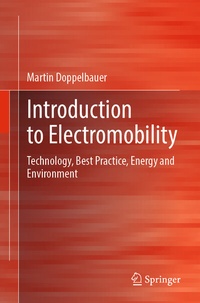
Introduction to Electromobility
Description

The book provides a comprehensive overview of all relevant technical and environmental aspects relating to road vehicles with low-emission drive technology. The focus is on electric and hybrid vehicles, whose drive technology, energy storage (batteries, hydrogen) and charging systems are presented in detail.
It also deals with overarching framework conditions such as climate protection, generation and distribution of electrical energy and hydrogen, raw materials, life cycle assessment and costs. The latest technical developments have been taken into account in this updated edition. The facts are made clear in many breakdown graphics. Examples deepen the material or provide a practical reference so that the content is more memorable for students.
This book is aimed, among others, at students from the subjects of automotive technology, energy technology, electrical engineering, energy supply, energy economics, mechanical engineering and industrial engineering.
Reviews / Votes
"Ein sehr schönes Buch, welches den Einstieg in die Elektromobilität erleichtert."Besonders hervorzuheben: "Die hervorragende Übersicht über die Weiten der Elektromobilität, insbesondere die detaillierten Ausführungen über die Grundlagen der elektrischen Maschinen sowie die ausführlichen Kapitel über die Energiespeicher und die Ladesysteme. Dieses habe ich in noch keinem anderen Buch so gut strukturiert gesehen." (Horst Sauer)More details
Other editions
Additional editions
Person
Univ.-Prof. Dr.-Ing. Martin Doppelbauer worked in leading managerial roles in the electrical engineering industry before accepting a position as full professor at the Institute of Electrical Engineering at the Karlsruhe Institute of Technology (KIT) in 2011. Since 2022, Martin Doppelbauer has also heads the "New Drive Systems" group at the Fraunhofer Institute for Chemical Technologies (ICT) in Pfinztal, Germany. His research focuses on drives and energy storage systems for road mobility, from pedelecs to cars and commercial vehicles.
Content
1. Introduction.- 2. Drives for Electric Vehicles.- 3. Hybrid Vehicle Drives.- 4. Driving Resistances and Energy Consumption.- 5. Operating Strategy.- 6. Energy storage systems.- 7. Fundamentals of Electric Machines.- 8. Synchronous Machines.- 9. Induction machines (IM).- 10. Power Electronic Components.- 11. Topology of Electric Drivetrains.- 12. Charging Systems.- 13. Framework of individual mobility.- 14. Production and Distribution of Energy.- 15. Life Cycle Assessment.- 16. Costs of Electric Mobility.
