

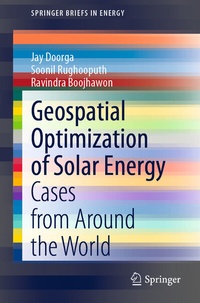
Geospatial Optimization of Solar Energy
Description

This book provides a comprehensive guide on how geographic information systems (GIS) can be used to optimize solar energy resources. A collection of the latest cutting-edge research is presented which seeks to address the most pressing issues faced by policymakers regarding the planning and exploitation of solar energy. Scientifically robust models are developed to guide researchers on identifying optimum sites for the implementation of solar energy projects. Each methodology presented is accompanied by global case studies, ranging from the small islands of Hawaii and Mauritius to larger countries such as India and Spain. This book is primarily targeted to researchers aspiring to unveil and optimize the solar resource potential of their countries for the benefit of a wider audience, ranging from architects, agro-industrialists, climatologists, and energy experts.
More details
Other editions
Additional editions
Persons
Dr Jay Rovisham Singh Doorga is a lecturer in the Department of Emerging Technologies, Faculty of Sustainable Development & Engineering, Université des Mascareignes. He holds a MSc in Environmental Change and Management from the University of Oxford and a PhD in GIS: Modelling and Forecasting from the University of Mauritius. He is the recipient of academic honours and awards, including the Oxford ECM Dissertation Award, Cambridge Outstanding Achievement Award, State of Mauritius Laureate Scholarship, and Gold Medalist of the University of Mauritius. His research interests focus on exploiting renewable energy resources and mitigating the impacts of climate change using Geographical Information Systems (GIS). At the Mauritius Oceanography Institute, he has led a national research project funded by the Government of Mauritius to explore the wave energy potential of Mauritius. He holds a patent for the invention of a wave energy prototype.
Professor Soonil Dutt Dharam Vir Rughooputh
is a Professor in the Department of Physics, Faculty of Science, University of Mauritius since 1999. He has a PhD in Physics from the University of London and conducted research at the Davy Faraday Laboratory at The Royal Institution of Great Britain. He was the first CEO of the Mauritius Renewable Energy Agency and has held various positions at the University of Mauritius; Acting Vice-Chancellor, Pro Vice-Chancellor, Dean and Head of the Department of Physics. He was a Visiting Scientist and Post-Doctoral Research Fellow at the University of California, Santa Barbara, USA, and he has worked in California as a Research Scientist. He also worked for Physical Optics Coorporation and Wyatt Technology Inc - both in California, USA. Professor Rughooputh is known for one-dimensional exciton propagation; chromism in conjugated polymers; electronic characterization of conducting polymer gels; and energy and environment modelling. He has contributed to over 180 scientific publications and one patent.
Associate Professor Ravindra Boojhawon
is an Associate Professor in the Department of Mathematics, Faculty of Science, University of Mauritius. He has a PhD in the field of Numerical Linear Algebra. He has extensive experience in developing GUIs and programming languages such as MATLAB, R, Microsoft Excel VBA, Mathematica and GIS software. He has also developed expertise over the years in consultancy services where he has used his programming skills and geostatistical background in problem solving related to environmental science. Dr Boojhawon has over 40 scientific publications in wide-ranging fields from the Environmental Science to Life Science and Mathematics.
