

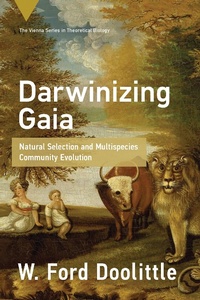
Darwinizing Gaia
Natural Selection and Multispecies Community Evolution
Published on 3. December 2024
272 pages
978-0-262-38062-1 (ISBN)
Description

A reinterpretation of James Lovelock's Gaia Hypothesis through the lens of Darwinian natural selection and multispecies community evolution.
First conceived in the 1970s, James Lovelock's Gaia Hypothesis proposed that living organisms developed in tandem with their inorganic surroundings, forming a complex, self-regulating system. Today, most evolutionary biologists consider the theory problematic. In Darwinizing Gaia, W. Ford Doolittle, one of evolutionary and molecular biology's most prestigious thinkers, reformulates what evolution by natural selection is while legitimizing the controversial Gaia Hypothesis. As the first book attempting to reconcile Gaia with Darwinian thinking, and the first on persistence-based evolution, Doolittle's clear, innovative position broadens evolutionary theory by offering potential remedies for Gaia's theoretical challenges.
Unquestionably, the current "polycrisis" is the most complex that Homo sapiens has ever faced, and this book can help overcome the widespread belief that evolutionary biologists don't believe Lovelock. Written in the tradition of Richard Dawkins's The Selfish Gene, Darwinizing Gaia will appeal to students, evolutionary scientists, philosophers, and microbiologists, as well as environmentalists seeking to understand the Earth as a system, at a time when climate change has drawn our planet's structure and function into sharp relief.
First conceived in the 1970s, James Lovelock's Gaia Hypothesis proposed that living organisms developed in tandem with their inorganic surroundings, forming a complex, self-regulating system. Today, most evolutionary biologists consider the theory problematic. In Darwinizing Gaia, W. Ford Doolittle, one of evolutionary and molecular biology's most prestigious thinkers, reformulates what evolution by natural selection is while legitimizing the controversial Gaia Hypothesis. As the first book attempting to reconcile Gaia with Darwinian thinking, and the first on persistence-based evolution, Doolittle's clear, innovative position broadens evolutionary theory by offering potential remedies for Gaia's theoretical challenges.
Unquestionably, the current "polycrisis" is the most complex that Homo sapiens has ever faced, and this book can help overcome the widespread belief that evolutionary biologists don't believe Lovelock. Written in the tradition of Richard Dawkins's The Selfish Gene, Darwinizing Gaia will appeal to students, evolutionary scientists, philosophers, and microbiologists, as well as environmentalists seeking to understand the Earth as a system, at a time when climate change has drawn our planet's structure and function into sharp relief.
More details
Other editions
Additional editions

Book
12/2024
MIT Press
€53.50
Shipment within 10-20 days
Person
W. Ford Doolittle directed the Evolutionary Biology Programme of the Canadian Institute for Advanced Research for 20 years and received the 2013 Gerhard Herzberg Gold Medal, Canada's top science prize, and the Killam Prize of the Canada Council, Canada's second most coveted award. He is a member of the US National Academy of Sciences and a Fellow of the Royal Societies of Canada and the United Kingdom.
Content
Preface: Why I am writing this book
Chapter 1. The Gaia Hypothesis
Chapter 2. Some unresolved conflicts in Darwinism
Chapter 3. The derivation of the classical (Darwinian) view
Chapter 4. Evolutionary transitions in individuality: MLS1 and MLS2 and their multispecies
equivalent
Chapter 5. Holobiosis
Chapter 6. Extended phenotypes, replicators and interactors, possible solutions
Chapter 7. Lateral gene transfer, its agents and its consequences
Chapter 8. Extending extended phenotypes and the gene's-eye view
Chapter 9. Clades: evolution by persistence
Chapter 10. Songs: evolution by recurrence
Chapter 11. Gaia 2.0
Chapter 1. The Gaia Hypothesis
Chapter 2. Some unresolved conflicts in Darwinism
Chapter 3. The derivation of the classical (Darwinian) view
Chapter 4. Evolutionary transitions in individuality: MLS1 and MLS2 and their multispecies
equivalent
Chapter 5. Holobiosis
Chapter 6. Extended phenotypes, replicators and interactors, possible solutions
Chapter 7. Lateral gene transfer, its agents and its consequences
Chapter 8. Extending extended phenotypes and the gene's-eye view
Chapter 9. Clades: evolution by persistence
Chapter 10. Songs: evolution by recurrence
Chapter 11. Gaia 2.0
