

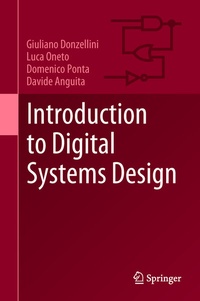
Introduction to Digital Systems Design
Description

This book has been designed for a first course on digital design for engineering and computer science students. It offers an extensive introduction on fundamental theories, from Boolean algebra and binary arithmetic to sequential networks and finite state machines, together with the essential tools to design and simulate systems composed of a controller and a datapath. The numerous worked examples and solved exercises allow a better understanding and more effective learning. All of the examples and exercises can be run on the Deeds software, freely available online on a webpage developed and maintained by the authors. Thanks to the learning-by-doing approach and the plentiful examples, no prior knowledge in electronics of programming is required. Moreover, the book can be adapted to different level of education, with different targets and depth, be used for self-study, and even independently from the simulator. The book draws on the authors' extensive experience in teaching and developing learning materials.
More details
Other editions
Additional editions
Persons
Luca Oneto was born in Rapallo, Italy in 1986. He received his BSc and MSc in Electronic Engineering at the University of Genoa, Italy respectively in 2008 and 2010. In 2014 he received his PhD from the School of Sciences and Technologies for Knowledge and Information Retrieval at the same university, with the thesis "Learning Based On Empirical Data". In 2017 he obtained the Italian National Scientific Qualification for the role of Associate Professor in Computer Engineering. He is currently an Assistant Professor at University of Genoa with particular interests in Statistical Learning Theory, Machine Learning, and Data Mining and he teaches the courses "Logic Design" and "Data Analysis and Data Mining" at the University of Genoa. He published more than hundred publications in both book collections and international journals and conferences.
Domenico Ponta is a Professor of Electronics at the Engineering School of the University of Genoa, Italy. He holds a master degree from the same university. After a few years spent in the United States as a Visiting Scholar at Stanford University and as a research engineer at Telesensory Systems, Inc., he joined the University of Genoa as Associate Professor in 1987. His research activity started with biophysics, semiconductor devices, circuits and electronic systems, then focused on the development of tools and systems for open, distance and collaborative learning, applied to Engineering and Computer Sciences education. He has participated to several EU projects in that field and carried out an extensive experimentation of toolsand practices. His long and continuous teaching activity includes courses on analog and digital electronics.
Davide Anguita (MSc - 1989, PhD - 1993) is an Associate Professor of Information Processing Systems at the University of Genoa, Italy (Department of Informatics, Bioengineering, Robotics and Systems Engineering). Before that, he held a visiting positions at the Hewlett-Packard Laboratories (HP-Labs, Analytical/Medical Dept., Palo Alto, CA, USA), the International Computer Science Institute, Berkeley, USA and the University of Trento, Italy. He teaches the courses "Logic Design" and "Data Analysis and Data Mining", he is member of the board of the Computational Intelligence Ph.D. course and coordinator of the management board of the Erasmus Mundus Doctorate on Interactive Cognitive Environments at the University of Genoa. From 2010 to 2013 he was coordinator of the course in Electronic Engineering and Information Technologies and, since 2015, he is the president of the ICT and Data Center of the University of Genova. His main research interests are in the field of theory, implementation and industrial applications of Computational Intelligence. He has been the principal investigator of numerous research and technology transfer projects (Finmeccanica, National Institute for Cancer Research, Whirlpool Europe, etc.) and was in charge of the research agreement between the University of Genova and Ferrari S.p.A. for the application of intelligent systems to FIA Formula One World Championship (F1) auto racing. He is also member of the EC-Network of Excellence NeuroNet 1 and NeuroNet 2, Chair of the Smart Adaptive Systems section of the EC-Network of Excellence EUNITE (European Network of Intelligent Technologies for Smart Adaptive Systems), and Chair of the EC Concerted Action NiSIS (Nature-inspired Smart information Systems) Focus Group on "Data Technologies". He is co-author of more than 140 publications on international journals or refereed conference proceedings and two patents on intelligent systems. He is a Senior Member of the IEEE.
