

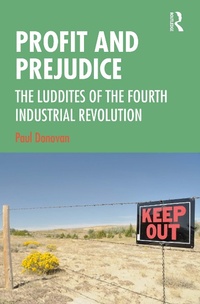
Profit and Prejudice
The Luddites of the Fourth Industrial Revolution
1st Edition
Published on 5. November 2020
274 pages
978-1-000-29234-3 (ISBN)
Description

Avoiding prejudice will be critical to economic success in the fourth industrial revolution. It is not the new and innovative technology that will matter in the next decade, but what we do with it. Using technology properly, with diverse decision making, is the difference between success and failure in a changing world. This will require putting the right person in the right job at the right time. Prejudice stops that happening.
Profit and Prejudice takes us through the relationship between economic success and prejudice in labour markets. It starts with the major changes that occur in periods of economic upheaval. These changes tend to be unpopular and complex - and complexity encourages people to turn to the simplistic arguments of 'scapegoat economics' and prejudice. Some of the changes of the fourth industrial revolution will help fight prejudice, but some will make it far worse. The more prejudice there is, the harder it will be for companies and countries to profit from the changes ahead. Profit is not the main argument against prejudice, but can certainly help fight it.
This book tells a story of the damage that prejudice can do. Using economics without jargon, students, investors and the public will be able to follow the narrative and see how prejudice can be opposed. Prejudice is bad for business and the economy. Profit and Prejudice explains why.
Profit and Prejudice takes us through the relationship between economic success and prejudice in labour markets. It starts with the major changes that occur in periods of economic upheaval. These changes tend to be unpopular and complex - and complexity encourages people to turn to the simplistic arguments of 'scapegoat economics' and prejudice. Some of the changes of the fourth industrial revolution will help fight prejudice, but some will make it far worse. The more prejudice there is, the harder it will be for companies and countries to profit from the changes ahead. Profit is not the main argument against prejudice, but can certainly help fight it.
This book tells a story of the damage that prejudice can do. Using economics without jargon, students, investors and the public will be able to follow the narrative and see how prejudice can be opposed. Prejudice is bad for business and the economy. Profit and Prejudice explains why.
Reviews / Votes
"With his trademark wit and deep insights, Paul Donovan tackles topics of enormous importance and relevance in Profit and Prejudice. Against the backdrop of worldwide protests against racism, sexism and other forms of prejudice, Paul explores the connections between capitalism, behavioral psychology and society to illuminate how conscious and unconscious bias lowers human welfare. Remarkably, he does so in easy-to-understand, jargon-free terms. This is a must read for anyone interested in how and why markets fail." - Larry Hatheway, Co-Founder, Jackson Hole Economics"In this engaging and timely book on the properties and problems of prejudice in the economy, Paul Donovan makes a compelling case for an upcoming generation embracing the fourth industrial revolution to turn its back on this particular type of irrational and damaging behaviour." - George Magnus, Associate at Oxford University's China Centre and Research Associate at SOAS, London
"Through engaging personal stories and thoughtful economic analyses, Paul explores how the turmoil of an economic revolution feeds prejudice and exclusion. He draws deep links between increasing economic inequality, status loss, and exclusion, but also reveals how to bridge the divide between industrial revolution and economic inclusion by sharing the gains of technology more equitably." - Vivienne Ming, CEO & Co-Founder, Socos Labs.
"Profit and Prejudice: The Luddites of the Fourth Industrial Revolution is the brilliant new book by Paul Donovan, chief economist of UBS Global Wealth Management. In the book, Donovan sets out the reasons why avoiding prejudice will be critical to economic success in a period of profound transition. He explains why the proper use of technology, with diverse decision-making, can be the difference between success and failure in a changing world." - The Bulletin with UBS, Monocle Radio, Episode 322, December 2020. "With his trademark wit and deep insights, Paul Donovan tackles topics of enormous importance and relevance in Profit and Prejudice. Against the backdrop of worldwide protests against racism, sexism and other forms of prejudice, Paul explores the connections between capitalism, behavioral psychology and society to illuminate how conscious and unconscious bias lowers human welfare. Remarkably, he does so in easy-to-understand, jargon-free terms. This is a must read for anyone interested in how and why markets fail." - Larry Hatheway, Co-Founder, Jackson Hole Economics
"In this engaging and timely book on the properties and problems of prejudice in the economy, Paul Donovan makes a compelling case for an upcoming generation embracing the fourth industrial revolution to turn its back on this particular type of irrational and damaging behaviour." - George Magnus, Associate at Oxford University's China Centre and Research Associate at SOAS, London
"Through engaging personal stories and thoughtful economic analyses, Paul explores how the turmoil of an economic revolution feeds prejudice and exclusion. He draws deep links between increasing economic inequality, status loss, and exclusion, but also reveals how to bridge the divide between industrial revolution and economic inclusion by sharing the gains of technology more equitably." - Vivienne Ming, CEO & Co-Founder, Socos Labs.
"With wit and a wonderfully straightforward style, Paul makes the case that prejudice of any kind prevents societies, organisations and people from fulfilling their potential. As Global politics and fake news become more polarising, and tap into the base fear of majority groups that they might lose out in a more inclusive world, Paul challenges us to be smart enough to heed the lessons of history and make different choices." - Carolanne Minashi, Global Head of Diversity & Inclusion UBS.
"Profit and Prejudice: The Luddites of the Fourth Industrial Revolution is the brilliant new book by Paul Donovan, chief economist of UBS Global Wealth Management. In the book, Donovan sets out the reasons why avoiding prejudice will be critical to economic success in a period of profound transition. He explains why the proper use of technology, with diverse decision-making, can be the difference between success and failure in a changing world." - The Bulletin with UBS, Monocle Radio, Episode 322, December 2020.
More details
Edition
1. Auflage
Language
English
Place of publication
London
United Kingdom
Publishing group
Taylor & Francis Ltd
Target group
College/higher education
Professional and scholarly
File size
3,70 MB
ISBN-13
978-1-000-29234-3 (9781000292343)
Copyright in bibliographic data and cover images is held by Nielsen Book Services Limited or by the publishers or by their respective licensors: all rights reserved.
Schweitzer Classification
Other editions
Additional editions
Book
04/2022
1st Edition
Routledge
€17.86
The article will not be published
Book
11/2020
1st Edition
Routledge
€45.60
Shipment within 15-20 days
Person
Paul Donovan joined UBS in 1992 as an intern. He is a managing director, and Chief Economist for UBS Global Wealth Management. Paul is responsible for formulating and presenting views on economics and policy.
Content
1. Profit and Prejudice 2. Past revolutions we have had 3. The revolution has started 4. Change and prejudice 5. Does technology make prejudice worse? The good news 6. Does technology make prejudice worse? The bad news 7. The economic damage of prejudice - Part 1: Firms 8. The economic damage of prejudice - Part 2: The economy9. The economic damage of gender prejudice 10. The economic damage of sexuality prejudice 11. Fighting back 12. Profit and prejudice
