

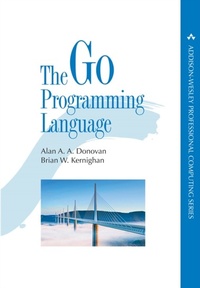
Go Programming Language, The
1st Edition
Published on 7. October 2015
400 pages
978-0-13-419055-6 (ISBN)
Description

The Go Programming Language is the authoritative resource for any programmer who wants to learn Go. It shows how to write clear and idiomatic Go to solve real-world problems. The book does not assume prior knowledge of Go nor experience with any specific language, so you'll find it accessible whether you're most comfortable with JavaScript, Ruby, Python, Java, or C++.
The first chapter is a tutorial on the basic concepts of Go, introduced through programs for file I/O and text processing, simple graphics, and web clients and servers.
Early chapters cover the structural elements of Go programs: syntax, control flow, data types, and the organization of a program into packages, files, and functions. The examples illustrate many packages from the standard library and show how to create new ones of your own. Later chapters explain the package mechanism in more detail, and how to build, test, and maintain projects using the go tool.
The chapters on methods and interfaces introduce Go's unconventional approach to object-oriented programming, in which methods can be declared on any type and interfaces are implicitly satisfied. They explain the key principles of encapsulation, composition, and substitutability using realistic examples.
Two chapters on concurrency present in-depth approaches to this increasingly important topic. The first, which covers the basic mechanisms of goroutines and channels, illustrates the style known as communicating sequential processes for which Go is renowned. The second covers more traditional aspects of concurrency with shared variables. These chapters provide a solid foundation for programmers encountering concurrency for the first time.
The final two chapters explore lower-level features of Go. One covers the art of metaprogramming using reflection. The other shows how to use the unsafe package to step outside the type system for special situations, and how to use the cgo tool to create Go bindings for C libraries.
The book features hundreds of interesting and practical examples of well-written Go code that cover the whole language, its most important packages, and a wide range of applications. Each chapter has exercises to test your understanding and explore extensions and alternatives. Source code is freely available for download from http://gopl.io/ and may be conveniently fetched, built, and installed using the go get command.
The first chapter is a tutorial on the basic concepts of Go, introduced through programs for file I/O and text processing, simple graphics, and web clients and servers.
Early chapters cover the structural elements of Go programs: syntax, control flow, data types, and the organization of a program into packages, files, and functions. The examples illustrate many packages from the standard library and show how to create new ones of your own. Later chapters explain the package mechanism in more detail, and how to build, test, and maintain projects using the go tool.
The chapters on methods and interfaces introduce Go's unconventional approach to object-oriented programming, in which methods can be declared on any type and interfaces are implicitly satisfied. They explain the key principles of encapsulation, composition, and substitutability using realistic examples.
Two chapters on concurrency present in-depth approaches to this increasingly important topic. The first, which covers the basic mechanisms of goroutines and channels, illustrates the style known as communicating sequential processes for which Go is renowned. The second covers more traditional aspects of concurrency with shared variables. These chapters provide a solid foundation for programmers encountering concurrency for the first time.
The final two chapters explore lower-level features of Go. One covers the art of metaprogramming using reflection. The other shows how to use the unsafe package to step outside the type system for special situations, and how to use the cgo tool to create Go bindings for C libraries.
The book features hundreds of interesting and practical examples of well-written Go code that cover the whole language, its most important packages, and a wide range of applications. Each chapter has exercises to test your understanding and explore extensions and alternatives. Source code is freely available for download from http://gopl.io/ and may be conveniently fetched, built, and installed using the go get command.
All prices
More details
Series
Edition
1. Auflage
Language
English
Place of publication
Boston
United States
Publishing group
Pearson Education (US)
Target group
College/higher education
File size
4,13 MB
ISBN-13
978-0-13-419055-6 (9780134190556)
Copyright in bibliographic data and cover images is held by Nielsen Book Services Limited or by the publishers or by their respective licensors: all rights reserved.
Schweitzer Classification
Other editions
Additional editions
Alan Donovan | Alan A. A. Donovan | Brian W. Kernighan
Go Programming Language, The
Book
11/2015
1st Edition
Addison Wesley
€44.99
Available immediately
Persons
Alan A. A. Donovan is a member of Google's Go team in New York. He holds computer science degrees from Cambridge and MIT and has been programming in industry since 1996. Since 2005, he has worked at Google on infrastructure projects and was the co-designer of its proprietary build system, Blaze. He has built many libraries and tools for static analysis of Go programs, including oracle, godoc -analysis, eg, and gorename.
Brian W. Kernighan is a professor in the Computer Science Department at Princeton University. He was a member of technical staff in the Computing Science Research Center at Bell Labs from 1969 until 2000, where he worked on languages and tools for Unix. He is the co-author of several books, including The C Programming Language, Second Edition (Prentice Hall, 1988), and The Practice of Programming (Addison-Wesley, 1999).
Brian W. Kernighan is a professor in the Computer Science Department at Princeton University. He was a member of technical staff in the Computing Science Research Center at Bell Labs from 1969 until 2000, where he worked on languages and tools for Unix. He is the co-author of several books, including The C Programming Language, Second Edition (Prentice Hall, 1988), and The Practice of Programming (Addison-Wesley, 1999).
Content
Preface xi
Chapter 1: Tutorial 1
1.1 Hello, World 1
1.2 Command-Line Arguments 4
1.3 Finding Duplicate Lines 8
1.4 Animated GIFs 13
1.5 Fetching a URL 15
1.6 Fetching URLs Concurrently 17
1.7 A Web Server 19
1.8 Loose Ends 23
Chapter 2: Program Structure 27
2.1 Names 27
2.2 Declarations 28
2.3 Variables 30
2.4 Assignments 36
2.5 Type Declarations 39
2.6 Packages and Files 41
2.7 Scope 45
Chapter 3: Basic Data Types 51
3.1 Integers 51
3.2 Floating-Point Numbers 56
3.3 Complex Numbers 61
3.4 Booleans 63
3.5 Strings 64
3.6 Constants 75
Chapter 4: Composite Types 81
4.1 Arrays 81
4.2 Slices 84
4.3 Maps 93
4.4 Structs 99
4.5 JSON 107
4.6 Text and HTML Templates 113
Chapter 5: Functions 119
5.1 Function Declarations 119
5.2 Recursion 121
5.3 Multiple Return Values 124
5.4 Errors 127
5.5 Function Values 132
5.6 Anonymous Functions 135
5.7 Variadic Functions 142
5.8 Deferred Function Calls 143
5.9 Panic 148
5.10 Recover 151
Chapter 6:. Methods 155
6.1 Method Declarations 155
6.2 Methods with a Pointer Receiver 158
6.3 Composing Types by Struct Embedding 161
6.4 Method Values and Expressions 164
6.5 Example: Bit Vector Type 165
6.6 Encapsulation 168
Chapter 7: Interfaces 171
7.1 Interfaces as Contracts 171
7.2 Interface Types 174
7.3 Interface Satisfaction 175
7.4 Parsing Flags with flag.Value 179
7.5 Interface Values 181
7.6 Sorting with sort.Interface 186
7.7 The http.Handler Interface 191
7.8 The error Interface 196
7.9 Example: Expression Evaluator 197
7.10 Type Assertions 205
7.11 Discriminating Errors with Type Assertions 206
7.12 Querying Behaviors with Interface Type Assertions 208
7.13 Type Switches 210
7.14 Example: Token-Based XML Decoding 213
7.15 A Few Words of Advice 216
Chapter 8: Goroutines and Channels 217
8.1 Goroutines 217
8.2 Example: Concurrent Clock Server 219
8.3 Example: Concu rent Echo Server 222
8.4 Channels 225
8.5 Looping in Parallel 234
8.6 Example: Concurrent Web Crawler 239
8.7 Multiplexing with select 244
8.8 Example: Concurrent Directory Traversal 247
8.9 Cancellation 251
8.10 Example: Chat Server 253
Chapter 9: Concurrency with Shared Variables 257
9.1 Race Conditions 257
9.2 Mutual Exclusion: sync.Mutex 262
9.3 Read/Write Mutexes: sync.RWMutex 266
9.4 Memory Synchronization 267
9.5 Lazy Initialization: sync.Once 268
9.6 The Race Detector 271
9.7 Example: Concurrent Non-Blocking Cache 272
9.8 Goroutines and Threads 280
Chapter 10: Packages and the Go Tool 283
10.1 Introduction 283
10.2 Import Paths 284
10.3 The Package Declaration 285
10.4 Import Declarations 285
10.5 Blank Imports 286
10.6 Packages and Naming 289
10.7 The Go Tool 290
Chapter 11: Testing 301
11.1 The go test Tool 302
11.2 Test Functions 302
11.3 Coverage 318
11.4 Benchmark Functions 321
11.5 Profiling 323
11.6 Example Functions 326
Chapter 12: Reflection 329
12.1 Why Reflection? 329
12.2 reflect.Type and reflect.Value 330
12.3 Display, a Recursive Value Printer 333
12.4 Example: Encoding S-Expressions 338
12.5 Setting Variables with reflect.Value 341
12.6 Example: Decoding S-Expressions 344
12.7 Accessing Struct Field Tags 348
12.8 Displaying the Methods of a Type 351
12.9 A Word of Caution 352
Chapter 13: Low-Level Programming 353
13.1 unsafe.Sizeof, Alignof, and Offsetof 354
13.2 unsafe.Pointer 356
13.3 Example: Deep Equivalence 358
13.4 Calling C Code with cgo 361
13.5 Another Word of Caution 366
Index 367
Chapter 1: Tutorial 1
1.1 Hello, World 1
1.2 Command-Line Arguments 4
1.3 Finding Duplicate Lines 8
1.4 Animated GIFs 13
1.5 Fetching a URL 15
1.6 Fetching URLs Concurrently 17
1.7 A Web Server 19
1.8 Loose Ends 23
Chapter 2: Program Structure 27
2.1 Names 27
2.2 Declarations 28
2.3 Variables 30
2.4 Assignments 36
2.5 Type Declarations 39
2.6 Packages and Files 41
2.7 Scope 45
Chapter 3: Basic Data Types 51
3.1 Integers 51
3.2 Floating-Point Numbers 56
3.3 Complex Numbers 61
3.4 Booleans 63
3.5 Strings 64
3.6 Constants 75
Chapter 4: Composite Types 81
4.1 Arrays 81
4.2 Slices 84
4.3 Maps 93
4.4 Structs 99
4.5 JSON 107
4.6 Text and HTML Templates 113
Chapter 5: Functions 119
5.1 Function Declarations 119
5.2 Recursion 121
5.3 Multiple Return Values 124
5.4 Errors 127
5.5 Function Values 132
5.6 Anonymous Functions 135
5.7 Variadic Functions 142
5.8 Deferred Function Calls 143
5.9 Panic 148
5.10 Recover 151
Chapter 6:. Methods 155
6.1 Method Declarations 155
6.2 Methods with a Pointer Receiver 158
6.3 Composing Types by Struct Embedding 161
6.4 Method Values and Expressions 164
6.5 Example: Bit Vector Type 165
6.6 Encapsulation 168
Chapter 7: Interfaces 171
7.1 Interfaces as Contracts 171
7.2 Interface Types 174
7.3 Interface Satisfaction 175
7.4 Parsing Flags with flag.Value 179
7.5 Interface Values 181
7.6 Sorting with sort.Interface 186
7.7 The http.Handler Interface 191
7.8 The error Interface 196
7.9 Example: Expression Evaluator 197
7.10 Type Assertions 205
7.11 Discriminating Errors with Type Assertions 206
7.12 Querying Behaviors with Interface Type Assertions 208
7.13 Type Switches 210
7.14 Example: Token-Based XML Decoding 213
7.15 A Few Words of Advice 216
Chapter 8: Goroutines and Channels 217
8.1 Goroutines 217
8.2 Example: Concurrent Clock Server 219
8.3 Example: Concu rent Echo Server 222
8.4 Channels 225
8.5 Looping in Parallel 234
8.6 Example: Concurrent Web Crawler 239
8.7 Multiplexing with select 244
8.8 Example: Concurrent Directory Traversal 247
8.9 Cancellation 251
8.10 Example: Chat Server 253
Chapter 9: Concurrency with Shared Variables 257
9.1 Race Conditions 257
9.2 Mutual Exclusion: sync.Mutex 262
9.3 Read/Write Mutexes: sync.RWMutex 266
9.4 Memory Synchronization 267
9.5 Lazy Initialization: sync.Once 268
9.6 The Race Detector 271
9.7 Example: Concurrent Non-Blocking Cache 272
9.8 Goroutines and Threads 280
Chapter 10: Packages and the Go Tool 283
10.1 Introduction 283
10.2 Import Paths 284
10.3 The Package Declaration 285
10.4 Import Declarations 285
10.5 Blank Imports 286
10.6 Packages and Naming 289
10.7 The Go Tool 290
Chapter 11: Testing 301
11.1 The go test Tool 302
11.2 Test Functions 302
11.3 Coverage 318
11.4 Benchmark Functions 321
11.5 Profiling 323
11.6 Example Functions 326
Chapter 12: Reflection 329
12.1 Why Reflection? 329
12.2 reflect.Type and reflect.Value 330
12.3 Display, a Recursive Value Printer 333
12.4 Example: Encoding S-Expressions 338
12.5 Setting Variables with reflect.Value 341
12.6 Example: Decoding S-Expressions 344
12.7 Accessing Struct Field Tags 348
12.8 Displaying the Methods of a Type 351
12.9 A Word of Caution 352
Chapter 13: Low-Level Programming 353
13.1 unsafe.Sizeof, Alignof, and Offsetof 354
13.2 unsafe.Pointer 356
13.3 Example: Deep Equivalence 358
13.4 Calling C Code with cgo 361
13.5 Another Word of Caution 366
Index 367
