

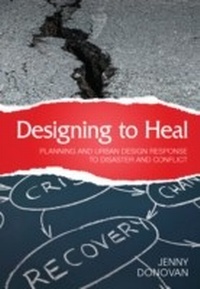
Designing to Heal
Planning and Urban Design Response to Disaster and Conflict
1st Edition
Published on 22. April 2013
287 pages
978-0-643-10647-5 (ISBN)
Description

Designing to Heal explores what happens to communities that have suffered disasters, either natural or man-made, and what planners and urban designers can do to give the affected communities the best possible chance of recovery. It examines the relationship that people have with their surroundings and the profound disruption to people's lives that can occur when that relationship is violently changed, when the familiar settings for their lives are destroyed and family, friends and neighbours are displaced, incapacitated or killed. The book offers a model of the healing process, outlining the emotional journey that people go on as they struggle to rebuild their lives. It outlines the characteristics of the built environment that may facilitate people to travel as smoothly as possible down this road to recovery and suggests elements of the design process that can help achieve this goal. Designing to Heal highlights the importance of thinking about urban design as a way of nurturing hope and creating the optimal conditions to achieve social objectives.
More details
Other editions
Additional editions
Book
04/2013
CSIRO Publishing
€97.50
Article exhausted; check different version
Content
- Intro
- Title
- Copyright
- Contents
- Acknowledgements
- Chapter 1 Introduction
- About this book
- The relationship between people and place
- Providing for human habitat
- The focus on cities
- Urban design
- Understanding disasters
- Why is responding to disasters an important and growing issue?
- Chapter 2 The high cost of living
- The changed relationship between people and place
- Emotional/psychological effects
- The fuzzy edges of disasters
- Loss of potential
- The implications for planning and urban design
- The silver lining - the positive effects of disasters
- Chapter 3 Recovering from disaster
- The timeline of disaster recovery
- Factors that influence the healing process
- Resilience and adaptive capacity
- Resilience and social capital
- Uncertainty
- Division and reconciliation
- Unintended consequences
- Displacement
- Disasters and echo disasters
- Hope - light at the end of the tunnel or an oncoming train?
- Chapter 4 Sixteen acres in Manhattan
- Background
- The impacts of the disaster
- Community responses
- Deciding the future of the site
- The memorial garden
- The museum
- Observations about the process
- Observations about the design
- Conclusions
- Chapter 5 Rebuilding political, social and human capital on Montserrat
- Timeline of disaster
- The impact of the disaster on the community
- Responding to the crisis
- Rehousing the displaced people
- Conclusions
- Chapter 6 Building bridges out of flags, murals, a prison and a shopping centre in Belfast
- Background
- Progressive space and regressive space
- Housing issues
- Putting the divisions into perspective
- Overcoming the legacy of the Troubles
- Belfast Flags of Hope
- The Re-imaging Communities program
- Mary McKee - putting the jigsaw together
- SLIG and the Stewartstown Road Regeneration Project
- Chapter 7 Providing hope for children in Addis Ababa, Ethiopia
- Addis Ababa
- Hope for Children projects
- Hope for Children Village
- Fast food outlet and village green
- School of St Yared
- Chapter 8 Giving new meaning to a tsunami-devastated beach, Hambantota, Sri Lanka
- Goal
- Objectives
- Hambantota Beach Park
- The Beach Concept Plan
- The proposals
- Outcomes
- Understanding local ways of getting things done
- Chapter 9 Loss and identity, rebuilding communities and buildings after the Victorian bushfires
- Kinglake and Marysville
- The conditions leading up to Black Saturday
- The fire
- The aftermath
- The responses
- Max Ginn - temporary villages
- Rebuilding advisors
- Rebuilding Advisory Centres
- Narbethong Community Hall
- El Kanah
- Memorials
- Experiences of the recovery
- Conclusions
- Chapter 10 Designing to heal
- Who is responsible for 'designing to heal'?
- Who are we designing for?
- Time
- The balance of factors that encourage or discourage community life
- Efficiency
- Build back better
- Planning to heal
- Typical 'designing to heal' process
- Chapter 11 The characteristics of places that are designed to heal
- Providing opportunity
- Places that invite occupation
- Resonance
- Polyvalence
- Flexibility
- Connectivity
- Reassurance
- Lessons learnt
- References
- Appendix 1: Interview with Tony McHugh: facilitating the healing process
- Appendix 2: Murrindindi Shire memorials guidelines
- Index
