

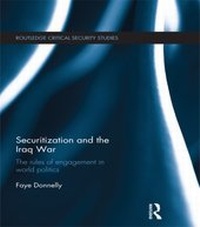
Securitization and the Iraq War
The rules of engagement in world politics
1st Edition
Published on 15. August 2013
208 pages
978-1-135-13181-4 (ISBN)
Description

This book critiques the conceptualization of security found in mainstream and critical theoretical debates, and applies this to the empirical case of the 2003 Iraq War.
The Iraq War represents one of the most puzzling, complex, and controversial events in the post-Cold War era. The manner in which the Bush administration finally decided to hold Saddam Hussein accountable through military intervention provoked a worldwide outcry due to the narratives they constructed to justify the "pre-emptive use of force" and "enhanced interrogation techniques."
Responding to constructivist and post-structuralist scholars' calls for a turn to discourse, and aligning its argument with critical security studies, particularly the Copenhagen School (CS), this book conceptualizes language as a pivotal mechanism of power. Adopting a Wittgensteinian approach, it moves away from thinking about the nexus between security and language from a single action, or speech act, to a series of actions or interactions. To illustrate this new approach, the author examines two cases in particular: the UN inspectors' finding that there was no credible evidence that Iraq possessed weapons of mass destruction (WMD) in early 2003 and the Abu Ghraib scandal in 2004. Both events show that the boundaries and relations between securitized rules and environments are not pre-given but produced in a particular language game.
This book will be of much interest to students of critical security studies, US foreign policy, and IR in general.
The Iraq War represents one of the most puzzling, complex, and controversial events in the post-Cold War era. The manner in which the Bush administration finally decided to hold Saddam Hussein accountable through military intervention provoked a worldwide outcry due to the narratives they constructed to justify the "pre-emptive use of force" and "enhanced interrogation techniques."
Responding to constructivist and post-structuralist scholars' calls for a turn to discourse, and aligning its argument with critical security studies, particularly the Copenhagen School (CS), this book conceptualizes language as a pivotal mechanism of power. Adopting a Wittgensteinian approach, it moves away from thinking about the nexus between security and language from a single action, or speech act, to a series of actions or interactions. To illustrate this new approach, the author examines two cases in particular: the UN inspectors' finding that there was no credible evidence that Iraq possessed weapons of mass destruction (WMD) in early 2003 and the Abu Ghraib scandal in 2004. Both events show that the boundaries and relations between securitized rules and environments are not pre-given but produced in a particular language game.
This book will be of much interest to students of critical security studies, US foreign policy, and IR in general.
More details
Series
Language
English
Place of publication
London
United Kingdom
Publishing group
Taylor & Francis Ltd
Target group
College/higher education
Professional and scholarly
File size
1,40 MB
ISBN-13
978-1-135-13181-4 (9781135131814)
Copyright in bibliographic data and cover images is held by Nielsen Book Services Limited or by the publishers or by their respective licensors: all rights reserved.
Schweitzer Classification
Other editions
Additional editions
Book
08/2013
1st Edition
Routledge
€230.27
Shipment within 15-20 days
Person
Faye Donnelly is a lecturer in the Department of International Relations at the University of St Andrews, and has PhD in International Relations.
Content
Introduction 1. Why Language Matters 2. Speaking Security: Securitisation and its Limitations 3. From a Speech Act towards a Language Game 4. Abu Ghraib: The Limits of a Language Game Conclusion: A Different Way of Speaking Security: Conclusions and Developments
