

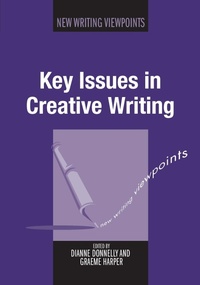
Key Issues in Creative Writing
Published on 14. November 2012
232 pages
978-1-84769-849-0 (ISBN)
Description

Key Issues in Creative Writing explores a range of important issues that inform the practice and understanding of creative writing. The collection considers creative writing learning and teaching as well as creative writing research. Contributors target debates that arise because of the nature of creative writing. These experts - from the UK, USA and Australia - specifically examine creative writing as a subject in universities and colleges and discuss both the creative knowledge and the critical understanding informing the subject and its future. Finally, this volume suggests ways in which addressing current issues will produce significant disciplinary knowledge that will contribute to the success of creative writing in current and future academic environments.
Reviews / Votes
Creative writers studying, researching and teaching in universities are facing deep unsettling change, as are universities themselves and the economies in which they are embedded. Writers as individuals know about the creative value of uncertainty, experiment, bold thinking and embracing contradictions; this provocative collection points to ways of doing this for the discipline as a whole. With perspectives from the US, the UK and Australia, this is globalized thinking in the good sense - not homogenized but expanded by considering their deep differences as well as their shared interests. Here is an array of possibilities by which creative writing may not simply survive but positively evolve. -- Philip Gross, Glamorgan University, UK More than any other book currently available, Key Issues in Creative Writing maps out the possibilities and problems that confront creative writing in the academy in the early decades of the twenty-first century. Refusing to isolate creative writing from the complex and turbulent worlds it must inhabit, the contributors to this volume provide an absolutely indispensable overview of the issues facing the field. If you are interested in the future of creative writing as an academic enterprise, you simply must read this book. -- Timothy Mayers, Millersville University of Pennsylvania, USAMore details
Series
Language
English
Place of publication
Bristol
United Kingdom
Publishing group
Channel View Publications Ltd
Target group
Professional and scholarly
ISBN-13
978-1-84769-849-0 (9781847698490)
Copyright in bibliographic data and cover images is held by Nielsen Book Services Limited or by the publishers or by their respective licensors: all rights reserved.
Schweitzer Classification
Other editions
Additional editions
Dianne Donnelly | Graeme Harper
Key Issues in Creative Writing
Book
11/2012
Multilingual Matters
€47.70
Shipment within 10-20 days
Persons
Dianne Donnelly, PhD, is the author of Establishing Creative Writing Studies as an Academic Discipline (2011) and the editor of Does the Writing Workshop Still Work? (2010). She is a regular contributor to the theory and pedagogy of creative writing and a frequent presenter at CCCC and AWP on creative writing pedagogy. She is on the editorial board for New Writing: The International Journal for the Practice and Theory of Creative Writing and Writing Commons, referees for the online peer-reviewed journal TEXT, and teaches writing at the University of South Florida.
Graeme Harper, DCA PhD, is Professor and Director of The Honors College at Oakland University, Michigan. He has held professorships in the UK, USA and Australia, is an honorary professor in the UK and the Editor-in-Chief of New Writing: the International Journal for the Practice and Theory of Creative Writing. He recently also published On Creative Writing (2010), and is currently working on Creative Writing Challenges. A winner of the National Book Council Award for New Fiction (Aust.), and a Commonwealth Scholarship, he is Editor of the New Writing Viewpoints book series.
Graeme Harper, DCA PhD, is Professor and Director of The Honors College at Oakland University, Michigan. He has held professorships in the UK, USA and Australia, is an honorary professor in the UK and the Editor-in-Chief of New Writing: the International Journal for the Practice and Theory of Creative Writing. He recently also published On Creative Writing (2010), and is currently working on Creative Writing Challenges. A winner of the National Book Council Award for New Fiction (Aust.), and a Commonwealth Scholarship, he is Editor of the New Writing Viewpoints book series.
Content
Acknowledgements
Introduction: Dianne Donnelly and Graeme Harper: Key Issues and Global Perspectives in Creative Writing
Part I
Chapter 1: Dianne Donnelly: Reshaping Creative Writing: Power and Agency in the Academy
Chapter 2: Mimi Thebo: Hey, Babe, Take a Walk on the Wild Side-Creative Writing in Universities
Chapter 3: Graeme Harper: Creative Writing Habitats
Chapter 4: Steve Healey: Beyond the Literary: Why Creative Literacy Matters
Chapter 5: Katharine Haake: To Fill with Milk: Or, the Thing and Itself
Chapter 6: Graeme Harper: Research in Creative Writing
Chapter 7: Dianne Donnelly: Creative Writing Knowledge
Part II
Chapter 8: Stephanie Vanderslice: Teaching Toward the Future
Chapter 9: Indigo Perry: Holding on and Letting Go
Chapter 10: Program Design and the Making of Successful Programs
10.1 Nigel McLoughlin: Building a Better Elephant Machine: A Case Study in Creative Writing Program Design
10.2 Patrick Bizzaro: The Future of Graduate Studies in Creative Writing: Institutionalizing Literary Writing Conclusion: Dianne Donnelly and Graeme Harper: Investigating Key Issues in Creative Writing
Introduction: Dianne Donnelly and Graeme Harper: Key Issues and Global Perspectives in Creative Writing
Part I
Chapter 1: Dianne Donnelly: Reshaping Creative Writing: Power and Agency in the Academy
Chapter 2: Mimi Thebo: Hey, Babe, Take a Walk on the Wild Side-Creative Writing in Universities
Chapter 3: Graeme Harper: Creative Writing Habitats
Chapter 4: Steve Healey: Beyond the Literary: Why Creative Literacy Matters
Chapter 5: Katharine Haake: To Fill with Milk: Or, the Thing and Itself
Chapter 6: Graeme Harper: Research in Creative Writing
Chapter 7: Dianne Donnelly: Creative Writing Knowledge
Part II
Chapter 8: Stephanie Vanderslice: Teaching Toward the Future
Chapter 9: Indigo Perry: Holding on and Letting Go
Chapter 10: Program Design and the Making of Successful Programs
10.1 Nigel McLoughlin: Building a Better Elephant Machine: A Case Study in Creative Writing Program Design
10.2 Patrick Bizzaro: The Future of Graduate Studies in Creative Writing: Institutionalizing Literary Writing Conclusion: Dianne Donnelly and Graeme Harper: Investigating Key Issues in Creative Writing
