

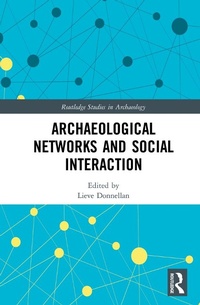
Archaeological Networks and Social Interaction
1st Edition
Published on 3. April 2020
238 pages
978-1-351-00304-9 (ISBN)
Description

Archaeological Networks and Social Interaction focuses on conceptualisations of human interaction, human-thing entanglement, material affordances and agency.
Network concepts in the archaeological discipline are ubiquitous these days. They range from loose concepts, used as metaphors to address a notion of connectivity, to highly formal and mathematically complex predictions of human behaviour. These different networked worlds sometimes clash and rarely converge. Archaeologists interested in network analysis, however, have achieved a much better understanding of the implications of adopting formal methods for studying social interaction and there have been theoretical advancements realising a better synergy between different theoretical perspectives. These nascent concerns are explored further in this volume with regional specialists exploring case studies from Prehistory to the Middle Ages throughout the Ancient and New Worlds, outlining how formal network approaches contribute to studying social interaction archaeologically.
This book will be of interest to archaeologists wishing to access the latest research on networks and interconnectivity and how these approaches have been productively modified to archaeological research.
Network concepts in the archaeological discipline are ubiquitous these days. They range from loose concepts, used as metaphors to address a notion of connectivity, to highly formal and mathematically complex predictions of human behaviour. These different networked worlds sometimes clash and rarely converge. Archaeologists interested in network analysis, however, have achieved a much better understanding of the implications of adopting formal methods for studying social interaction and there have been theoretical advancements realising a better synergy between different theoretical perspectives. These nascent concerns are explored further in this volume with regional specialists exploring case studies from Prehistory to the Middle Ages throughout the Ancient and New Worlds, outlining how formal network approaches contribute to studying social interaction archaeologically.
This book will be of interest to archaeologists wishing to access the latest research on networks and interconnectivity and how these approaches have been productively modified to archaeological research.
More details
Series
Edition
1. Auflage
Language
English
Place of publication
London
United Kingdom
Publishing group
Taylor & Francis Ltd
Target group
College/higher education
Product notice
Reflowable
Illustrations
8 Tables, black and white; 66 Line drawings, black and white; 37 Halftones, black and white; 103 Illustrations, black and white
ISBN-13
978-1-351-00304-9 (9781351003049)
Copyright in bibliographic data and cover images is held by Nielsen Book Services Limited or by the publishers or by their respective licensors: all rights reserved.
Schweitzer Classification
Other editions
Additional editions
Lieve Donnellan
Archaeological Networks and Social Interaction
Book
12/2021
1st Edition
Routledge
€67.30
Shipment within 10-20 days
Lieve Donnellan
Archaeological Networks and Social Interaction
Book
04/2020
1st Edition
Routledge
€230.27
Shipment within 10-20 days
Person
Lieve Donnellan is Assistant Professor of Classical Archaeology at Aarhus University in Denmark. She specialises in the study of networks and forms of interaction in the Ancient Mediterranean and has a keen interest in digital methodologies and archaeological theories.
Content
1. Archaeological networks and social interaction
2. Relational concepts and challenges to network analysis in social archaeology
3. Entangled identities: processes of status construction in late Urnfield burials
4. Distributed feasts: reciprocity, hospitality and banquets in Iron Age to Orientalising central and southern Italy
5. Marble networks: social interaction in houses at Pompeii
6. Objects that bind, objects that separate
7. A complex beadwork: bead trade and trade beads in Scandinavia ca. 800-1000 AD revisited
8. Social network analysis and the social interactions that define Hopewell
9. Terrestrial communication networks and political agency in Early Iron Age Central Italy (950-500 BCE): a bottom-up approach
2. Relational concepts and challenges to network analysis in social archaeology
3. Entangled identities: processes of status construction in late Urnfield burials
4. Distributed feasts: reciprocity, hospitality and banquets in Iron Age to Orientalising central and southern Italy
5. Marble networks: social interaction in houses at Pompeii
6. Objects that bind, objects that separate
7. A complex beadwork: bead trade and trade beads in Scandinavia ca. 800-1000 AD revisited
8. Social network analysis and the social interactions that define Hopewell
9. Terrestrial communication networks and political agency in Early Iron Age Central Italy (950-500 BCE): a bottom-up approach
