

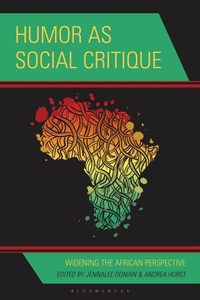
Humor as Social Critique
Widening the African Perspective
Published on 4. September 2025
272 pages
978-1-9787-4932-0 (ISBN)
Description

This interdisciplinary collection by Jennalee Donian and Andrea Hurst brings together insights from various humanities disciplines to examine humor's role in navigating complex political, cultural, and personal landscapes.
Humor as Social Critique: Widening the African Perspective explores how humor functions as a powerful tool for social critique in the African context. Part I delves into humor's relationship with political critique, analyzing how comedians, writers, and artists use humor to resist oppressive power structures and foster dialogue. Part II examines humor's potential for socio-cultural critique, exploring how it reflects and shapes cultural norms, identities, and power dynamics. Part III investigates the role of humor in self-critique, highlighting its therapeutic potential and ability to promote humility and self-awareness. By centering African perspectives while engaging with global voices, Humor as Social Critique challenges the notion that humor is a uniquely localized phenomenon. Instead, it celebrates humor's ability to transcend geographical and cultural boundaries, enriching the tapestry of human experience. This book offers valuable insights for scholars and readers interested in the intersections of humor, culture, and social justice.
Humor as Social Critique: Widening the African Perspective explores how humor functions as a powerful tool for social critique in the African context. Part I delves into humor's relationship with political critique, analyzing how comedians, writers, and artists use humor to resist oppressive power structures and foster dialogue. Part II examines humor's potential for socio-cultural critique, exploring how it reflects and shapes cultural norms, identities, and power dynamics. Part III investigates the role of humor in self-critique, highlighting its therapeutic potential and ability to promote humility and self-awareness. By centering African perspectives while engaging with global voices, Humor as Social Critique challenges the notion that humor is a uniquely localized phenomenon. Instead, it celebrates humor's ability to transcend geographical and cultural boundaries, enriching the tapestry of human experience. This book offers valuable insights for scholars and readers interested in the intersections of humor, culture, and social justice.
More details
Language
English
Place of publication
New York
United States
Publishing group
Bloomsbury Publishing Plc
Target group
Professional and scholarly
Illustrations
1 table, 15 bw photos, 1 bw illus
File size
5,37 MB
ISBN-13
978-1-9787-4932-0 (9781978749320)
Copyright in bibliographic data and cover images is held by Nielsen Book Services Limited or by the publishers or by their respective licensors: all rights reserved.
Schweitzer Classification
Other editions
Additional editions
Book
11/2025
Rowman & Littlefield Publishers
€119.70
Shipment within 3-4 weeks
Persons
Jennalee Donian is NIHSS-ISCIA post-doctoral fellow at Nelson Mandela University, South Africa.
Andrea Hurst is Professor of Philosophy and the NRF SARChI Chair (ISCIA) at Nelson Mandela University, South Africa.
Andrea Hurst is Professor of Philosophy and the NRF SARChI Chair (ISCIA) at Nelson Mandela University, South Africa.
Content
Introduction: Humor, Critique, and the African Context, Jennalee Donian (Nelson Mandela University, South Africa) and Andrea Hurst (Nelson Mandela University, South Africa)
Part I: Humor and Political Critique
1. Deflating Populist Bubbles: From Satirical Irony to Good-Humored Resistance, Christopher Allsobrook (University of Fort Hare, South Africa)
2. "Laughtivistic" Webcomics: The Virtual Carnival of Liminal Spaces, Dina Oleimy (The American University in Cairo, Egypt)
3. "Guys, we are Called for a Family Meeting": Humor, Family Metaphor, and the COVID-19 Pandemic in South Africa, Robin K. Crigler (Johannesburg Institute for Advanced Study, South Africa)
4. The Africanist Presence in the Double Satire of Warren Beatty's Bulworth, Rodney Taveira (University of Sydney, Australia)
Part II: Humor and Socio-Cultural Critique
5. Exploring Incongruency, Superiority, and Relief in Trevor Noah's Born a Crime, Alfred Schaffer (Stellenbosch University, South Africa) and Aletta Simpson (Stellenbosch University, South Africa)
6. "Humor Midwifery" and the Power of the "HumPract" on African Social Media, Taiwo Oloruntoba-Oju (University of Ilorin, Nigeria) and Ibukun Osuolale-Ajayi (University of Ilorin, Nigeria)
7. Laughing at Religion: Humor as a Vehicle for a Secular Spirituality, Patrick Giddy (University of KwaZulu-Natal, South Africa)
8. Weapons and Tools: Toward a Differential Analysis of Humor, Ian Buchanan (University of Wollongong, Australia)
Part III: Humor and Self-Critique
9. "The Wit-Machine" and the Shift from Critical Thinking to Complexity Thinking, Andrea Hurst (Nelson Mandela University, South Africa) and Jennalee Donian (Nelson Mandela University, South Africa)
10. The Ethical Value of Njakiri, Lawrence Ogbo Ugwuanyi (University of Abuja, Nigeria)
11. How to Fail: Stepping into the Clown, Klara Van Wyk (University of Cape Town, South Africa) and Abigail Wiese (Nelson Mandela University, South Africa)
Conclusion: The Power of Humor, Jennalee Donian (Nelson Mandela University, South Africa)
Index
About the Contributors
Part I: Humor and Political Critique
1. Deflating Populist Bubbles: From Satirical Irony to Good-Humored Resistance, Christopher Allsobrook (University of Fort Hare, South Africa)
2. "Laughtivistic" Webcomics: The Virtual Carnival of Liminal Spaces, Dina Oleimy (The American University in Cairo, Egypt)
3. "Guys, we are Called for a Family Meeting": Humor, Family Metaphor, and the COVID-19 Pandemic in South Africa, Robin K. Crigler (Johannesburg Institute for Advanced Study, South Africa)
4. The Africanist Presence in the Double Satire of Warren Beatty's Bulworth, Rodney Taveira (University of Sydney, Australia)
Part II: Humor and Socio-Cultural Critique
5. Exploring Incongruency, Superiority, and Relief in Trevor Noah's Born a Crime, Alfred Schaffer (Stellenbosch University, South Africa) and Aletta Simpson (Stellenbosch University, South Africa)
6. "Humor Midwifery" and the Power of the "HumPract" on African Social Media, Taiwo Oloruntoba-Oju (University of Ilorin, Nigeria) and Ibukun Osuolale-Ajayi (University of Ilorin, Nigeria)
7. Laughing at Religion: Humor as a Vehicle for a Secular Spirituality, Patrick Giddy (University of KwaZulu-Natal, South Africa)
8. Weapons and Tools: Toward a Differential Analysis of Humor, Ian Buchanan (University of Wollongong, Australia)
Part III: Humor and Self-Critique
9. "The Wit-Machine" and the Shift from Critical Thinking to Complexity Thinking, Andrea Hurst (Nelson Mandela University, South Africa) and Jennalee Donian (Nelson Mandela University, South Africa)
10. The Ethical Value of Njakiri, Lawrence Ogbo Ugwuanyi (University of Abuja, Nigeria)
11. How to Fail: Stepping into the Clown, Klara Van Wyk (University of Cape Town, South Africa) and Abigail Wiese (Nelson Mandela University, South Africa)
Conclusion: The Power of Humor, Jennalee Donian (Nelson Mandela University, South Africa)
Index
About the Contributors
