

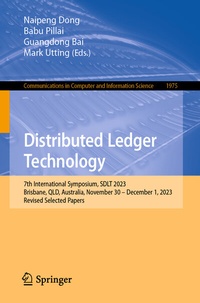
Distributed Ledger Technology
7th International Symposium, SDLT 2023, Brisbane, QLD, Australia, November 30 - December 1, 2023, Revised Selected Papers
Published on 8. February 2024
IX, 147 pages
978-981-97-0006-6 (ISBN)
Description

This book constitutes the proceedings of the 7th International Symposium, SDLT 2023, held in Brisbane, QLD, Australia, during November 30 - December 1, 2023.
The 8 full papers and the short paper included in this volume were carefully reviewed and selected from 32 submissions. The volume focuses on current systems and new solutions to create a scientific background for a solid development of innovative Distributed Ledger Technology application.
More details
Series
Edition
1st ed. 2024
Language
English
Place of publication
Singapore
Singapore
Publishing group
Springer Singapore
Target group
Professional and scholarly
Product notice
Reflowable
Illustrations
IX, 147 p. 48 illus., 40 illus. in color.
File size
15,41 MB
ISBN-13
978-981-97-0006-6 (9789819700066)
DOI
10.1007/978-981-97-0006-6
Schweitzer Classification
Other editions
Additional editions
Naipeng Dong | Babu Pillai | Guangdong Bai
Distributed Ledger Technology
7th International Symposium, SDLT 2023, Brisbane, QLD, Australia, November 30 - December 1, 2023, Revised Selected Papers
Book
02/2024
Springer
€69.54
Shipment within 3-4 weeks
Content
- Intro
- Preface
- Organization
- Contents
- One-Phase Batch Update on Sparse Merkle Trees for Rollups
- 1 Introduction
- 2 Preliminaries
- 2.1 Leaf Operation
- 2.2 Sparse Merkle Tree
- 3 Related Work
- 4 One-Phase Batch Update on Sparse Merkle Tree
- 4.1 Leaf Operation Algorithms
- 4.2 Batch Update Algorithm
- 4.3 Comparison
- 5 Experimental Analysis
- 5.1 Experimental Setup
- 5.2 Dataset Collection
- 5.3 Multi-threading Optimisation
- 6 Evaluation
- 6.1 Micro-benchmarks
- 6.2 Macro-benchmark
- 7 Conclusion and Discussion
- 7.1 Future Work
- A zkSync Lite Details
- A.1 Design
- A.2 On-Chain
- A.3 Off-Chain
- B zkSync Lite Transaction Flow
- B.1 Overall Transaction Flow
- B.2 Transaction Flow Within Server
- C zkSync Transaction Types
- C.1 From Transactions to Leaf Operations
- C.2 Normal Transaction Types
- C.3 Priority Transaction Types
- D zkSync Lite Sparse Merkle Tree Usage
- References
- On the Relevance of Blockchain Evaluations on Bare Metal
- 1 Introduction
- 2 Analysis
- 2.1 Cloud Environments
- 2.2 Local Testbeds
- 3 Evaluation
- 3.1 Inter-switch Communication
- 3.2 Isle Scalability
- 3.3 Emulated Latency
- 4 Discussion
- 5 Related Work
- 6 Conclusion
- References
- EVM-Vale: Formal Verification of EVM Bytecode Using Vale
- 1 Introduction
- 2 Background
- 2.1 The Ethereum Virtual Machine
- 2.2 FStar
- 2.3 Vale
- 3 Encoding EVM-R into F* and Raising into Vale
- 3.1 Handling Arithmetic Overflow via Refinement
- 3.2 Unimplemented Features
- 4 Case Studies
- 4.1 Casino
- 4.2 Coin
- 5 Challenges
- 6 Related Work
- 7 Conclusion
- References
- Detecting Malicious Blockchain Transactions Using Graph Neural Networks
- 1 Introduction
- 2 Related Work
- 3 Methodology
- 3.1 Data Collection
- 3.2 Data Modelling
- 3.3 Data Pre-processing
- 3.4 Grap Neural Network-Based (GNN) Analysis
- 4 Evaluation
- 5 Conclusion
- References
- Data Sharing Using Verifiable Credentials in the Agriculture Sector
- 1 Introduction
- 2 Implementation of a Decentralized Agricultural Ecosystem
- 2.1 Why Use a Decentralized Model?
- 2.2 Verifiable Data Registry
- 2.3 Verifiable Credential
- 2.4 AnonCreds vs W3C Credentials
- 2.5 Connections, Issuing, Presentation Proof Protocols
- 2.6 Governance
- 2.7 Decentralized Identity Wallet
- 2.8 Personal vs Enterprise Decentralized Identity Wallets
- 3 Conclusions
- References
- Linking NFT Transaction Events to Identify Privacy Risks
- 1 Introduction
- 2 Related Works
- 3 Overview of the Proposed Concept
- 3.1 Data Collection Phase
- 3.2 Visualisation Through Graphs Phase
- 3.3 Analysis Phase
- 4 Data Collection and Processing
- 4.1 Experimental Setup
- 4.2 Data Collection
- 5 Analysis and Discussion
- 5.1 Neo4j Setup
- 5.2 Visualising Through Graph Format
- 5.3 Discussion
- 6 Conclusion
- References
- The Benefits of Non-Fungible Token (NFT) Technology in Music Copyright
- 1 Introduction
- 2 Blockchain Technology and Its Role in NFTs
- 3 Related Works
- 4 Copyright Challenges and Traditional Approaches
- 4.1 Proving Ownership
- 4.2 Licensing Complexity
- 4.3 Royalty Tracking and Copyright Fractionalised Ownership
- 5 Proposed Solution: Integrating NFTs into Music Copyright and Licensing Management
- 5.1 Music Tokenization Through NFTs
- 5.2 Licensing Framework Integrated with NFTs
- 6 Design Overview: Prototype Implementation
- 7 Conclusion
- References
- Central Bank Digital Currency Models
- 1 Introduction
- 2 Background
- 2.1 Digital Payment Systems
- 2.2 CBDCs
- 2.3 Navigating the Emergence of CBDCs
- 2.4 CBDC Design
- 3 CBDC Models
- 3.1 China
- 3.2 Japan
- 3.3 United States
- 3.4 Australia
- 3.5 Discussions
- 4 Observations on CBDC Dynamics
- 4.1 Technological Advancement
- 4.2 Financial Stability
- 4.3 Privacy
- 4.4 Centralised Control
- 5 Conclusion
- References
- Understanding Real-Time Payment Dynamics in Australia
- 1 Introduction
- 1.1 Payment Settlement Time
- 1.2 Payment Cost-to-Cost Money Exchange
- 1.3 Problem Definition
- 2 Real-Time Payment System
- 2.1 Payment System Workflow
- 2.2 Payment Network Provider
- 2.3 Payment Surcharge
- 2.4 Digital Payment - Discussion
- 3 Real Time Payment System (RTPs)
- 3.1 Functionalities: RTPs vs traditional payment
- 3.2 Business Model for RTPs
- 4 RTPs in Australia
- 4.1 New Payments Platform
- 4.2 PayId
- 4.3 Osko Payment
- 4.4 PayTo
- 4.5 Difference Osko and PayTo
- 4.6 Potential Benefits and Use Case of RTPs
- 4.7 Discussion
- 5 Adoption of RTPs in Australia
- 5.1 RTPs Service Providers
- 5.2 Observations
- 5.3 Consumer Behaviour
- 5.4 Strategic Drivers for the Adoption of RTPs
- 5.5 The Network Effect: How Adoption Challenges Grow with User Base
- 5.6 RTPs and Blockchain
- 6 Conclusion
- References
- Author Index
