

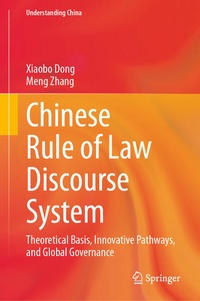
Chinese Rule of Law Discourse System
Description

This book establishes an innovative interdisciplinary research paradigm for studying China's distinctive legal discourse, systematically elucidating the generative logic and global interaction mechanisms of contemporary Chinese legal narratives. Breaking free from the constraints of legal-centrism, the author creatively integrates legal philosophy, critical discourse analysis, and area studies to construct a three-tiered analytical framework of "civilizational foundations-methodological innovation-practical verification," establishing an autonomous paradigm for Chinese legal discourse research.
The work achieves dual academic breakthroughs: First, it constructs a theoretical framework for analyzing contemporary Chinese legal discourse, providing new cognitive schemata for legal discourse studies and global governance scholarship. Second, it pioneers the introduction of philosophy of technology into legal research, demonstrating how digital technologies reshape China's legal trust mechanisms. At the policy level, it proposes the "Four Principles of Legal Discourse Innovation" and a "Communication Efficacy Enhancement Matrix," offering actionable solutions for building a new-era legal system and participating in global rule-making.
With its theory-practice integrated approach, this book caters to both general readers interested in legal civilization and scholars in international relations, legal studies, and global governance by providing an analytical framework that combines academic depth with policy relevance. It holds particular enlightening value for students in related disciplines.
More details
Other editions
Additional editions
Persons
Xiaobo Dong is a renowned contemporary Chinese jurist and legal linguist in China. He is a Professor at School of Foreign Languages and Cultures of Nanjing Normal University and a Distinguished Professor of Jilin International Studies University, Deputy Director of the Belt and Road Rule of Law Research Center at Academy of China's Modernization of Rule of Law and Researcher at Jiangsu Academy of Talent Development Strategy. He is also the Director and Chief Expert of Jiangsu International Rule of Law Research Center, as well as the Chief Expert on major projects of the National Social Science Fund of China. His research interests include history of Sino-west civilization exchanges, legal linguistics, legal translation, language strategy and planning, cross-cultural communication. In recent years, he has published over 250 interdisciplinary academic papers in prominent journals and more than 80 books, including academic monographs, edited volumes, and translations. He has authored multiple English academic monographs published by internationally leading publishing groups and has dozens of research papers published in high-level journals such as Nature. He enjoys a distinguished academic reputation internationally.
Meng Zhang is Ph.D. candidate at the School of Foreign Languages and Cultures at Nanjing Normal University, and a lecturer at the School of English at Jilin International Studies University. Her research interests include legal linguistics, legal translation, and language policy and planning.
Content
Chapter 1. Concept Definition and Differentiation of Chinese Rule of Law Discourse.- Chapter 2. Fundamental Orientations of Chinese Rule of Law Discourse.- Chapter 3. The Ideological Resources of Chinese Rule of Law Discourse.- Chapter 4. The Basic Constituents of Chinese Rule of Law Discourse.- Chapter 5. The Necessities, Practical Dilemmas and Mission of Innovation of Chinese Rule of Law Discourse .- Chapter 6. Basic Principles for the Innovation of Chinese Rule of Law Discourse .- Chapter 7. Basic Paths for the Innovation of Chinese Rule of Law Discourse .- Chapter 8. The Global Propositions of Chinese Rule of Law Discourse in the New Era.- Chapter 9. Planning of Chinese Rule of Law Discourse in the New Era.- Chapter 10. The Enhancement of the Spreading Ability of Chinese Rule of Law Discourse.
