

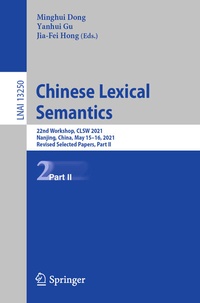
Chinese Lexical Semantics
22nd Workshop, CLSW 2021, Nanjing, China, May 15-16, 2021, Revised Selected Papers, Part II
Published on 15. June 2022
XVIII, 412 pages
978-3-031-06547-7 (ISBN)
Description

This book constitutes the thoroughly refereed post-workshop proceedings of the 22nd Chinese Lexical Semantics Workshop, CLSW 2021, held in Nanjing, China in May 2021.
The 68 full papers and 4 short papers included in this volume were carefully reviewed and selected from 261 submissions. They are organized in the following topical sections: Lexical Semantics and General Linguistics; Natural Language Processing and Language Computing; Cognitive Science and Experimental Studies; Lexical Resources and Corpus Linguistics.
More details
Series
Edition
1st ed. 2022
Language
English
Place of publication
Cham
Switzerland
Publishing group
Springer International Publishing
Product notice
Reflowable
Illustrations
XVIII, 412 p. 112 illus., 66 illus. in color.
File size
26,67 MB
ISBN-13
978-3-031-06547-7 (9783031065477)
DOI
10.1007/978-3-031-06547-7
Schweitzer Classification
Other editions
Additional editions
Minghui Dong | Yanhui Gu | Jia-Fei Hong
Chinese Lexical Semantics
22nd Workshop, CLSW 2021, Nanjing, China, May 15-16, 2021, Revised Selected Papers, Part II
Book
06/2022
Springer
€85.59
Shipment within 15-20 days
Content
- Intro
- Preface
- Organization
- Contents - Part II
- Contents - Part I
- Cognitive Science and Experimental Studies
- Human Body Metaphor in News Headlines
- Abstract
- 1 Introduction
- 2 Human Body Metaphor from the Perspective of Metaphorical Inheritance
- 3 Distribution of Metaphors in Various Parts
- 3.1 Corpus Description
- 3.2 Classification and Statistics of Human Body Metaphors
- 4 Metaphor Classification of Various Parts of the Human Body
- 4.1 Metaphor with 'Hand' as the Source Domain
- 4.2 Metaphor with 'Lower Limbs' as the Source Domain
- 4.3 Metaphor with 'Eyes' as the Source Domain
- 4.4 Metaphor with 'Mouth' as the Source Domain
- 4.5 Metaphor with 'Body' as the Source Domain
- 4.6 Metaphor with 'Face' as the Source Domain
- 4.7 Metaphor with 'Head' as the Source Domain
- 4.8 Metaphor with 'Ears/Nose' as the Source Domain
- 4.9 Metaphor with Other Parts of the Human Body as the Source Domain
- 5 Cognitive Analysis of Human Metaphor
- 5.1 Metaphorical Mapping of the Human Body Under the Concept of Metaphorical Inheritance
- 5.2 Cognitive Rules of the Human Body Metaphor
- 5.3 The Source Domain Does not Appear in the News Headline
- 6 The Emotional Embodiment of Metaphor in News
- 6.1 Human Body Metaphors Have a Positive Emotional Tendency
- 6.2 Human Body Metaphors Have a Negative Emotional Tendency
- 7 Conclusion
- Acknowledgments
- References
- Human Cognitive Constraints on the Separation Frequency and Limit of Separable Words
- Abstract
- 1 Introduction
- 2 Research Subjects
- 2.1 Identification Criteria
- 2.2 Range of Subjects
- 3 Research Procedure
- 4 Results
- 4.1 Inserted Chinese Characters Between AB of Separable Word
- 4.2 Inserted Words Between AB of Separable Word
- 5 Discussion
- 6 Summary
- References
- A Quantitative Research on the Spatial Imageries for Among Flowers
- Abstract
- 1 Introduction
- 2 Semantic Network Analysis of Spatial Imagery
- 3 Spatial Imagery Clustering Based on Word2vec Model
- 4 A Comparative Analysis of the Differences in the Use of Spatial Imagery in the Poets' Works
- 5 Conclusion
- Acknowledgements
- References
- Study on the Order of Double-Syllable Double Attributives and Selection Restrictions-Take the Structures of a1 + a2 + De + n and a1' + De + a2' + n' as Examples
- Abstract
- 1 Introduction
- 2 Corpus Screening and Processing
- 3 Analysis of Semantic and Syntactic Features
- 4 Restrictive Factors of Adjective Order
- 5 The Collection of Nouns and Their Characteristics
- 6 The Restriction of Prosodic Structure of Double Attributive Adjectives on Syntax
- 7 Conclusion
- Acknowledgments
- References
- Embodied Grounding of Concreteness/Abstractness: A Sensory-Perceptual Account of Concrete and Abstract Concepts in Mandarin Chinese
- Abstract
- 1 Introduction
- 2 Method
- 2.1 Stimuli
- 2.2 Procedure
- 2.3 Participants
- 3 Results
- 3.1 Operationalization of Concreteness/Abstractness Through Sensory-Perceptual Strengths
- 3.2 Relationship Between Concreteness/Abstractness and Sensory-Perceptual Strengths
- 3.3 Predictor of Concreteness Effects Through Maximum Sensory-Perceptual Strength
- 4 Discussion
- 5 Conclusion
- Ethics Statement
- References
- A Diachronic Study on Linguistic Synesthesia in Chinese
- Abstract
- 1 Introduction
- 2 Data Collection
- 3 Diachronic Transfers of Linguistic Synesthesia in Chinese
- 3.1 Diachronic Transfers Consistent with the Synchronic Pattern
- 3.2 Diachronic Transfers Inconsistent with the Synchronic Pattern
- 3.3 Summary
- 4 Conclusion
- Acknowledgments
- References
- The Relationship Between Lexical Richness and the Quality of CSL Learners' Oral Narratives
- Abstract
- 1 Introduction
- 2 Lexical Richness Measures
- 2.1 Lexical Diversity
- 2.2 Lexical Sophistication
- 2.3 Lexical Density
- 2.4 Lexical Density
- 3 Methods
- 3.1 Research Questions
- 3.2 The Subjects
- 3.3 The Measurement
- 3.4 Data Processing
- 4 Results of Pearson Correlation Analysis
- 4.1 Correlation Between Lexical Variation and Oral Narrative Quality
- 4.2 Correlation Between Lexical Sophistication and Oral Narrative Quality
- 4.3 Correlation Between Lexical Density and Oral Narrative Quality
- 4.4 Correlation Between Lexical Errors and Oral Narrative Quality
- 5 The Results of Multiple Regression Analysis
- 5.1 Multiple Regression Analysis Between Lexical Richness and Oral Scores
- 5.2 Validity Test of Regression Equation
- 6 Conclusion
- Acknowledgments
- References
- Interpreting Accomplishments by Script Knowledge: A Comparison Study Between Chinese and French
- Abstract
- 1 Introduction
- 2 Methods
- 2.1 Participants
- 2.2 Design and Materials
- 2.3 Procedure
- 2.4 Data Categorization
- 3 Results
- 4 Discussion and Conclusion
- Acknowledgments
- References
- Lexical Resources and Corpus Linguistics
- Creation and Significance of Database of Dictionary of Cognate Words
- Abstract
- 1 Introduction
- 1.1 Need for Quantitative Research in Specific Books
- 1.2 Need for Information Extraction
- 1.3 Need for Digitization of Literature
- 2 Design of the Full-Text Database
- 2.1 Conceptual Data Model
- 2.2 Logical Data Model
- 2.3 Analysis of Normal Forms
- 2.4 Design of Table Structure
- 3 Research on the Dictionary of Cognate Words with Database
- 3.1 Overview of the Dictionary of Cognate Words
- 3.2 Items in the Dictionary of Cognate Words
- 3.3 Other Information in the Dictionary of Cognate Words
- 4 Conclusion
- References
- Chinese Predicate Chunk Knowledge Base Construction and Internal Boundary Recognition
- Abstract
- 1 Introduction
- 2 Related Studies
- 2.1 Researches on the Chunk Definitions and Classifications
- 2.2 Research on Recognition of Chunk Boundaries
- 3 Definition of Predicate Chunk and Establishment of Sub-chunk Types
- 3.1 Definition of Predicate Chunk
- 3.2 Determination of Sub-chunk Type
- 4 Knowledge Base Construction
- 4.1 Corpus Selection
- 4.2 Labeling Process
- 4.3 Statistical Analysis
- 5 Automatic Recognition of the Internal Boundary of Predicate Chunk
- 5.1 Task Modeling and Data
- 5.2 Experimental Model
- 5.3 Experimental Results
- 5.4 Experimental Outlooks
- 6 Conclusion
- Acknowledgement
- References
- Translational Equivalents for Culture-Specific Words in Chinese-English Dictionaries
- Abstract
- 1 Introduction
- 2 Lexicographic Equivalents
- 3 The Present Study
- 4 Conclusion
- References
- (b) Dictionaries
- Quantitative Analysis of Chinese and English Verb Valencies Based on Probabilistic Valency Pattern Theory
- Abstract
- 1 Introduction
- 2 Methods and Materials
- 2.1 Materials
- 2.2 Methods
- 3 Results and Discussions
- 3.1 Verb Valency Distribution of Chinese and English
- 3.2 Mean Verb Valency of Chinese and English
- 3.3 Probabilistic Valency Pattern of Chinese and English Verbs
- 4 Conclusion
- References
- A Quantitative Approach to the Stylistic Assessment of the Middle Chinese Texts
- Abstract
- 1 Introduction
- 2 Methodology of the Quantitative Stylistic Classification
- 3 Quantitative Stylistic Analysis of Middle Chinese Texts
- 4 Conclusion
- Acknowledgments
- References
- Construction and Evaluation of Chinese Word Segmentation Datasets in Malay Archipelago
- Abstract
- 1 Introduction
- 2 Related Work
- 2.1 General CWS
- 2.2 Domain-Specific CWS
- 3 Dataset
- 4 Experiment
- 4.1 Baseline
- 4.2 Experimental Setting
- 4.3 Evaluation Metrics
- 4.4 Result and Analysis
- 5 Conclusion
- Acknowledgement
- References
- Social Changes Manifested in the Diachronic Changes of Reform-Related Chinese Near Synonyms
- Abstract
- 1 Introduction
- 2 Method
- 3 Results
- 4 Conclusion
- Acknowledgments
- References
- Semantic Classification of Adverbial Adjectives Based on Chinese Chunkbank
- Abstract
- 1 Introduction
- 2 Resource Construction
- 2.1 Structure Chunkbank Data Resource Construction
- 2.2 Construction of Adverbial Adjective List
- 3 Standard of Classification
- 4 Classification Results and Analysis
- 4.1 Classification Results
- 4.2 Result Analysis
- 5 Conclusion
- Appendix
- References
- Prepositional Frame Extraction and Semantic Classification Based on Chinese ChunkBank
- Abstract
- 1 Introduction
- 2 State of the Art
- 2.1 Research on Prepositional Words and Circumposition
- 2.2 Prepostional Frame in Our Definition
- 3 Extraction of Prepositional Frame
- 3.1 Resources of the Chinese ChunkBank
- 3.2 Extraction of Prepositional Frame and Noise Reduction
- 4 Semantic Alignment and Classification of Prepositional Frame
- 5 Conclusions and Future Work
- Appendix
- Appendix 1
- Appendix 2
- References
- From Complex Emotion Words to Insomnia and Mental Health: A Corpus-Based Analysis of the Online Psychological Consultation Discourse About Insomnia Problems in Chinese
- Abstract
- 1 Introduction
- 2 Methodology
- 2.1 Data
- 2.2 Emotion Detection
- 2.3 Data Mining Methods
- 3 Results
- 3.1 Overall Distribution of Emotions and Mental Disease Types
- 3.2 Prediction of Mental Health Conditions Based on Emotion Intensity Levels
- 3.3 Relevance Analysis of Emotion Types and Psychiatric Disorders
- 4 Discussion
- 5 Linguistic and Clinical Implications and Limitations
- Acknowledgments
- References
- A Quantitative Study on the Measure Index of Syntactic Complexity in Textbooks for Chinese as a Second Language
- Abstract
- 1 Introduction
- 2 Research Methods and Materials
- 2.1 Data Sources
- 2.2 Selection of Indicators
- 2.3 Statistical Index and Calculation Methods
- 2.3.1 Aggregate Index
- 2.3.2 Length Index
- 2.3.3 Relative Index
- 3 Results
- 3.1 Statistical Distribution and Difference Test: Aggregate Index
- 3.2 Statistical Distribution and Difference Test: Length Index
- 3.3 Statistical Distribution and Difference Test: Relative Index
- 4 Discussion and Conclusions
- Acknowledgments
- References
- Construction and Quantitative Analysis of Jiangsu Dialect Function Word Knowledgebase
- Abstract
- 1 Introduction
- 2 Related Work
- 2.1 Dialect Research
- 2.2 Data Resources
- 3 Construction of the Knowledgebase
- 3.1 Markup Language from HowNet
- 3.2 Corpus and Annotation
- 3.3 Statistics and Result Analysis
- 4 Conclusion
- 5 Future Work
- References
- Construction of Event Annotation Corpus for Political News Texts
- Abstract
- 1 Introduction
- 2 Annotation System and Standard of Political News Text
- 2.1 Text Annotation Schema of Political News
- 2.2 Annotation Syntax Definition
- 2.3 Annotation Rules
- 2.4 Handling of Special Circumstances
- 3 Corpus Construction
- 3.1 Data Preparation and Preprocessing
- 3.2 Annotation Platform
- 3.3 Annotation Consistency Control
- 4 Analysis of Corpus Annotation Results
- 4.1 Annotation Result Analysis
- 4.2 Annotation Consistency Analysis
- 4.3 Visual Display of Corpus
- 5 Conclusion
- Acknowledgments
- References
- Developing a Syntactic and Semantic Annotation Tool for Research on Chinese Vocabulary
- Abstract
- 1 Introduction
- 2 Related Research
- 3 Developing a Syntactic and Semantic Annotation Tool
- 4 Dependency Annotation of the Visual Verb kànjiàn
- 4.1 Data Collection
- 4.2 An Annotation Norm Different from LTP
- 4.3 Annotation Error Analysis
- 4.4 Arcs of Syntactic and Semantic Dependencies
- 5 The Syntax and Semantics of the Visual Verb kànjiàn
- 5.1 Syntactic Dependencies of the Visual Verb kànjiàn
- 5.2 Semantic Dependency of Kànjiàn
- 6 Comparisons with Chinese Dictionaries
- 7 Conclusion
- Acknowledgements
- References
- An Overview of the Construction of Near-Synonyms Discrimination Resources
- Abstract
- 1 Introduction
- 2 Chinese Near-Synonyms Discrimination Dictionary
- 2.1 The Words in the Near-Synonyms Discrimination Dictionary
- 2.2 The Presentation of the Dictionary
- 2.3 Summary
- 3 Corpus-Based Resources for Near-Synonyms Discrimination
- 3.1 Sketch Engine
- 3.2 Chinese Learners Writing Corpus
- 3.3 Concordance
- 3.3.1 AntCon
- 3.3.2 Tango
- 3.4 Online Dictionary of Near-Synonyms
- 3.4.1 Thesaurus
- 3.5 Linggle
- 3.6 Summary
- 4 Challenge and Trend of Chinese Near-Synonyms Resources
- 4.1 Dimensions of Chinese Near-Synonyms Discrimination
- 4.2 Construct a Special Knowledge Base for Near-Synonyms Discrimination
- 5 Conclusion
- Acknowledgments
- References
- Contemporary Chinese Social Vocative Terms
- Abstract
- 1 Introduction
- 2 The Six Categories of Social Vocative Terms
- 2.1 Substitution of Greetings
- 2.2 Generalization of Kinship Terms
- 2.3 Quasi-generalization of the Occupational Terms
- 2.4 Generalization of Laudatory Terms
- 2.5 Cyberspeaks Borrowing
- 2.6 Conventional Terms
- 3 Principles of Application and Distribution Pattern of Social Vocatives
- 3.1 Principles of Application
- 3.2 Distribution Pattern
- 4 Conclusion
- References
- The Corpus Construction of Basic Noun Compound Phrase in Literature Domain and Its Comparison with News Domain
- Abstract
- 1 Introduction
- 2 Related Works
- 3 Construction of Basic Noun Compound Phrase Database in Literary Domain
- 3.1 Corpus Selection and Processing
- 3.2 Phrase Extraction and Filtering
- 3.3 Corpus Tagging
- 3.4 Corpus Overview
- 4 Comparison and Analysis
- 4.1 Overview of BCNP
- 4.2 Structural Relations of BCNP
- 4.3 Usage of Nouns That Make up BCNP
- 4.4 Comparison of Semantic Relations of BCNP
- 5 Conclusion
- Acknowledgements
- References
- Predicate Annotation for Chinese Intent Detection
- Abstract
- 1 Introduction
- 2 Multi-point Representation and Core Predicate
- 2.1 Single-Point Representation and Full Representation in Multi-point Representation
- 2.2 Core Predicate
- 3 Core Predicate Annotation Rules
- 3.1 Simple Sentence
- 3.2 Complex Sentences
- 4 Construction of Core Predicate Corpus
- 4.1 Data Preparation
- 4.2 Annotation Process and Quality Control
- 5 Experiment
- 5.1 Datasets and Evaluation Indicators
- 5.2 Model
- 5.3 Experiment Setup
- 5.4 Experimental Results
- 5.5 Errors Analysis and Discussion
- 6 Related Works
- 7 Conclusion
- References
- The Development of the Chinese Monosyllabic Motion-Directional Constructions: A Diachronic Constructional Approach
- Abstract
- 1 Introduction
- 2 Some Basic Concepts of the Framework
- 2.1 Diachronic Construction Grammar
- 2.2 Multiple Sources
- 3 Data and Methodology
- 4 The Development of the Monosyllabic Directional Construction
- 5 The Mechanisms of the Emergence and Disappearance of [MMV Zai NPplace]*[Change of Location]
- 5.1 The Emergence of the Construction
- 5.2 The Disappearance of the Construction
- 6 Conclusion
- References
- A Corpus Study of Anaphora in Chinese Conditionals
- Abstract
- 1 Introduction
- 2 Corpus Study: Materials and Methods
- 2.1 The Selection of Materials
- 2.2 The Selection Procedures
- 2.3 The Selection Scope
- 3 Results and Discussion
- 3.1 Comparison Within Structure: Hypotheses 1, 2 and 3
- 3.2 Comparisons Between Structures: Hypotheses 4 and 5
- 4 Conclusion
- Acknowledgements
- References
- Research on the Distribution and Characteristics of Negative Quasi-Prefixes in Different Registers
- Abstract
- 1 Introduction
- 1.1 Negative Quasi-Prefixes in Chinese
- 1.2 Language Register
- 2 Method and Design
- 3 Statistics and Analysis
- 3.1 The Negative Quasi-Prefix " (fei)-"
- 3.2 The Negative Quasi-prefix "?(bù)-"
- 3.3 The Negative Quasi-Prefix "?(wú)-"
- 3.4 Negative Quasi-Prefixes in the Three Registers
- 4 Conclusion
- Acknowledgments
- References
- A Quantitative Study on Mono-Valent Noun and Its Ellipsis
- Abstract
- 1 Introduction
- 2 Related Works
- 2.1 Definition, Classification and Grammatical Characteristics of Mono-valent Nouns
- 2.2 Ellipsis of Mono-Valent Nouns in Sentences
- 3 Data Selection and Word List Construction
- 3.1 BLCU Treebank 1.0
- 3.2 Word List Construction
- 4 Ellipsis Phenomena of Mono-Valent Nouns
- 4.1 Extract Redundant Sentences and Elliptical Sentences of Mono-Valent Nouns
- 4.2 Ellipsis Rules of Mono-Valent Nouns
- 5 Explanation of the Ellipsis from the Perspective of Grammatical Metonymy
- 6 Conclusion
- Acknowledgments
- References
- Construction of Chinese Obstetrics Knowledge Graph Based on the Multiple Sources Data
- Abstract
- 1 Introduction
- 2 Construction Process of Chinese Obstetrics Knowledge Graph
- 3 Conceptual Layers
- 4 Data Layers
- 4.1 Obstetric Knowledge Acquisition
- 4.2 Semi-automatic Annotating
- 4.2.1 Rule-Based Methods
- 4.2.2 Machine Learning Methods
- 4.3 Knowledge Fusion
- 5 Construction Results and Display
- 6 Conclusion
- Acknowledgments
- References
- Correction to: Social Changes Manifested in the Diachronic Changes of Reform-Related Chinese Near Synonyms
- Correction to: Chapter "Social Changes Manifested in the Diachronic Changes of Reform-Related Chinese Near Synonyms" in: M. Dong et al. (Eds.): Chinese Lexical Semantics, LNAI 13250, https://doi.org/10.1007/978-3-031-06547-7_15
- Author Index
