

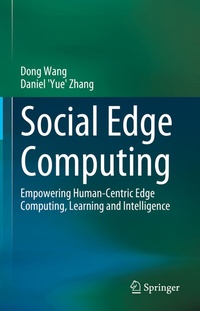
Social Edge Computing
Description

The rise of the Internet of Things (IoT) and Artificial Intelligence (AI) leads to the emergence of edge computing systems that push the training and deployment of AI models to the edge of networks for reduced bandwidth cost, improved responsiveness, and better privacy protection, allowing for the ubiquitous AI that can happen anywhere and anytime. Motivated by the above trend, this book introduces a new computing paradigm, the Social Edge Computing (SEC), that empowers human-centric edge intelligent applications by revolutionizing the computing, intelligence, and the training of the AI models at the edge. The SEC paradigm introduces a set of critical human-centric challenges such as the rational nature of edge device owners, pronounced heterogeneity of the edge devices, real-time AI at the edge, human and AI interaction, and the privacy of the edge users. The book addresses these challenges by presenting a series of principled models and systems that enable the confluence of the computing capabilities of devices and the domain knowledge of the people, while explicitly addressing the unique concerns and constraints from humans.
Compared to existing books in the field of edge computing, the vision of this book is unique: we focus on the social edge computing (SEC), an emerging paradigm at the intersection of edge computing, AI, and social computing. This book discusses the unique vision, challenges and applications in SEC. To our knowledge, keeping humans in the loop of edge intelligence has not been systematically reviewed and studied in an existing book. The SEC vision generalizes the current machine-to-machine interactions in edge computing (e.g., mobile edge computing literature), and machine-to-AI interactions (e.g., edge intelligence literature) into a holistic human-machine-AI ecosystem.
More details
Other editions
Additional editions

Persons
Daniel 'Yue' Zhang is currently a research scientist at Amazon Alexa AI, USA. Daniel obtained his Ph.D. from the department of Computer Science and Engineering at University of Notre Dame, IN, USA in 2020. He received his M.S. degree from Purdue University, West Lafayette, IN, USA, in 2012 and a B.S. degree from Shanghai Jiao Tong University, Shanghai, China, in 2008. His research interests include human-centric learning and computing, social sensing, edge computing, and natural language understanding. Daniel has published over 70 peer reviewed articles and served as TPC and reviewers in multiple top conferences and journals in related fields.
