

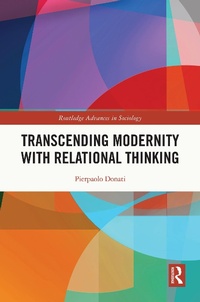
Transcending Modernity with Relational Thinking
1st Edition
Published on 30. March 2021
262 pages
978-1-000-38267-9 (ISBN)
Description

The Open Access version of this book, available at http://www.taylorfrancis.com/books/e/9781003146698, has been made available under a Creative Commons Attribution-Non Commercial-No Derivatives 4.0 license.
This book explores the ways in which social relations are profoundly changing modern society, arguing that, constituting a reality of their own, social relations will ultimately lead to a new form of society: an aftermodern or relational society. Drawing on the thought of Simmel, it extends the idea that society consists essentially of social relations, in order to make sense of the operation of dichotomous forces in society and to examine the emergence of a "third" in the morphogenetic processes. Through a realist and critical relational sociology, which allows for the fact that human beings are both internal and external to social relations, and therefore to society, the author shows how we are moving towards a new, trans-modern society - one that calls into question the guiding ideas of Western modernity, such as the notion of linear progression, that science and technology are the decisive factors of human development, and that culture can entirely supplant nature. As such, it will appeal to sociologists, social theorists, economists, political scientists, and social philosophers with interests in relational thought, critical realism, and social transformation.
This book explores the ways in which social relations are profoundly changing modern society, arguing that, constituting a reality of their own, social relations will ultimately lead to a new form of society: an aftermodern or relational society. Drawing on the thought of Simmel, it extends the idea that society consists essentially of social relations, in order to make sense of the operation of dichotomous forces in society and to examine the emergence of a "third" in the morphogenetic processes. Through a realist and critical relational sociology, which allows for the fact that human beings are both internal and external to social relations, and therefore to society, the author shows how we are moving towards a new, trans-modern society - one that calls into question the guiding ideas of Western modernity, such as the notion of linear progression, that science and technology are the decisive factors of human development, and that culture can entirely supplant nature. As such, it will appeal to sociologists, social theorists, economists, political scientists, and social philosophers with interests in relational thought, critical realism, and social transformation.
More details
Series
Edition
1. Auflage
Language
English
Place of publication
London
United Kingdom
Publishing group
Taylor & Francis Ltd
Target group
College/higher education
Illustrations
3 Tables, black and white; 17 Halftones, black and white; 17 Illustrations, black and white
File size
7,34 MB
ISBN-13
978-1-000-38267-9 (9781000382679)
Copyright in bibliographic data and cover images is held by Nielsen Book Services Limited or by the publishers or by their respective licensors: all rights reserved.
Schweitzer Classification
Other editions
Additional editions
Pierpaolo Donati
Transcending Modernity with Relational Thinking
Book
01/2023
1st Edition
Routledge
€63.40
Shipment within 15-20 days
Pierpaolo Donati
Transcending Modernity with Relational Thinking
Book
05/2021
Routledge
Unfortunately, price unknown
Available (delivery time upon request)
Pierpaolo Donati
Transcending Modernity with Relational Thinking
Book
03/2021
1st Edition
Routledge
€161.21
Shipment within 15-20 days
Person
Pierpaolo Donati is Alma Mater Professor (PAM) of Sociology at the University of Bologna, Italy. Former President of the Italian Sociological Association, he is the author of Relational Sociology: A New Paradigm for the Social Sciences, co-author of The Relational Subject, and co-editor of Social Science, Philosophy and Theology in Dialogue.
Content
Introduction: Towards a Relational Society; Part 1: The Emergence of Aftermodernity; 1. Beyond the Modern Dilemma Freedom (Lib) vs Control (Lab): What After?; 2. Overcoming the Market/State Binary Code; 3. Shedding Light on Society through a Relational (Not Relationist) Gaze; Part 2: Insights into the Morphogenetic Changes of Social Morality; 4. Relational Society as a Morphogenetic Configuration; 5. The Morphogenesis of Social Morality; 6. Morality and Social Networks; Part 3: Why and How Can the New Society be "Good"?; 7. What Does the Good Life Consist Of?; 8. The Emergence of New Social Subjects Generating Relational Goods; Part 4: The Hybridisation of Society: Shall We Forget About its Human Character?; 9. The New Scenario of a Hybridised Society; 10. Prospects: Should We Abandon the Dream of a Human(e) Society?
