

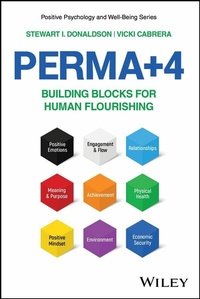
PERMA+4
Description

Provides the tools and knowledge to develop and nurture the essential building blocks of a thriving life
Understanding how to thrive, not just survive, has never been more critical in today's world. Grounded in over 25 years of peer-reviewed research, PERMA +4: Pathways to Well-Being and Positive Functioning provides a comprehensive guide to the essential building blocks of flourishing. Authors Stewart Donaldson and Victoria Cabrera share the latest evidence while providing actionable insights on how positive psychology interventions can help cultivate happiness and resilience.
With clear explanations of nine scientifically validated building blocks, including emotions, engagement, relationships, meaning, and accomplishment, PERMA +4 equips readers with tools to build their well-being while empowering others to do the same. The PERMA+4 framework extends foundational work by integrating new insights into areas such as physical health, mindset, and economic security. Each easy-to-read chapter is packed with practical activities, step-by-step guidance, informational charts and figures, full-color images, "Key Takeaways, " and reflection questions.
Offering practical strategies for anyone eager to lead a more fulfilling life, PERMA +4:
- Introduces the PERMA+4 framework, extending Martin Seligman's foundational well-being theory with new evidence
- Explains the science behind positive psychology interventions and why they work
- Integrates findings from more than 1,000 research studies on flourishing and well-being
- Covers practical applications for education, workplaces, healthcare, and personal growth
Ideal for health practitioners, educators, workplace leaders, and well-being coaches, PERMA +4: Building Blocks for Human Flourishing is essential reading for undergraduate, graduate, and professional audiences. It is perfect for courses in positive psychology, public health, leadership, and organizational development, or as a reference for practitioners aiming to enhance well-being in diverse settings.
More details
Other editions
Additional editions
Persons
Stewart I. Donaldson, PhD, is a Distinguished University Professor, President of the Claremont Flourishing Center, and Executive Director of the Claremont Evaluation Center and The Evaluators' Institute at Claremont Graduate University. His leadership in advancing well-being research has earned him numerous awards and accolades worldwide.
Vicki Cabrera, PhD, is a Research Fellow at Claremont Graduate University and Principal Well-being and Social Impact Consultant, Evaluator, and Researcher at Vicki Cabrera Consulting. She is an expert in well-being science, positive psychology, organizational psychology, and program evaluation and design. An award-winning scholar-practitioner, Dr. Cabrera also conducts scholarly research and has published articles and book chapters in leading journals.
Content
About the Authors xiii
Preface xv
Acknowledgements xix
1 A Fresh Look at the Science of Well- Being and Positive Functioning 1
A Fresh New Look at Feeling and Doing Well in Life 1
PERMA+4 Building Blocks of Well-Being and Optimal Functioning 2
Human Flourishing 4
Human Suffering 6
Human Struggling 7
Human Languishing 8
Human Thriving 9
Measuring Human Flourishing 10
Why Is Well-Being Important? 12
How to Use This Book 14
Conclusion 14
References 15
2 Positive Emotions 17
What Are Positive Emotions? 18
Circumplex Model of Emotions 19
Why Positive Emotions Are a Building Block of Well-Being 22
The Broaden and Build Theory of Positive Emotions 23
How to Leverage the Power of Positive Emotions to Improve Well-Being 24
Apply What You Learned About Positive Emotions 26
Learn More About Positive Emotions 26
Key Takeaways 26
References 27
3 Engagement and Flow 31
What Are Engagement and Flow? 33
The Difference Between Engagement and Flow 34
Why Is Flow a Building Block of Well-Being? 35
How to Create More Experiences of Engagement and Flow to Care for Your Well-Being 36
How to Create the Conditions of Flow for Others 38
Apply What You Learned About Engagement and Flow 38
Learn More About Engagement and Flow 39
Key Takeaways 39
References 39
4 Positive Relationships 41
What Are Positive Relationships? 42
What About at School or Work? 42
Why are Positive Relationships a Building Block of Well-Being 43
How to Build and Nurture More Positive Relationships 44
Apply What You Learned About Positive Relationships 45
Learn More About Positive Relationships 45
Key Takeaways 46
References 46
5 Meaning and Purpose 49
What Is Meaning and Purpose? 50
What Exactly Is Meaning? 50
Why Does Meaning and Purpose Matter? 51
Why Is Meaning and Purpose a Building Block of Human Flourishing? 51
How to Develop Meaning and Purpose 52
Apply What You Learned About Meaning and Purpose 53
Learn More About Meaning and Purpose 54
Key Takeaways 54
References 55
6 Achievement 57
What Is Achievement? 58
Why Is Achievement a Building Block of Human Flourishing? 59
Achievement in the Workplace 60
How to Nurture Achievement 61
Apply What You Learned About Achievement 61
Learn More About Achievement 62
Key Takeaways 62
References 63
7 Physical Health 65
What Is Physical Health? 66
Why Is Physical Health Important for Well-Being? 67
How to Improve and Maintain Physical Health 68
Take It One Step at a Time 69
Apply What You Learned About Physical Health 70
Learn More About Physical Health 70
Key Takeaways 70
References 71
8 Positive Mindset 73
A Real-World Journey of Growth 73
What Is a Positive Mindset? 74
Why Is a Positive Mindset Important for Well-Being? 76
How to Develop and Maintain a Positive Mindset 77
The Psychological Capital Intervention (PCI) Model 79
Apply What You Learned About Mindset 81
Learn More About Mindset 81
Key Takeaways 81
References 82
9 Environment 85
What Is the Environment Building Block? 87
Why Your Environment Is a Building Block of Human Flourishing 87
How to Improve Your Environment to Support Your Well-Being 88
Apply What You Learned About Your Environment 90
Learn More About Environment 90
Key Takeaways 90
References 91
10 Economic Security 93
What Is Economic Security? 94
Why Economic Security Is Crucial for Well-Being 95
The Research on Economic Security and Life Satisfaction 96
How to Improve Economic Security 96
Apply What You Learned About Economic Security 98
Learn More About Economic Security 98
Key Takeaways 98
References 99
11 PERMA+4 Science: Why It Is Important to Monitor & Assess Well- Being 101
Science: A Simple Guide 102
The Science of Positive Psychology and PERMA+4 103
Validated Research Measures 106
The PERMA+4 Scale 106
The PERMA+4 Short Scale 108
The Satisfaction with Life Scale 108
The Flourishing Scale 109
The Global Flourishing Index 109
Practical Tools for Developing and Monitoring Your PERMA+ 4 and Well-Being 110
How to Score the Cantril's Ladder 113
How to Interpret Your Cantril's Ladder Scores 113
Conclusion 114
Key Takeaways 115
References 116
12 Activities to Develop PERMA + 4 119
How to Use This Chapter 120
How This Chapter Is Organized 120
Positive Emotions 120
Personal Activities 120
Activities for Others 121
Engagement and Flow 122
Personal Activities 122
Activities for Others 123
Positive Relationships 123
Personal Activities 123
Activities for Others 124
Meaning and Purpose 125
Personal Activities 125
Activities for Others 125
Achievement 126
Personal Activities 126
Activities for Others 127
Physical Health 127
Personal Activities 127
Activities for Others 128
Mindset 129
Personal Activities 129
Activities for Others 130
Environment 130
Personal Activities 130
Activities for Others 131
Economic Security 132
Personal Activities 132
Activities for Others 133
Activities That Develop Multiple PERMA + 4 Building Blocks 133
Personal Activities 133
Activities for Others 134
Resources for More Activities to Strengthen PERMA + 4 Building Blocks 135
Key Takeaways 135
PERMA+4 Activities Resources 135
Books 135
Journal Articles 136
References 139
13 More PERMA+4 Resources 143
The PERMA Framework 144
Journal Articles 144
Books 145
Measures 145
Digital Resources: Websites, Articles, Video, and Audio Materials 145
The PERMA+4 Framework 146
Journal Articles 146
Books 147
Measures 148
PERMA+4 Short Scale 148
Positive Functioning at Work Scale-Spanish Version 148
Positive Functioning at Work Scale - German Version (PFW-DE) 148
Digital Resources: Websites, Articles, Video and Audio Materials 148
Positive Emotions 149
Journal Articles 149
Books 150
Measures 151
Digital Resources: Websites, Articles, Video and Audio Materials 152
Engagement and Flow 153
Journal Articles 153
Books and Book Chapters 154
Chapters 154
Measures 155
Digital Resources: Websites, Articles, Video and Audio Materials 156
Positive Relationships 157
Journal Articles 158
Books and Book Chapters 158
Books 159
Measures 159
Digital Resources: Websites, Video & Audio Materials 160
Meaning and Purpose 161
Journal Articles 161
Books 162
Measures 163
Digital Resources: Websites, Video & Audio Materials 163
Achievement 164
Journal Articles 164
Books 165
Measures 166
Digital Resources: Videos, Podcasts, and Websites 166
Physical Health 167
Journal Articles 167
Books 168
Measures 168
Digital Resources: Videos, Podcasts, and Websites 169
Mindset 170
Journal Articles 170
Books 171
Measures 172
Digital Resources: Websites, Articles, Video and Audio Materials 172
Environment 173
Journal Articles 173
Books 174
Measures 174
Digital Resources: Videos, Podcasts, and Websites 175
Economic Security 175
Journal Articles 175
Books 176
Measures 176
Digital Resources: Videos, Podcasts, and Websites 177
Key Takeaways 177
References 178
Index 179
1
A Fresh Look at the Science of Well-Being and Positive Functioning
" A joyful life is an individual creation that cannot be copied from a recipe."
-Mihaly Csikszentmihalyi-Flow, 1990
A Fresh New Look at Feeling and Doing Well in Life
I'm really sorry to admit that after more than 25 years of positive psychological science research (Donaldson et al., 2020), and many more years of study in other fields, we've come to an evaluative conclusion about what makes a good life-it depends. That is, it depends largely on how you live, not just what you read. We will be encouraging you to learn, explore, and care for many of the most effective ingredients that seem to comprise a life worth living. And we will help guide you toward how you can best combine these ingredients with your values so that you can be your best self more often during your precious time on Earth. We aspire to provide you with a range of useful ideas, scientific findings, and evidence-informed activities and tools that will inspire you to work on your individual creation, your engaging and meaningful life, on a regular basis.
People who learn to control inner experience will be able to determine the quality of their lives, which is as close as any of us can come to being happy.
-Mihaly Csikszentmihalyi (1990)
Professor Mihaly Csikszentmihalyi taught us that in order to be truly happy, we must learn to control the direction of our attention. Even in the face of a bad day (which we all have), suffering, trauma, tragedy, or death of a loved one, once we experience and navigate the normal grieving process, it is what we choose to place our attention on that makes us happy or sad.
It is better to look suffering straight in the eye, acknowledge and respect its presence, and then get busy as soon as possible focusing on things we choose to focus on.
-Mihaly Csikszentmihalyi (1997)
So what should we focus our attention on? More likes on our social media? Fast cars? Big homes? Money? Beer? Good wine? Sex, drugs, and rock 'n' roll? How about ways to flourish more often in our lives through developing and caring for our PERMA+4 Building Blocks of Well-Being and Optimal Functioning?
PERMA+4 Building Blocks of Well-Being and Optimal Functioning
During the past 25 years, scientists inspired by the vision for a new science of positive psychology have been conducting rigorous peer-reviewed research to discover how to help people flourish more often throughout their lifespan (see Donaldson et al., 2020). These positive psychological scientists have determined with great confidence that there are at least nine building blocks of well-being that we can develop and care for that will make us feel and do well in our lives. The first five were introduced by Professor Martin Seligman in his 2011 book Flourish: A Visionary New Understanding of Happiness and Well-Being, and the additional +4 were added based on extensive empirical research by Professor Stewart Donaldson and colleagues (Donaldson & Donaldson, 2020; Donaldson et al., 2021, 2022).
- Positive emotions: Experiencing happiness, joy, love, gratitude, etc. in the here and now.
- Engagement: Fully using your strengths, skills, and attention, and being highly absorbed or experiencing flow while engaged in the activities of your life.
- Relationships: Having the ability to establish and maintain positive, mutually beneficial relationships with others, characterized by the experiences of love and appreciation.
- Meaning: The experience of being connected to something larger than the self or serving a higher purpose.
- Accomplishment: Experiencing a sense of mastery over a particular domain of interest or achieving important or challenging life/work goals.
- Physical health: Having optimal physiological functioning, being able to carry out daily physical activities, and feeling in control and optimistic about your health.
- Mindset: Adopting a growth mindset characterized by an optimistic, future-oriented view of life, where challenges or setbacks are seen as opportunities to grow. This may also be a function of having positive psychological capital (hope, optimism, self-efficacy, and resilience), perseverance, and/or grit.
- Environment: The quality of one's physical environment (which includes spatiotemporal elements, such as access to natural light, fresh air, and physical safety), aligned to the preferences of the individual.
- Economic security: Perceptions of financial security and stability required to satisfy individual needs.
We will discuss each of these PERMA+4 building blocks in much more detail in the chapters that follow. You will learn about the theory, research, and most importantly how to develop and care for each of these building blocks to promote your own well-being, as well as how to help other people in your life feel well and do well. But, before we go deeper into the PERMA+4 building blocks, let me first discuss why we think these applications of the science of positive psychology are so important for your life and for the lives of your colleagues, friends, and loved ones.
Human Flourishing
PERMA+4 has been found to be one of the strongest predictors we have ever discovered to indicate who is flourishing in life. The latest positive psychological science research identifies well-being and optimal functioning (two essential indicators of human flourishing) across a wide range of cultures and domains such as work, school, higher education, community service, and everyday life (see Cabrera & Donaldson, 2024).
Human flourishing refers to living a life in which individuals thrive, experience happiness, and achieve their fullest potential (Keyes, 2002). It goes beyond simply being free from illness or hardship; flourishing encompasses a deep sense of well-being, fulfillment, and purpose.
At its core, human flourishing means living in alignment with our values and capabilities, where physical, emotional, and mental health are all in balance. It involves positive emotions like joy, love, and gratitude, as well as meaningful relationships that provide connection and support. Flourishing individuals often feel engaged in their daily activities, are optimistic about the future, and pursue goals that align with their passions and skills.
Importantly, flourishing also involves resilience-the ability to bounce back from setbacks (Donaldson & Villalobos, 2025; Luthans et al., 2007). Life isn't free from challenges, but those who flourish find ways to grow through adversity, learn from their experiences, and find strength in difficult times.
In addition to personal factors, flourishing is influenced by external conditions. Supportive environments, such as safe communities, opportunities for education and meaningful work, and access to healthcare, play a crucial role. Flourishing often involves contributing to the well-being of others, creating a ripple effect of positivity and growth.
Psychologists, philosophers, and researchers have studied flourishing for centuries, linking it to concepts like Aristotle's idea of "eudaimonia" (living a virtuous and meaningful life). Modern science-based frameworks, such as PERMA+4, provide tools to understand and foster flourishing.
Ultimately, human flourishing is about living a rich and rewarding life-not perfect, but deeply satisfying and impactful. It is the aspiration to not just survive but thrive, to find joy and purpose in the every day, and to leave a positive mark on the world around us.
One approach for better understanding when you are flourishing is to compare it to other states of being along a flourishing-suffering continuum. For example, we can think of a flourishing ladder that anchors suffering at the bottom, and as you move up, you go through struggling, languishing, and thriving until you arrive at flourishing. We imagine most people experience all of these states at various times in their lives. But we also know that there are practices we can all develop and follow that improve our chances of flourishing more often.
Human Suffering
Kuzmaphoto / Adobe Stock Photo
Unfortunately, most people experience suffering throughout their lives. However, it has been found that people who are low on PERMA+4 and well-being tend to experience more suffering than those with higher levels. The good news is that effective PERMA+4 practices and interventions have the potential to significantly reduce the amount of suffering in people's lives. To better understand what it feels like to be in a flourishing versus suffering state, we will briefly describe human suffering.
Human suffering and human flourishing are two very different experiences, like being lost in a storm versus walking in sunshine. While flourishing is about living a life full of joy, purpose, and connection, suffering involves deep pain, struggle, and a sense of being stuck or overwhelmed.
When people flourish, they feel positive emotions like happiness, love, and gratitude. They have meaningful relationships, a sense of accomplishment, and a purpose that gives their life direction. In...
