

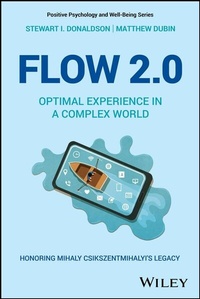
Flow 2.0
Description

How the pioneering co-founder of the field of positive psychology can help us navigate our increasingly complicated world
Over the years since Mihaly Csikszentmihalyi first published Flow: The Psychology of Optimal Experience, the field of positive psychology has become a rigorous, evidence-based discipline. Dr. Csikszentmihalyi's pioneering work on "flow," a state in which one is completely absorbed in a task or activity, continues to make lasting, positive impacts on individuals, groups, organizations, and societies around the world.
In Flow 2.0, authors Stewart I. Donaldson and Matthew Dubin show us how their colleague's and mentor's contributions can be extended to improve our lives in 2024 and beyond. With an accessible and engaging narrative, the authors share what they have learned about flow over two decades of empirical research and provide a new framework designed to help us be fully engaged in our lives and flourish in complex and dynamic environments.
Seven concise chapters explore ways the world has changed since the concept of flow was first developed, introduce the basics of flow and optimal experience, examine how we in our complex social and work lives, identify the essential role of flow in the PERMA+4 framework for work-related well-being and performance, and more.
Addressing modern life contexts such as the hybrid world of work and the increasingly digital future of society, Flow 2.0: Optimal Experience in a Complex World is a must-read for all those seeking to improve their own lives and the lives of those around them.
More details
Other editions
Additional editions
Persons
Stewart I. Donaldson, Ph.D., is Distinguished University Professor and Executive Director of the Claremont Evaluation Center (CEC) and the Evaluators' Institute (TEI) at Claremont Graduate University (CGU). He is the co-founder of the first graduate and research-focused master's degree programs in positive psychology at CGU. Professor Donaldson serves on the Council of Advisors for the International Positive Psychology Association (IPPA) and is President of the Western Positive Psychology Association (WPPA). He has published hundreds of peer-reviewed articles, chapters, and evaluation reports, and more than 20 books on positive psychology and evaluation science topics.
Matthew Dubin, Ph.D., is an Organizational Psychologist and one of the leading practitioners on enabling flow at work. He is the co-founder of The Venn Collective, a culture and leadership development consultancy that utilizes flow-based principles to create peak-performing organizations. He works primarily with top-tier organizations in the media, sports, and entertainment industries, such as the Los Angeles Lakers, the National Women's Soccer League, the Toronto Blue Jays, FOX Sports, Hulu, and Paramount.
Content
About the Authors viii
Preface x
1 The New Science and Practice of Positive Psychology: PERMA+4, Optimal Experience, and Beyond 1
The Evidence Base 2
PERMA and PERMA+4 Frameworks 4
Flow 2.0, Optimal Experience, and Beyond 5
References 7
Part I What Mihaly Taught Us About Flow 9
2 The Basics of Flow and Optimal Experience 11
Conditions of the Flow Experience 12
Clear Goals 12
Immediate Feedback 14
The Balance Between Challenge and Skill 15
Characteristics of the Flow Experience 17
Complete Concentration 18
Merging of Action and Awareness 19
Loss of Self- Consciousness 19
Sense of Control 21
Losing Track of Time 22
Intrinsic Motivation 23
Flow in Modern Society 24
References 27
3 Flowing Together: An Overview of Collective Flow 30
Terms to Describe Flow with Others 31
Ten Factors for Creating Collective Flow 32
Group's Goal 33
Close Listening 35
Complete Concentration 35
Being in Control 36
Blending Egos 37
Equal Participation 38
Familiarity 38
Communication 39
Keep it Moving Forward 40
The Potential for Failure 41
The Power of Collective Flow 43
References 44
Part II Flow 2.0 Across Life Contexts 47
4 Flow 2.0: New Digital and the Hybrid World of Work 49
Workplace as the Setting for Finding Flow 49
Positive Psychology Goes to Work 50
Positive Psychology in the Workplace 2.0 51
Work Engagement and Flow 53
Sustaining Focus at Work in the Age of Distraction 54
Facilitating Flow at Work 57
Conclusion 60
References 61
5 Finding Flow in Sports and Leisure Pursuits 64
Flow and Leisure 65
Going with the Flow 66
Flow, TV, and Video Games 69
Flow and Sports 72
Conclusion 78
References 79
6 The Future of Flow in the Digital Society 82
Flow and Artificial Intelligence 86
Overflow: Mitigating a Future of Digital Flow Addiction and Loneliness 88
Flow in the Future: The Balance of Social Interaction in the Digital and Physical Worlds 90
An Optimal Future for Optimal Experience 94
References 97
Part III Summing Up and Conclusions 101
7 What Mihaly's Insights Mean for Our Lives: Human Flourishing, Well- Being, and Positive Functioning in the Years Ahead 103
The Legacy He Wanted to Leave: Positive Psychology 103
Criticisms of Positive Psychology 109
He Wanted Us to Share with the World the Power Flow Theory and Flow 2.0 111
Conclusion 115
References 117
Selected Books by Mihaly Csikszentmihalyi 119
Index 120
Preface
The world continues to evolve at an accelerating pace. In recent years, technologically enhanced remote and hybrid learning environments and workplaces, as well as regular interactions with artificial intelligence and social robots, have become commonplace. Many would agree that we are living at a different time with new daily challenges than when Professor Mihaly Csikszentmihalyi introduced us to Flow: The Psychology of Optimal Experience (1990) and his vision for the science of positive psychology.
People who learn to control inner experience will be able to determine the quality of their lives, which is as close as any of us can come to being happy.
(Csikszentmihalyi 1990 in Flow: The Psychology of Optimal Experience)
Positive psychology is "a science of positive subjective experience, positive individual traits, and positive institutions that promises to improve quality of life and prevent the pathologies that arise when life is barren and meaningless."
(Seligman & Csikszentmihalyi 2000, p. 5).
Professor Csikszentmihalyi taught us so much more about life than we can share in this book, which is intended to honor his legacy and show how some of his major contributions can be extended to improve our lives in 2024 and beyond.
I (Stewart Donaldson) was first inspired by Professor Csikszentmihalyi's work when I read Beyond Boredom and Anxiety: Experiencing Flow in Work and Play (Csikszentmihalyi 1975) when I was a graduate student in the late 1980s. I was instantly a fan of his work and have followed it closely ever since. I was thrilled when I heard he was leaving the University of Chicago to join us on the faculty at Claremont Graduate University (1999). But, I never imagined we would become very close friends and colleagues and I would be afforded the honor and amazing opportunity to work closely with Mihaly for approximately 20 years on so many fruitful projects. For example, along with our colleague Jeanne Nakamura, we designed and implemented the first research-oriented PhD and MA programs in 2006 at Claremont Graduate University, which became more popular and successful than we could have ever imagined. Together, we led the World Congress of Positive Psychology in Los Angeles in 2013, created the Western Positive Psychology Association the same year, served on boards together, traveled around the world to many different positive psychology conferences, served on many positive psychology dissertation committees, and published two editions of our book Positive Psychology Science: Improving Everyday Life, Well-being, Work, Education, and Societies Across the Globe (2020) among many other enriching flow-producing activities. This 20-year friendship and collaboration has been the highlight of my academic career.
I (Matthew Dubin) first came across Mihaly's genius as an undergrad at the University of Michigan. I was introduced to the concept of flow in Dr. Christopher Peterson's (one of my other heroes and mentors) Positive Psychology course. It is often hyperbole to say one particular thing "changed my life," but reading Flow truly did. It was through his teachings that I finally had the language to understand the best moments of my life, and the types of experiences I was constantly seeking. Having grown up in Southern California and knowing I wanted to return home after four winters in Michigan, and then hearing that Mihaly was a co-founder of the only doctorate in Positive Psychology program in the nation, it felt like fate. When I walked into his office for the first time in 2011, seeing piles of thousands of papers strewn across his desk and him leaning back in his chair with his infectious smile, I felt such a sense of calm. I had so many questions for him, but he would always turn the conversation back to me, my interests, and my ideas. Truly the most humble man I've ever met. He had absolutely zero ego about the concept of flow and only was interested in exploring it as an idea outside of himself, not seeking any credit or attention. It reminded me how certain songs become so significant that they seem to belong to everyone, as though the original artist provided a gift to the world. As my advisor and the chair of my dissertation committee, Mihaly made himself available for countless additional conversations in that same office over the next eight years, many of which I count among the peak flow experiences of my life. He cared so much about his students, and truly supported them all as whole people with complex outer and inner lives. Since his passing, I still feel his presence every day, and, when confronted with a complex decision, think: "What would Mihaly do or say here?" The best part of writing this book, by far, was feeling like he was here with me every time I sat down to write. He was a giant in the field, but also a true giant of humanity.
We were both devastated when we heard the sad news that the father of flow was no longer with us in the physical world. It was so difficult to talk about this personal and professional loss, and to help our public relations team at Claremont Graduate University (CGU) share the story of his amazing positive influence on people around the world.
***
The CGU press release is published here, in part, with permission:
Passings: Mihaly Csikszentmihalyi, the 'Father of Flow,' 1934-2021
THE SEARCH FOR HAPPINESS: Mihaly Csikszentmihalyi at the podium during the 2018 Western Positive Psychology Association conference in Claremont.
BACK IN THE 1950s, when Mihaly Csikszentmihalyi was 16 and traveling in Switzerland (but with no money to enjoy skiing or even go to a movie), he heard about a free lecture in Zurich. The lecture was on the topic of flying saucers.
It sounded entertaining to him, he told a TED audience in 2004. Since it was free, he decided to go.
The man he heard that night didn't talk about aliens from outer space. He spoke about how the psyches of Europeans had been so deeply traumatized by World War II that they projected UFOs into the skies.
It was a coping mechanism, the man said, a way of finding order in the inexplainable chaos of war.
Csikszentmihalyi had no idea that the lecturer that night was Carl Jung-but hearing Jung stayed with him long after he moved to the United States at the age of 22. He'd witnessed that wartime trauma himself-his own family suffered the loss of his two older brothers-and it instilled in him a deep desire to study psychology and understand what a meaningful life can be.
That inquiry into life's meaning and purpose resulted in an acclaimed professional career that, over many years, garnered him much praise and attention as a founder of the popular and growing field of positive psychology and as the "father of flow," which refers to the optimal psychological state when one is fully immersed in an activity.
The CGU community is mourning the loss of this pioneering figure known fondly on campus as "Mike C." According to a message posted on Facebook by the family, Csikszentmihalyi died last week on October 20, surrounded by his family in his Claremont home. Isabella, his wife of 60 years, was at his bedside. He was 87.
Reactions: On-Campus & Beyond
CGU President Len Jessup and School of Social Science, Policy & Evaluation (SSSPE) Dean Michelle Bligh delivered the sad news of Mike's passing in messages to the entire university community as well as to the members of the Division of Organizational & Behavioral Sciences (DBOS).
For CGU's Stewart Donaldson, who worked with Csikszentmihalyi to create the university's trailblazing program in positive psychology, the news was still a shock even though he knew Mike had been ailing in recent years.
He said it felt like losing a parent.
"I haven't felt this low since my dad died," said Donaldson, who is a University Distinguished Professor and directs the Claremont Evaluation Center. "He was such a trustworthy friend, and I learned so much from him. He was one of the most present people I knew. He'd just listen to you, and he was in the moment, in the flow, and I think that's because he'd studied it for so long and knew how to live life in that optimal state."
Word also spread to many beyond campus, including Martin Seligman, Emeritus Zellerbach Family Professor of Psychology at the University of Pennsylvania. Seligman co-founded the field of positive psychology with Mike in the late 1990s.
Seligman, who received the news as his first grandson was being born, said it plunged him into "the profoundest grief at losing my colleague and friend Mike" even as he was experiencing the elation of becoming a grandparent.
Similar sentiments were expressed on social media by former colleagues and students and in the Hungarian press. Boing Boing referred to him as "legendary"; The Budapest Times and Hungary Today hailed him as the "Flow Theory Architect." Hungary Daily News celebrated his career and called him a psychologist "whose theory conquered the world."
Early Years, Move to Claremont
Born in 1934 in Fiume, Italy (now Rijeka, Croatia), Csikszentmihalyi was the son of Hungarian diplomat Alfred Csikszentmihalyi (né Hausenblasz) and Edith Jankovich de Jeszenicze. As a refugee in postwar Rome, he attended the Classical...
