

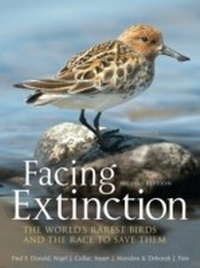
Facing Extinction
The World's Rarest Birds and the Race to Save Them: 2nd Edition
2nd Edition
Published on 20. August 2010
312 pages
978-1-4081-3908-0 (ISBN)
Description

An authoritative study of extinction in birds, with case studies of 20 critically endangered species and the research initiatives designed to save them.
Almost two hundred species of birds have become extinct in the past 400 years, and a similar number today are in imminent danger of following them. The world's conservationists are leading the fight to prevent the demise of these remaining critically endangered birds, with a fair degree of success.
This new book examines the process and issues concerning extinction - how and why it happens and what can be done about it. Whilst man is to blame for many of the causes, such as persecution and habitat loss, species have become extinct on a regular basis since life began.
After several thought-provoking introductory chapters, the book showcases about 20 species on the brink of extinction from around the world and describes the work that is being undertaken to save them. Some are success stories, but a few are not.
This is a subject close to the hearts of all birders and ornithologists and this book, written by a team of leading conservationists, will strike a chord in most of them.
Almost two hundred species of birds have become extinct in the past 400 years, and a similar number today are in imminent danger of following them. The world's conservationists are leading the fight to prevent the demise of these remaining critically endangered birds, with a fair degree of success.
This new book examines the process and issues concerning extinction - how and why it happens and what can be done about it. Whilst man is to blame for many of the causes, such as persecution and habitat loss, species have become extinct on a regular basis since life began.
After several thought-provoking introductory chapters, the book showcases about 20 species on the brink of extinction from around the world and describes the work that is being undertaken to save them. Some are success stories, but a few are not.
This is a subject close to the hearts of all birders and ornithologists and this book, written by a team of leading conservationists, will strike a chord in most of them.
More details
Edition
2nd edition
Language
English
Place of publication
London
United Kingdom
Publishing group
Bloomsbury Publishing PLC
Target group
Professional and scholarly
Illustrations
Colour photographs and artworks
ISBN-13
978-1-4081-3908-0 (9781408139080)
Copyright in bibliographic data and cover images is held by Nielsen Book Services Limited or by the publishers or by their respective licensors: all rights reserved.
Schweitzer Classification
Other editions
Additional editions
Paul Donald | Nigel Collar | Stuart Marsden
Facing Extinction
The world's rarest birds and the race to save them: 2nd edition
Book
10/2013
2nd Edition
Helm
€88.20
Shipment within 10-20 days
Paul Donald | Nigel Collar | Stuart Marsden
Facing Extinction
The World's Rarest Birds and the Race to Save Them
Book
08/2010
Poyser
€75.80
Article exhausted; check different version
Persons
Paul Donald is Principal Conservation Scientist at the RSPB and Editor-in-Chief of the leading journal Ibis.
Nigel Collar is Leventis Fellow in Conservation Biology at BirdLife International, and is the author of numerous books, papers and articles on threatened birds.
Stuart Marsden is Reader in Conservation Ecology at Manchester Metropolitan University and Editor-in-chief of Bird Conservation International.
Debbie Pain is Director of Conservation at the Wildfowl and Wetlands Trust, and was formerly Head of International Research at the RSPB.
Nigel Collar is Leventis Fellow in Conservation Biology at BirdLife International, and is the author of numerous books, papers and articles on threatened birds.
Stuart Marsden is Reader in Conservation Ecology at Manchester Metropolitan University and Editor-in-chief of Bird Conservation International.
Debbie Pain is Director of Conservation at the Wildfowl and Wetlands Trust, and was formerly Head of International Research at the RSPB.
Content
Acknowledgements
Preface
1. The nature of rarity and the rarity of nature
2. The distribution and causes of rarity
3. Sociable Lapwing Vanellus gregarius
4. Spoon-billed Sandpiper Eurynorhynchus pygmeus
5. Brazilian Merganser Mergus octosetaceus
6. Royal Cinclodes Cinclodes aricomae
7. Bengal Florican Houbaropsis bengalensis
8. Liben Lark Heteromirafa sidamoensis
9. Yellow-crested Cockatoo Cacatua sulpurea
10. Rarity and extinction on islands
11. Stephens Island Wren Xenicu (Traversia) lyalli
12. Tristan Albatross Diomedea dabbenena
13. Raso Lark Alauda razae
14. Po'ouli Melamprosops phaeosoma
15. Saving the world's rarest birds
16. Kakapo Strigops habroptila
17. Asian vultures Gyps bengalensis, G. tenuirostris, G. indicus
18. Philippine Eagle Pithecophaga jefferyi
19. Alagos Curassow Mitu mitu
20. Spix's Macaw Cyanopsitta spixii
21. Madagascar Pochard Aythya innotata
22. The lost and the found
23. Gurney's Pitta Pitta gurneyi
24. Forest Owlet Heteroglaux blewitti
25. Slender-billed Curlew Numenius tenuirostris and Eskimo Curlew N. borealis
26. Rarity and extinction in the future
References
Preface
1. The nature of rarity and the rarity of nature
2. The distribution and causes of rarity
3. Sociable Lapwing Vanellus gregarius
4. Spoon-billed Sandpiper Eurynorhynchus pygmeus
5. Brazilian Merganser Mergus octosetaceus
6. Royal Cinclodes Cinclodes aricomae
7. Bengal Florican Houbaropsis bengalensis
8. Liben Lark Heteromirafa sidamoensis
9. Yellow-crested Cockatoo Cacatua sulpurea
10. Rarity and extinction on islands
11. Stephens Island Wren Xenicu (Traversia) lyalli
12. Tristan Albatross Diomedea dabbenena
13. Raso Lark Alauda razae
14. Po'ouli Melamprosops phaeosoma
15. Saving the world's rarest birds
16. Kakapo Strigops habroptila
17. Asian vultures Gyps bengalensis, G. tenuirostris, G. indicus
18. Philippine Eagle Pithecophaga jefferyi
19. Alagos Curassow Mitu mitu
20. Spix's Macaw Cyanopsitta spixii
21. Madagascar Pochard Aythya innotata
22. The lost and the found
23. Gurney's Pitta Pitta gurneyi
24. Forest Owlet Heteroglaux blewitti
25. Slender-billed Curlew Numenius tenuirostris and Eskimo Curlew N. borealis
26. Rarity and extinction in the future
References
