

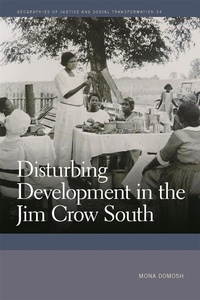
Disturbing Development in the Jim Crow South
Published on 1. March 2023
176 pages
978-0-8203-6343-1 (ISBN)
Description

Disturbing Development in the Jim Crow South documents how Black employees of the cooperative extension service of the USDA practiced rural improvement in ways that sustained southern Black farmers' lives and livelihoods in the early decades of the twentieth century, resisting the white supremacy that characterized the Jim Crow South.
Mona Domosh details the various mechanisms-the transformation of home demonstration projects, the development of a movable school, and the establishment of Black landowning communities-through which these employees were able to alter USDA's mandates and redirect its funds. These tweakings and translations of USDA directives enabled these employees to support poor Black farmers by promoting food production, health care, and land and home ownership, thus disturbing a system of plantation agriculture that relied on the devaluing of Black lives.
Through the documentation of these efforts, Domosh uncovers an important and previously unknown episode in the long history of international development that highlights the roots of liberal development schemes in the anti-Black racism that constituted plantation agriculture and illustrates how racist systems can be quietly and subtly resisted by everyday people working within the confines of white supremacy.
Mona Domosh details the various mechanisms-the transformation of home demonstration projects, the development of a movable school, and the establishment of Black landowning communities-through which these employees were able to alter USDA's mandates and redirect its funds. These tweakings and translations of USDA directives enabled these employees to support poor Black farmers by promoting food production, health care, and land and home ownership, thus disturbing a system of plantation agriculture that relied on the devaluing of Black lives.
Through the documentation of these efforts, Domosh uncovers an important and previously unknown episode in the long history of international development that highlights the roots of liberal development schemes in the anti-Black racism that constituted plantation agriculture and illustrates how racist systems can be quietly and subtly resisted by everyday people working within the confines of white supremacy.
More details
Other editions
Additional editions
Mona Domosh
Disturbing Development in the Jim Crow South
Book
03/2023
University of Georgia Press
€26.10
Shipment within 10-20 days
Mona Domosh
Disturbing Development in the Jim Crow South
Book
03/2023
University of Georgia Press
€144.04
Shipment within 10-20 days
Person
Mona Domosh is professor of geography at Dartmouth College. Her previous publications include Contemporary Human Geography: Culture, Globalization, Landscape (co-authored with Roderick Neumann and Patricia Price), American Commodities in an Age of Empire, and Invented Cities: The Creation of Landscape in 19th Century New York and Boston. She lives in Lebanon, New Hampshire.
