

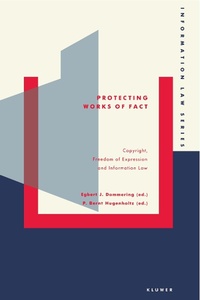
Protecting Works of Fact
Published on 1. June 1991
122 pages
978-90-411-8074-2 (ISBN)
Description

With the year 2000 in sight, the information industry is changing into second gear. New information services are introduced each day, using telecommunications networks or newly developed carrier media. Factual information, such as stock market data, weather reports, topographical data and business news, is rapidly becoming a very valuable commodity. And wherever business is booming, piracy is looming.
Can copyright law provide adequate protection? Is there a conflict between a copyright in works of fact and the freedom of expression? Are information monopolies compatible with the EEC Treaty?
'Protecting Works of Fact' is about these and other dilemmas of information law. The book contains a collection of articles written by legal scholars and practitioners. Most articles were originally presented at the Copyright in Information Conference of the Institute for Information Law (University of Amsterdam), which was held in Amsterdam on December 1, 1989. In addition, the book contains a general introduction to information law.
'Protecting Works of Fact' is the first volume of the Information
Can copyright law provide adequate protection? Is there a conflict between a copyright in works of fact and the freedom of expression? Are information monopolies compatible with the EEC Treaty?
'Protecting Works of Fact' is about these and other dilemmas of information law. The book contains a collection of articles written by legal scholars and practitioners. Most articles were originally presented at the Copyright in Information Conference of the Institute for Information Law (University of Amsterdam), which was held in Amsterdam on December 1, 1989. In addition, the book contains a general introduction to information law.
'Protecting Works of Fact' is the first volume of the Information
More details
Other editions
Additional editions
Book
06/1991
1st Edition
Kluwer Law International
€63.13
Shipment within 15-20 days
Content
- Cover
- Half Title Page
- Editorial Board
- Title Page
- Copyright Page
- Preface
- Table of Contents
- Chapter I An Introduction to Information Law. Works of Fact at theCrossroads of Freedom and Protection
- I. Information Law
- 1. THE INFORMATION SOCIETY
- 2. SPECIALISATIONS IN THE LAW
- 3. LEGAL SPECIALISATION AND INFORMATION
- 4. SOME CONCLUSIONS
- 5. INFORMATION LAW: A NEW PARADIGM?
- 6. CONCLUSION
- II. Works of Fact
- 7. THE IMPORTANCE OF WORKS OF FACT
- 8. THE VALUE OF WORKS OF FACT
- 9. THE COMPILATION OF A DATA BANK
- 10. THE ACCESS OF INSTITUTIONS TO THE DATA BANK MARKET AND THE INDIVIDUAL ACCESS TO THE BANK SERVICE
- 11. THE ACCESS TO THE TELECOMMUNICATIONS SERVICES OF DATA BANKS AND THEIR USERS, BOTH AS INSTITUTIONS AND AS INDIVIDUALS
- 12. RIGHTS AND OBLIGATIONS PERTAINING TO INFORMATION IN RELATION TO DATA BANKS
- 13. OWNERSHIP RELATIONS
- Chapter II Creation and Commercial Value: Copyright Protection of Works of Information in the United States
- Introduction
- I. Copyright Protection of Information Works: A HistoricalPerspective
- II. Informational Works in Contemporary U.S. Copyright Analysis
- A. SUBJECT MATTER
- B. SCOPE
- III. Recommendation: A Compulsory License for DerivativeInformation Compilations
- Conclusion
- Chapter III Protection of Compilation of Facts in Germany andThe Netherlands
- Introduction
- I. The Growing Needs of the Information Industry
- II. Facts are not 'Discovered'
- III. Originality is a Subjective Notion
- IV. Doctrine and Case Law Diverge
- Chapter IV The Nordic Catalogue Rule
- I. Introduction
- II. Nature of the Catalogue Rule
- III. Differences with Copyright Protection
- IV. Variations in National Laws
- V. Competition Law
- VI. Subject Matter Protected
- VII. Scope of Protection
- VIII. No Catalogue Protection for Computer Programs
- Chapter V Protection of Raw Data and Data Banks in France
- I. Introduction
- II. Copyright and Raw Data: Copyright Protection against DataBanks
- A. THE RULE
- B. THE EXCEPTIONS
- III. Copyright and Processed Data: Copyright Protection for DataBanks
- Chapter VI Information Monopolies in European Community Law
- I. Introduction
- II. Copyright and the Common Market
- III. Competition Law and Rights in Information
- IV. Monopolies in Information
- V. Conclusion
- Appendix I SUPREME COURT OF THE NETHERLANDS (ROGE RAAD)
- Appendix II SUPREME COURT OF THE UNITED STATES
- Back Cover
