

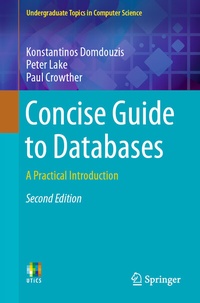
Concise Guide to Databases
Description

This updated and expanded, easy-to-read textbook/reference presents a comprehensive introduction to databases, opening with a concise history of databases and of data as an organisational asset. As relational database management systems are no longer the only database solution, the book takes a wider view of database technology, encompassing big data, NoSQL, object and object-relational, and in-memory databases. Presenting both theoretical and practical elements, the new edition also examines the issues of scalability, availability, performance and security encountered when building and running a database in the real world.
Topics and features:
- Presents review and discussion questions at the end of each chapter, in addition toskill-building, hands-on exercises
- Provides new material on database adaptiveness, integration, and efficiency in relation to data growth
- Introduces a range of commercial databases and encourages the reader to experiment with these in an associated learning environment
- Reviews use of a variety of databases in business environments, including numerous examples
- Discusses areas for further research within this fast-moving domain
With its learning-by-doing approach, supported by both theoretical and practical examples, this clearly-structured textbook will be of great value to advanced undergraduate and postgraduate students of computer science, software engineering, and information technology. Practising database professionals and application developers will also find the book an ideal reference that addresses today's business needs.
More details
Other editions
Additional editions
Persons
Peter Lake (now retired) was formerly Course Leader for the Oracle IT&M MSc and the IT Professional MSc at Sheffield Hallam University, UK. His other Springer publications include Information Systems Management in the Big Data Era and Guide to Cloud Computing .
Paul Crowther (now retired) was formerly Head of Postgraduate (taught programmes) in the Faculty of Arts, Computing, Engineering and Sciences at Sheffield Hallam University, UK.
