
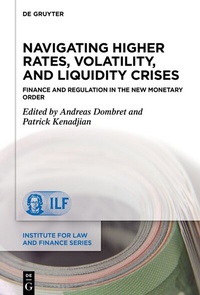
Navigating Higher Rates, Volatility, and Liquidity Crises
Description
Alles über E-Books | Antworten auf Fragen rund um E-Books, Kopierschutz und Dateiformate finden Sie in unserem Info- & Hilfebereich.
When central banks started raising interest rates in reaction to the spike in inflation which followed the COVID-19 epidemic, they put an end to a more than a decade of "low for longer" interest rates to which the financial sector had adjusted their balance sheets and business models. The resulting "new monetary order" has required all parts of the financial sector to make serious adjustments. The fate of the US and Swiss banks caught up in the March 2023 "bank turmoil" can be seen as a cautionary tale for those who do not adjust in a timely fashion. This book reviews how the financial sector evolved during "low for longer" and examines how monetary policy, financial regulation and supervision, the banking and the non-bank financial sectors can be expected to evolve under this new order.
More details
Other editions
Additional editions

Persons
Andreas Dombret, Frankfurt am Main, Germany; Patrick S. Kenadjian, London, UK.
System requirements
File format: PDF
Copy protection: Watermark-DRM (Digital Rights Management)
System requirements:
- Computer (Windows; MacOS X; Linux): Use the free software Adobe Reader, Adobe Digital Editions, or any other PDF viewer of your choice (see eBook Help).
- Tablet/Smartphone (Android; iOS): Install the free app Adobe Digital Editions or another reading app for eBooks, e.g., PocketBook (see eBook Help).
- E-reader: Bookeen, Kobo, Pocketbook, Sony, Tolino and many more (only limited: Kindle).
The file format PDF always displays a book page identically on any hardware. This makes PDF suitable for complex layouts such as those used in textbooks and reference books (images, tables, columns, footnotes). Unfortunately, on the small screens of e-readers or smartphones, PDFs are rather annoying, requiring too much scrolling.
This eBook uses Watermark-DRM, a „soft” copy protection. This means that there are no technical restrictions to prevent illegal distribution. However, there is a personalised watermark embedded in the eBook that can be used to identify the purchaser of the eBook in the event of misuse and to provide evidence for legal purposes.
For more information, see our eBook Help page.