

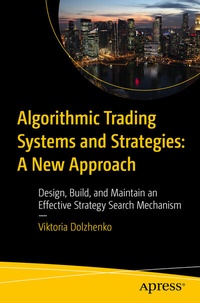
Algorithmic Trading Systems and Strategies: A New Approach
Description

Design and develop a complex trading system from idea to operation. Old approaches were based on manually searching for strategy ideas. This book shows you how to create a system that will generate, optimize, and launch profitable strategies into a fully automatic mode.
Imagine a system that only requires access to the Internet and electricity from a trader. This book describes the architecture and features of such a system and provides recommendations for further development. Most books cover only the implementation stage and overlook the design and maintenance of these systems. Here, you'll walk through the entire process of creating a complex, scalable and easily supported system.
For example, you'll design an application based on microservice architecture and learn about development environments. You'll also examine the advantages of horizontal scaling in the context of creating trading systems. Along the way, you'll set up Kubernetes, connect the monitoring system. and understand the intricacies of continuous integration and continuous delivery.
Testing and identifying only dozens of strategies is a thing of the past. Algorithmic Trading Systems and Strategies: A New Approach shows you how to analyze thousands in the same amount of time.
More details
Other editions
Additional editions
Person
Since childhood, I dreamed of being a programmer, namely from the moment when the first computer appeared in our house. Since then, I have regularly participated in programming competitions for children. And now many years have passed and at the moment I have more than 10 years of experience in developing complex systems from scratch.
My professional passion has become complex design of various applications. At the same time, in my daily life I was attracted to the idea of algorithmic trading. And at that moment the stars aligned. I was interested in building a system that would search for and find profitable strategies on its own. At that time, developing such a system for algorithmic trading became one of the most interesting and difficult tasks for me.
This project was my personal one, so, unfortunately, I filled the cones myself. The process was quite long, but by the end everything in my head lined up into a logical and correct model. Now I want to share my findings and conclusions with the world, so that everyone who wants to build their own algorithmic systems will not be like blind people and waste time creating ineffective systems. I want my readers to adopt my experience and their developments to bring maximum benefit to their creators.
Content
1. Popular Approaches.- 2.Introduction to Developing Trading Systems.- 3.Architectural Solution. - 4. Services and Subsystems.- 5. Technology Stack and Libraries.- 6. Optimization Algorithms.- 7. Implementation of Optimization Algorithms.- 8. Implementation of Core Modules.- 9. Approaches to Final implementation.
