

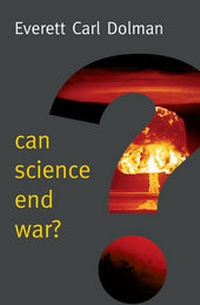
Can Science End War?
Description

Is this vision of future war possible, or even inevitable? In this timely new book, Everett Carl Dolman examines the relationship between science and war. Historically, science has played an important role in ending wars - think of the part played by tanks in breaching trench warfare in the First World War, or atom bombs in hastening the Japanese surrender in the Second World War - but to date this has only increased the danger and destructiveness of future conflicts. Could science ever create the con-ditions of a permanent peace, either by making wars impossible to win, or so horrific that no one would ever fight? Ultimately, Dolman argues that science cannot, on its own, end war without also ending what it means to be human.
More details
Other editions
Additional editions
Person
Content
1 Can Science End War? 1
2 Is War Good for Science? 26
3 Can Scientists End War? 50
4 Can Science Limit War? 77
5 What Will Tomorrow's War Look Like? 106
6 What Will End War? 138
Epilogue 168
Bibliography 174
Index 181
ONE
Can Science End War?
"Now I am become Death, the destroyer of worlds."
J. Robert Oppenheimer
On July 16, 1945, J. Robert Oppenheimer, the father of America's atomic bomb, was a "nervous wreck" (Morton Szasz 1992: 71). He was chain-smoking and his weight had dropped precipitously, to less than 115 pounds. General Wesley Groves, Commander of the Manhattan Project, was so worried that he had recently ordered mandatory psychological evaluations for all his top scientists to determine if they were still mentally stable enough to carry out their duties (Clarfield and Wiecek 1984: 51). It seemed as though nothing would go as planned. Preparations for the first atomic explosion had been frantically underway at the Trinity test site near Alamogordo for months, but a rare tropical air mass had moved in the previous week, transforming the usually arid New Mexico desert into a muddy quagmire. Technicians were still making repairs after a bulldozer accidentally cut the main cable from the control center to the tower that held the bomb some 20 feet above the ground. Making matters worse, that very morning a report came in from a test of the conventional-explosives atomic detonation device (the so-called "Chinese copy," a mock-up of the Trinity bomb without fissile material) that there wasn't enough explosive power to initiate a chain reaction in the plutonium (Rhodes 1986: 656-7). Trinity could very well be a dud.
Repairs were hastily completed, the rains stopped, and fingers were crossed. Bets were made among the scientists regarding the yield of the device. Incalculable intellectual effort and more than three years of the most expensive scientific project in history were about to be validated - or discredited - in the following minutes. Oppenheimer peered over the shoulder of electrician Ernest Titterton, who initiated the firing sequence. The many high-speed cameras set up to monitor the event began filming, along with seismographs, geophones, and spectrographs, but before the confirmation signal they expected on the small screen in front of them appeared, the control room lit up so brightly that neither could see it. They rushed out the door, and as the light faded they peered through smoked glass at the rising mushroom cloud. Forty seconds later, the shock wave hit.
Oppenheimer was jubilant, as were most of the scientists and technicians at Trinity. As he triumphantly circled the room he delightedly pumped the hands of everyone he could find. By the time he reached the last member of the team, physicist Kenneth Bainbridge, the technical director at Alamogordo, the joy in the room had tapered considerably. Bainbridge responded to Oppenheimer's congratulation with a muted: "Now we're all sons of bitches" (Rhodes 1986: 675). Bainbridge might have been the first to transition fully from elation to somber grimness born of a combination of exhaustion and then trepidation, but the mood quickly overtook the rest of the group. Oppenheimer, who studied philosophy to help him understand science, was aware of the change. He had discovered the Hindu religious text Bhagavad Gita while at Harvard, and had taken great comfort from it. Later, at Berkeley, Oppenheimer learned Sanskrit just so he could read it in its original form. As exultation transitioned into trepidation, he recalled a line from the warrior god Vishnu, instructing the worldly Prince to fulfill his duty regardless of the terrible human cost when doing so. Believing it would assuage some worry and put the test in perspective, Oppenheimer quoted from his own translation: "Now I am become Death, the destroyer of worlds" (Giovannitti and Freed 1965: 197).
Can science end war?
Can science, in its current form, bring the scourge of war finally to an end? It is perhaps the most important question of our age, not least because it was science that delivered the means to destroy all of humanity when scientists unlocked then released the awesome power of the atom. While war has always been bloody and too often ruinous, so-called advances in the weaponization of biological, chemical, and nuclear sciences have made it conceivably total.
In theory, science can bring war to an end. Of course, in theory, anything is possible. In practice.not so much. The enduring conundrum for science is that every solution offered seems to generate two additional problems, each requiring its own scientific remedy. Every effort to limit the occurrence or destruction of war through science has in time had the unintended effect of increasing both the ways and means of making war. When the fixed machine gun, for example, made trench warfare dominant by World War I, military planners sought a scientific solution to overcome or bypass trenches and strike deep into enemy territory - the rationale for adapting both the airplane and the automobile (as a heavily armored tank) as warfighting technologies and poison gas as a chemically derived battlefield tactic. Complicating matters, the pace of change is accelerating, meaning that ever more scientists have to work harder in a growing variety of specialties just to keep up. Today, practically invisible robotic drones overfly the battlespace, monitoring persons and locations of interest and, when conditions permit, unleashing deadly missile attacks. Terrorists put toxic gasses in subways and threaten municipal water supplies with poison, extremists execute innocent victims on the Internet and use the resulting notoriety to recruit armies of sadistic killers, and states arm rebel forces with sophisticated artillery, tanks, mines, and anti-aircraft defenses, all the while maintaining plausible deniability. Science has thus allowed war to reach the primordial depths (the deep seas), physical heavens (in outer space), and virtual domains (cyberspace), with no hint of slowing down. Such a path may follow classic economic theory (keep up the supply of scientific solutions in a profitable market while increasing the demand for more scientists), but is intuitively unsettling when adapting emerging technologies to the violent destruction of war.
The Trinity detonation of the world's first atomic bomb will be referred to throughout this text as an exemplar of the disconnect between the goals of science and the ends of war as well as the long-standing if uneasy relationship scientists and warriors have had throughout history. That relationship was solidified with the success of the Manhattan Project, and set the blueprint for all major powers' weapons development and war-planning efforts since. States will use every scintilla of scientific expertise available to them as they seek out the next technology that will change the character of war, and the full force of government will be leveraged to make sure scientists' efforts are not available to potential adversaries. For their part, scientists will flock to national banners as access to massive government funds and super-secret technology are available only through them. If the cutting edge of science is where scientists want to be, then the state-sponsored research laboratory is the place to be.
The result is that science and war have become inextricably linked, and in this book I explore the nature of these links and the problems that abound. To do so I delve into philosophy to underpin my assertions, and attempt to tie these metaphysical ruminations to the practical efforts of science in support of war, and the equally unsettling if contemporarily ubiquitous efforts of war in support of science. The bottom line is that science cannot end war, for science is less an ideology than a tool. It serves those who use its methods.
Defining science and war
We all know war when we see it. It is the most brutal form of social interaction, as a rule to be avoided except as last resort, and yet common enough that it appears to be a fixture of human development. It should hardly need a strict academic definition, but for a thorough examination of the relationship between science and war, both must be identified and judiciously separated.
The authoritative Academic Press Dictionary of Science and Technology defines science as "The systematic observation of natural events and conditions in order to discover facts about them and to formulate laws and principles based on these facts" (Morris 1992: 1257). This widely used definition was reworded and formalized in 2007 by the UK Science Council, making it the world's first official definition of science: "the intellectual and practical activity encompassing the systematic study of the structure and behavior of the physical and natural world through observation and experiment" (Sample 2009).
Science is therefore not properly a thing; rather, it is a way of knowing. It presumes a systematic and rational universe that can be studied and understood through rigorous application of the scientific method. It is evidentiary, accepting as valid only data that can be observed and measured and outcomes that are repeatable. It is further understood that the purpose for studying nature through science is to gain control over the physical world so as to enhance humanity's security and welfare. In principle, it is objective and value-neutral, meaning that its study should not be limited by preconceived goals or required results, though it recognizes that moral and ethical considerations can be externally mandated - such things as limits to experiments on human subjects, for...
