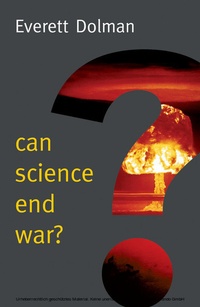
Can Science End War?
Description

Free-roaming killer drones stalk the battlespace looking for organic targets. Human combatants are programmed to feel no pain. Highpower microwave beams detonate munitions, jam communications, and cook internal organs.
Is this vision of future war possible, or even inevitable? In this timely new book, Everett Carl Dolman examines the relationship between science and war. Historically, science has played an important role in ending wars – think of the part played by tanks in breaching trench warfare in the First World War, or atom bombs in hastening the Japanese surrender in the Second World War – but to date this has only increased the danger and destructiveness of future conflicts. Could science ever create the con-ditions of a permanent peace, either by making wars impossible to win, or so horrific that no one would ever fight? Ultimately, Dolman argues that science cannot, on its own, end war without also ending what it means to be human.
Everett Carl Dolman served as a strategic intelligence analyst for the US Government before receiving his doctorate from the University of Pennsylvania. He has published three books and dozens of articles and book chapters on international security, geopolitics, air and space power, political theory, and civil-military relations. He is currently professor of comparative military studies at the US Air Force?s School of Advanced Air and Space Studies (SAASS), Air University.
More details
Other editions
Additional editions