

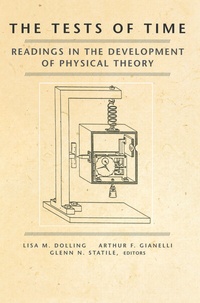
The Tests of Time
Readings in the Development of Physical Theory
1st Edition
Published on 18. November 2019
760 pages
978-1-4008-8916-7 (ISBN)
Description

The development of physical theory is one of our greatest intellectual achievements. Its products--the currently prevailing theories of physics, astronomy, and cosmology--have proved themselves to possess intrinsic beauty and to have enormous explanatory and predictive power. This anthology of primary readings chronicles the birth and maturation of five such theories (the heliocentric theory, the electromagnetic field theory, special and general relativity, quantum theory, and the big bang theory) in the words of the scientists who brought them to life. It is the first historical account that captures the rich substance of these theories, each of which represents a fascinating story of the interplay of evidence and insight--and of dialogue among great minds.
Readers sit in with Copernicus, Kepler, and Galileo as they overturn the geocentric universe; observe the genius of Faraday and Maxwell as they "discover" the electromagnetic field; look over Einstein's shoulder as he works out the details of relativity; listen in as Einstein and Bohr argue for the soul of quantum mechanics in the Completeness Debate; and watch as Hubble and others reveal the history of the universe.
The editors' approach highlights the moments of discovery that rise from scientific creativity, and the presentation humanizes the scientific process, revealing the extent to which great scientists were the first to consider the philosophical implications of their work. But, most significantly, the editors offer this as their central thesis: although each was ushered in by a revolution, and each contains counterintuitive elements that delayed its acceptance, these five theories exhibit a continuous rational development that has led them to a permanent place in the worldview of science.
Accessible to the general reader yet sufficiently substantive that working scientists will find value in it, The Tests of Time offers an intimate look into how physical theory has been developed, by the brilliant people who have developed it.
Readers sit in with Copernicus, Kepler, and Galileo as they overturn the geocentric universe; observe the genius of Faraday and Maxwell as they "discover" the electromagnetic field; look over Einstein's shoulder as he works out the details of relativity; listen in as Einstein and Bohr argue for the soul of quantum mechanics in the Completeness Debate; and watch as Hubble and others reveal the history of the universe.
The editors' approach highlights the moments of discovery that rise from scientific creativity, and the presentation humanizes the scientific process, revealing the extent to which great scientists were the first to consider the philosophical implications of their work. But, most significantly, the editors offer this as their central thesis: although each was ushered in by a revolution, and each contains counterintuitive elements that delayed its acceptance, these five theories exhibit a continuous rational development that has led them to a permanent place in the worldview of science.
Accessible to the general reader yet sufficiently substantive that working scientists will find value in it, The Tests of Time offers an intimate look into how physical theory has been developed, by the brilliant people who have developed it.
More details
Other editions
Additional editions
Lisa M. Dolling | Arthur F. Gianelli | Glenn N. Statile
The Tests of Time
Readings in the Development of Physical Theory
Book
02/2003
Princeton University Press
€117.61
Article exhausted; check different version
Lisa M. Dolling | Arthur F. Gianelli | Glenn N. Statile
The Tests of Time
Readings in the Development of Physical Theory
Book
02/2003
Princeton University Press
€73.90
Shipment within 10-20 days
Persons
Lisa M. Dolling, Arthur F. Gianelli, and Glenn N. Statile teach the history and philosophy of science on both the graduate and undergraduate levels at St. John's University. Arthur Gianelli is Chair of the Philosophy Department and the coeditor of The Metaphysical Quest. Lisa Dolling has written and lectured on the philosophy of Niels Bohr and directs the Science and Religion project at St. John's. Glenn Statile has lectured and written on topics in cosmology and the philosophy of science.
Content
- Cover
- Title
- Copyright
- Dedication
- Contents
- Preface
- Acknowledgments
- Philosophical Introduction: Philosophy of Science and Physical Theory
- PART I The Heliocentric Theory
- Introduction
- 1. ARISTOTLE
- The Physical Foundation for the Geocentric Universe
- 2. ARISTARCHUS
- An Early Version of Heliocentrism
- 3. CLAUDIUS PTOLEMY
- The Case for Geocentrism
- 4. NICHOLAUS COPERNICUS
- First Thoughts on Heliocentrism
- 5. NICHOLAUS COPERNICUS
- The Heliocentric Theory
- 6. TYCHO BRAHE
- The Supernova of 1572
- 7. TYCHO BRAHE
- Observational Evidence against the Aristotelian Cosmology
- 8. JOHANNES KEPLER
- The Sun as the Source of Planetary Motions
- 9. GALILEO GALILEI
- Telescopic Observations in Support of Copernicus
- 10. JOHANNES KEPLER
- The Superiority of the Copernican System
- 11. GALILEO GALILEI
- The Coherence of the Copernican Theory
- 12. ISAAC NEWTON
- The Physical Foundations of Heliocentrism
- 13. JOHN HERSCHEL
- The Discovery of Stellar Parallax
- Selected Bibliography
- PART II Electromagnetic Field Theory
- Introduction
- 1. WILLIAM GILBERT
- The Properties of Magnets
- 2. CHARLES COULOMB
- The Law of Electric Force
- 3. HANS CHRISTIAN OERSTED
- The Effect of a Current of Electricity on a Magnetic Needle
- 4. ANDRÉ MARIE AMPÈRE
- A Positivist Approach to Electromagnetism
- 5. ISAAC NEWTON
- The Particle Theory of Light
- 6. CHRISTIAAN HUYGENS
- The Wave Theory of Light
- 7. THOMAS YOUNG
- The Vindication of the Wave Theory of Light
- 8. AUGUSTIN FRESNEL AND DOMINIQUE ARAGO
- The Transverse Nature of Light Waves
- 9. MICHAEL FARADAY
- Electromagnetic Induction
- 10. MICHAEL FARADAY
- The Concept of an Electromagnetic Field
- 11. JAMES CLERK MAXWELL
- The Theory of the Electromagnetic Field
- 12. JAMES CLERK MAXWELL
- The Electromagnetic Theory of Light
- 13. JAMES CLERK MAXWELL
- The Medium for Electromagnetic Waves
- 14. HEINRICH HERTZ
- The Production of Electromagnetic Waves
- Selected Bibliography
- PART III The Theory of Relativity
- Introduction
- 1. JAMES CLERK MAXWELL
- The Ether
- 2. ALBERT MICHELSON
- The Ether and Optical Experiments
- 3. GEORGE F. FITZGERALD
- The Contraction Hypothesis
- 4. HENDRICK A. LORENTZ
- The Contraction Hypothesis
- 5. HENRI POINCARÉ
- A Prelude to Relativity
- 6. ALBERT EINSTEIN
- The Postulates of the Special Theory of Relativity
- 7. HERMAN MINKOWSKI
- The Space-Time Continuum
- 8. ALBERT EINSTEIN
- The Foundation of the General Theory of Relativity
- 9. ALBERT EINSTEIN
- The Ramifications of the Special and General Theories of Relativity
- 10. ARTHUR EDDINGTON
- The Bending of Light Rays
- 11. ALBERT EINSTEIN
- Ether and Relativity
- 12. ALBERT EINSTEIN
- Later Comments on General Relativity
- 13. ALBERT EINSTEIN
- E = MC2
- Selected Bibliography
- PART IV Quantum Theory
- Introduction
- Historical and Conceptual Development
- 1. MAX PLANCK
- The Quantum Hypothesis
- 2. ALBERT EINSTEIN
- The Photon
- 3. NIELS BOHR
- The Quantum Character of the Atom
- 4. LOUIS DE BROGLIE
- The Wave Nature of the Electron
- 5. NIELS BOHR
- Complementarity and the New Quantum Theory
- 6. NIELS BOHR
- The Debate with Einstein
- 7. ALBERT EINSTEIN
- Response to Bohr
- 8. WERNER HEISENBERG
- A Brief History of Quantum Theory
- 9. WERNER HEISENBERG
- The Copenhagen Interpretation
- 10. ERWIN SCHRÖDINGER
- The Fundamental Idea of Wave Mechanics
- 11. ERWIN SCHRÖDINGER
- Are There Quantum Jumps?
- 12. P.A.M. DIRAC
- The Conceptual Difficulties of Quantum Theory
- 13. JOHN A. WHEELER
- Observer-Created Reality
- The Completeness Debate
- 14. ALBERT EINSTEIN, BORIS PODOLSKY, AND NATHAN ROSEN
- The EPR Paradox
- 15. ALBERT EINSTEIN
- The Argument for Incompleteness
- 16. NIELS BOHR
- Response to EPR
- 17. DAVID BOHM
- The Hidden Variables Hypothesis
- 18. J. S. BELL
- Comment on the Hidden Variables Hypothesis
- 19. J. S. BELL
- A Conceptual Analysis of the EPR Thought Experiment of David Bohm
- 20. ABNER SHIMONY
- Philosophical Reflections on the Completeness Debate
- Selected Bibliography
- PART V Big Bang Cosmological Theory
- Introduction
- 1. HENRIETTA LEAVITT
- Variables in the Magellanic Clouds
- 2. HENRIETTA LEAVITT
- The Variability-Luminosity Relationship
- 3. VESTO SLIPHER
- The Radial Velocity of the Andromeda Nebula
- 4. VESTO SLIPHER
- The Discovery of the Red Shift of Nebula
- 5. HARLOW SHAPLEY
- The Measurement of Great Distances
- 6. WILLEM DE SITTER
- Relativity and Cosmology
- 7. EDWIN HUBBLE
- The Structure of the Universe
- 8. EDWIN HUBBLE
- The Velocity-Distance Relationship
- 9. ARTHUR EDDINGTON
- The Expanding Universe
- 10. GEORGES LEMAI^TRE
- The Beginning of Big Bang Cosmology
- 11. ARNO PENZIAS AND ROBERT WILSON
- The Discovery of Background Radiation
- 12. R. H. DICKE, P.J.E. PEEBLES, P. G. ROLL, D. T. WILKINSON
- An Explanation of the Penzias and Wilson Discovery
- 13. STEVEN WEINBERG
- The Cosmic Microwave Radiation Background
- 14. ALAN GUTH AND PAUL STEINHARDT
- The Inflationary Universe
- 15. GEORGE SMOOT AND KEAY DAVIDSON
- Wrinkles in Time
- 16. STEPHEN HAWKING
- The Edge of Spacetime
- Selected Bibliography
- Epilogue
- 1. HELGE KRAGH
- Physical Theory: Present and Future
- Sources of the Readings
- Index of Names
- Index of Concepts
- Permissions
